Election Commission jurisdiction in political party ownership disputes
Source:etvbharat ↗
Why It Matters
Intra-party disputes and splits are recurrent themes in Indian polity. Understanding the ECI's quasi-judicial role in determining party ownership (under the Election Symbols Order) and the subsequent scope of judicial review is critical for the Polity segment of the syllabus.
Summary
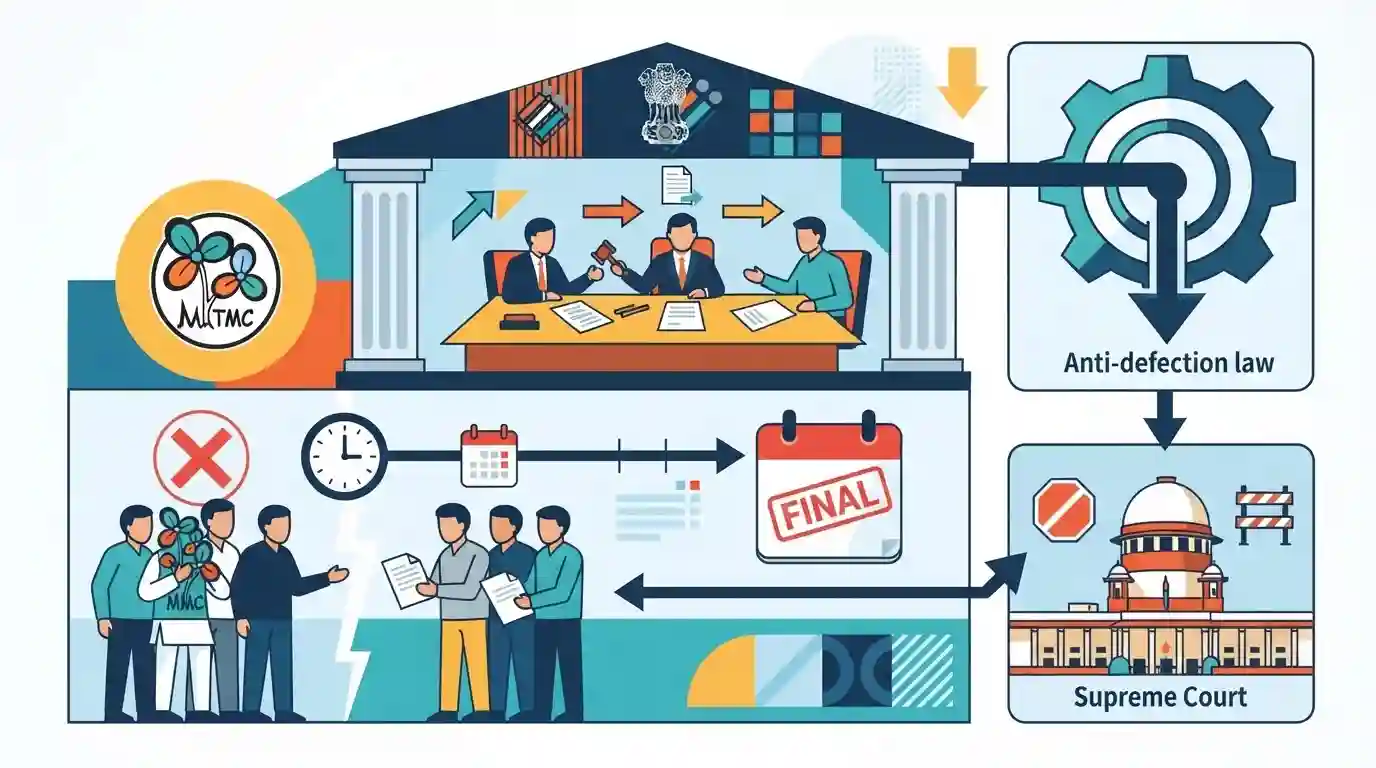
The Election Commission of India (ECI) is adjudicating a factional dispute over the ownership of the Trinamool Congress (TMC). Former Lok Sabha Secretary-General and constitution expert PDT Achary emphasized that the ECI must impose a strict, final deadline for the conflicting factions to submit their responses. He noted that endless extensions delay the democratic process and that the ECI has the authority to make a unilateral decision based on existing evidence if deadlines are ignored. The matter also highlights the procedural sequence in such disputes, where the Supreme Court usually only intervenes after the ECI has delivered its final verdict on the party's ownership and symbol.
Key Points
- The Election Commission of India (ECI) is reviewing an ownership dispute within the Trinamool Congress (TMC) following a factional tussle.
- Constitution expert PDT Achary advised that the ECI must set a final, strict deadline for responses rather than granting endless extensions.
- If a faction fails to file its reply by the stipulated deadline, the ECI holds the authority to decide the case ex-parte based on the available documents.
- The Supreme Court typically refrains from intervening in such intra-party disputes until the ECI passes a final order.
Important Terms
Election Commission of India (ECI)

An autonomous constitutional body administering India's electoral processes. Under Article 324 and the Election Symbols Order, it exercises quasi-judicial powers to conclusively resolve disputes between rival factions claiming ownership of a recognized political party.
UPSC context
GS Paper 2 (Constitutional Bodies). Tests knowledge of Article 324, quasi-judicial powers, and mechanisms for internal party dispute resolution.
Supreme Court of India
India's apex judicial body. In cases of factional party disputes, the Supreme Court generally refrains from intervening until the Election Commission issues a final verdict regarding party ownership and election symbol allocation.
UPSC context
GS Paper 2 (Judiciary). Relevant for understanding appellate jurisdiction, judicial review limitations, and interplay with independent constitutional bodies.
Election Symbols (Reservation and Allotment) Order, 1968
A legal order empowering the Election Commission of India to recognize political parties, allocate symbols, and adjudicate disputes between rival party factions over the use of a recognized party's name and symbol.
UPSC context
GS Paper 2 (Elections). Crucial for questions on the Representation of the People Act and the ECI's adjudicatory powers.
Anti-Defection Law
Enshrined in the 10th Schedule, it outlines disqualification rules for defecting legislators. During party splits, this legislative process operates separately from the ECI’s quasi-judicial determination of which faction represents the real party.
UPSC context
GS Paper 2 (Legislature). Frequently tested on disqualification criteria, the Speaker's role, and institutional overlaps during party crises.
Trinamool Congress (TMC)
A prominent Indian political party. Its ongoing factional dispute serves as a contemporary case study illustrating the Election Commission's procedural authority to set strict deadlines and adjudicate competing claims over party ownership.
UPSC context
GS Paper 2 (Political Parties). Provides real-world context for questions on intra-party democracy, factionalism, and electoral dispute mechanisms.
Prelims Trap
Disputes over party symbols between rival factions are decided by the Speaker or Presiding Officer under the Tenth Schedule.
The ECI exclusively adjudicates factional disputes over party names and symbols under the Election Symbols Order, 1968. The Speaker only handles legislator disqualifications under the Tenth Schedule.
Static Concepts Connected
How does the ECI resolve party symbol disputes between rival factions?
- Test of Majority: Evaluates the numeric strength of rival factions in both the organizational and legislative wings of the party to see who holds real control.
- Party Constitution Test: Examines which faction is adhering to the internal democratic structures and rules laid out in the party's own registered constitution.
- Sadiq Ali Case: The Supreme Court upheld the ECI's exclusive jurisdiction and its 'Test of Majority' methodology in this landmark 1971 ruling.
What are the rules regarding party splits and mergers under the Anti-Defection Law?
- No Split Exemption: The 91st Amendment Act (2003) omitted the provision that previously protected legislators from disqualification in the event of a one-third party split.
- Merger Exemption: Disqualification does not apply if an original political party merges with another and at least two-thirds of its legislative members agree to the merger.
- Speaker's Authority: The Presiding Officer has the sole initial authority to decide disqualification petitions arising from defection, subject to subsequent judicial review.
Cross-Topic Patterns
Dual Authority in Party Splits
Legislative disqualifications are handled by the Presiding Officer under the Tenth Schedule, while party identity (name/symbol) is decided by the ECI. These parallel tracks frequently trigger complex constitutional litigation.
Article 324's Quasi-Judicial Reach
Adjudicating the real faction under the Symbols Order highlights the ECI's quasi-judicial capabilities, extending its Article 324 mandate beyond the mere administrative conduct of elections.

Expect a 2026 multi-statement question contrasting the ECI's jurisdiction under the Symbols Order with the Speaker's Tenth Schedule powers.
Linked PYQs · 2
Linked PYQs · 2
- 2021WBCS_PRELIMSGS1
The Election Commission is constructed by the
- 2023WBCS_PRELIMSGS1
Which amendment of Indian Constitution is related to the Anti-defection law?
