National Flag Misuse Allegations and Election Campaign Code Violations
Source:The Hindu ↗
Why It Matters
Highlights the legal framework safeguarding national symbols, particularly the Prevention of Insults to National Honour Act, 1971, and the Flag Code of India. It also illustrates the intersection of these laws with election campaigns, the Model Code of Conduct, and political accountability.
Summary
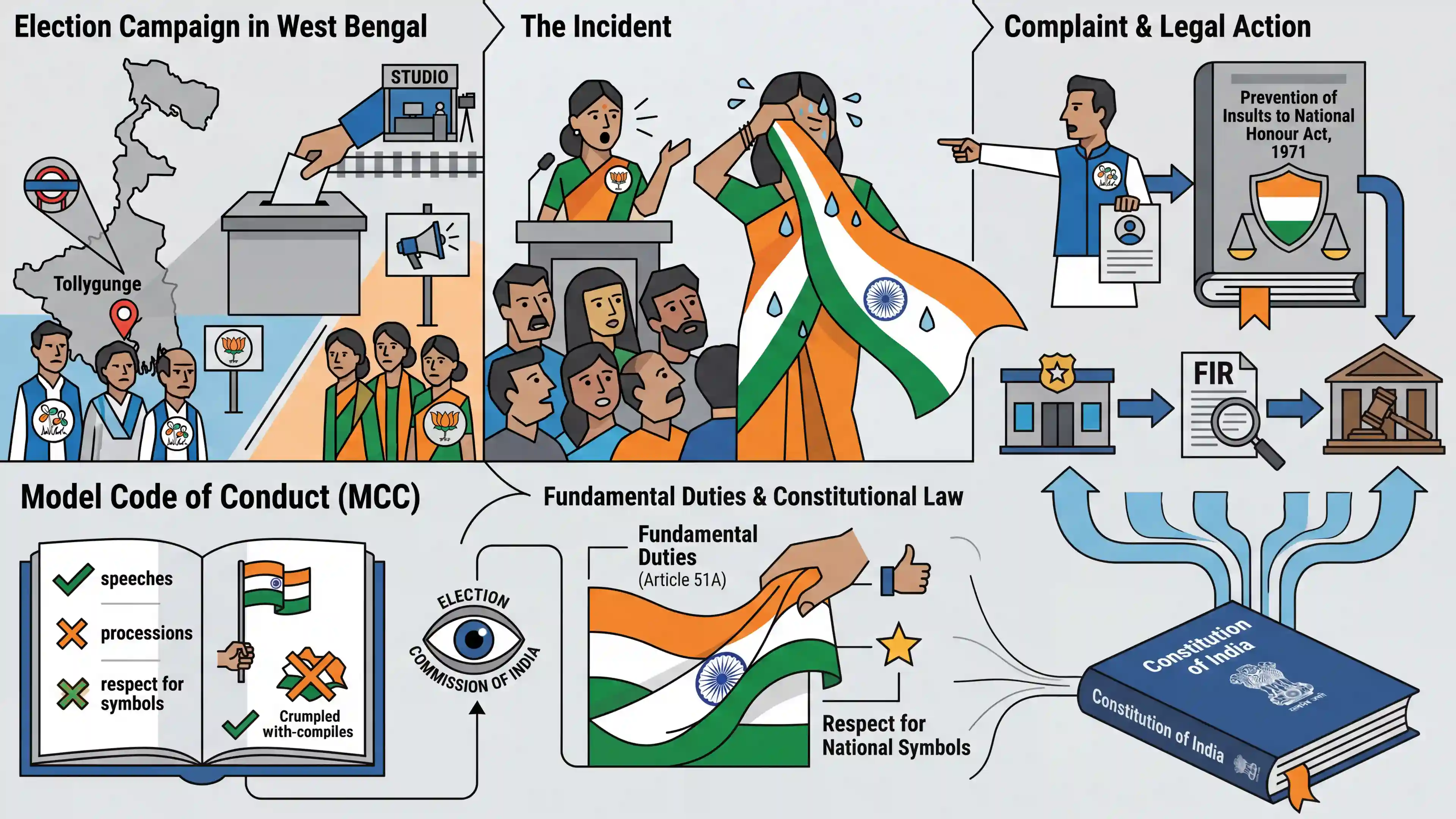
The Trinamool Congress (TMC) has filed a police complaint against BJP candidate Papia Adhikari, accusing her of violating the Prevention of Insults to National Honour Act, 1971. The complaint alleges that during her election campaign in the Tollygunge constituency in West Bengal, Adhikari used a dupatta featuring the Indian tricolour to wipe her face. The incident has prompted the TMC to demand the registration of a First Information Report (FIR) and subsequent legal action, highlighting the strict rules surrounding the dignified use of national symbols in public and during political campaigns.
Key Points
- The TMC lodged a police complaint against BJP candidate Papia Adhikari for allegedly misusing the national flag during an election campaign in Kolkata.
- Adhikari was reportedly seen using a dupatta bearing the Indian tricolour to wipe her face.
- The complaint cites a violation of the Prevention of Insults to National Honour Act, 1971, urging police to treat it as an FIR.
Important Terms
Prevention of Insults to National Honour Act, 1971

A statute prohibiting the desecration or insult of national symbols, including the National Flag, Constitution, Anthem, and Map, punishable by up to three years' imprisonment.
UPSC context
GS Paper 2: Statutory provisions protecting national symbols; often compared with the Flag Code in Prelims.
Flag Code of India, 2002
A 2002 executive consolidation of laws, conventions, and instructions governing the correct display and usage of the National Flag to ensure its dignity.
UPSC context
GS Paper 2: Governance and Constitutional symbols; tests knowledge of non-statutory guidelines versus statutory laws.
Model Code of Conduct (MCC)
Guidelines issued by the Election Commission of India to regulate the conduct of political parties and candidates during elections to ensure a level playing field.
UPSC context
GS Paper 2: Electoral reforms and the role of the ECI; critical for understanding "free and fair elections."
Fundamental Duties
Moral obligations of citizens under Article 51A (Part IV-A) to respect the Constitution, National Flag, and National Anthem, added by the 42nd Amendment.
UPSC context
GS Paper 2: Indian Constitution; examines the relationship between rights and duties and their legal enforceability.
Election Commission of India (ECI)
The constitutional authority established under Article 324, responsible for administering election processes in India at the Union and State levels.
UPSC context
GS Paper 2: Constitutional bodies; tests powers of oversight, disqualification, and enforcement of election laws.
Prelims Trap
"The Election Commission completely prohibits the display of the National Flag by political parties during election campaigns."
The ECI does not absolutely ban the National Flag in campaigns; it only mandates strict adherence to the Flag Code and the 1971 Act.
Static Concepts Connected
How does insulting national symbols affect electoral candidacy under the RPA 1951?
- Statutory Disqualification: Section 8(1)(k) of the RPA 1951 disqualifies individuals convicted of an offence under the Prevention of Insults to National Honour Act, 1971.
- Duration of Ban: The disqualification applies to Parliament and State Legislatures and lasts for a period of six years from the date of conviction.
What are the key restrictions on using the National Flag under the 1971 Act?
- Clothing Restrictions: It cannot be used as a portion of a costume or uniform worn below the waist by any person.
- Print Restrictions: It is legally prohibited to embroider or print the flag on cushions, handkerchiefs, napkins, undergarments, or dress material.
- Flag Code vs Act: While the 1971 Act penalizes insults, the separate Flag Code of India (amended 2021) regulates allowed materials, now permitting polyester and machine-made flags.
Cross-Topic Patterns
RPA Section 8 vs. MCC violations
While Model Code of Conduct violations generally yield warnings or temporary campaign bans, statutory offences like insulting the national flag trigger Section 8 RPA disqualification, fundamentally altering candidate eligibility.
Fundamental Duties & Statutory Enforcement
Article 51A(a) mandates respecting the National Flag but is non-justiciable. The Prevention of Insults to National Honour Act, 1971 provides the statutory teeth required to penalize violations of this duty.

Expect a Prelims question on RPA 1951 testing if convictions under the 1971 National Honour Act automatically trigger disqualification.
Linked PYQs · 4
Linked PYQs · 4
- 2023PrelimsGS1
Consider the following statements in respect of the National Flag of India according to the Flag Code of India, 2002: Statement-I: One of the standard sizes of the National Flag of India is 600 mm x 400 mm. Statement-II: The ratio of the length to the height (width) of the Flag shall be 3:2. Which one of the following is correct in respect of the above statements?
- 2015PrelimsGS1
"To uphold and protect the Sovereignty, Unity and Integrity of India" is a provision made in the
- 2022MainsGS2
Discuss the role of the Election Commission of India in the light of the evolution of the Model Code of Conduct.
- 2022MainsGS2
Discuss the procedures to decide the disputes arising out of the election of a Member of the Parliament or State Legislature under The Representation of the People Act, 1951. What are the grounds on which the election of any returned candidate may be declared void ? What remedy is available to the aggrieved party against the decision ? Refer to the case laws.
