Opposition Criticism on Intelligence and Security Policy
Source:The Hindu ↗
Why It Matters
The article highlights the intersection of political discourse with crucial governance issues: the accountability of intelligence agencies post-terror attacks, the effectiveness of India's diplomatic leverage in isolating state-sponsors of terrorism, and concerns regarding the integrity of the electoral roll revision process.
Summary
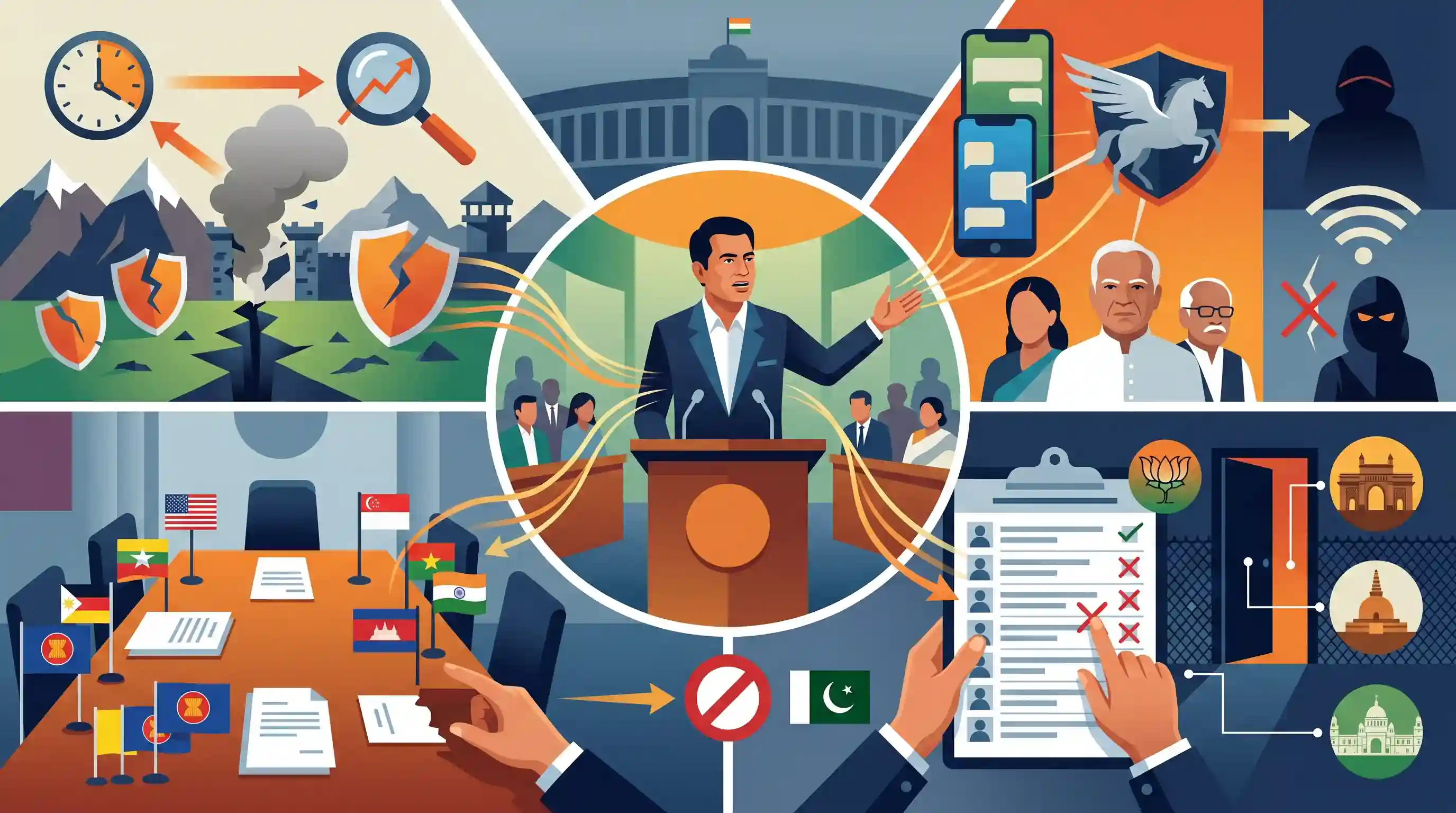
TMC leader Abhishek Banerjee launched a multi-pronged attack on the Union Government during an INDIA bloc meeting, citing intelligence failures in the Pahalgam terror attack and questioning the extension of the IB chief. He accused the Centre of using Pegasus spyware against the opposition rather than terrorists, and criticized a perceived decline in foreign policy after ASEAN nations failed to explicitly name Pakistan when condemning the attack. Additionally, Banerjee highlighted the Election Commission's Special Intensive Revision as a "backdoor NRC," alleging voter list manipulation by the BJP in states like Maharashtra, Bihar, and West Bengal.
Key Points
- TMC leader Abhishek Banerjee criticized the Union Government for intelligence failures leading to the Pahalgam terror attack and questioned the extension given to the IB chief.
- He accused the government of misusing Pegasus spyware to target opposition leaders rather than employing it to track terrorists.
- Banerjee highlighted diplomatic shortcomings, noting that ASEAN nations did not explicitly condemn Pakistan following the Pahalgam attack, and criticized the government's lack of communication with Indian citizens.
- He alleged that the Election Commission's Special Intensive Revision of electoral rolls is being utilized as a "backdoor NRC" to manipulate voter lists in states like Maharashtra, Bihar, and West Bengal.
Important Terms
Pegasus

Military-grade spyware by NSO Group capable of 'zero-click' phone infiltration for surveillance.
UPSC context
GS-III (Cybersecurity) and GS-II (Right to Privacy/Article 21).
Special Intensive Revision
A door-to-door voter verification drive by the ECI to ensure accurate, error-free electoral rolls.
UPSC context
GS-II (Electoral Reforms and Constitutional mandate under Article 324).
National Register of Citizens (NRC)
A legal register listing all genuine Indian citizens, created per the 1951 Census.
UPSC context
GS-II (Citizenship) and GS-III (Internal Security/Illegal Migration).
Intelligence Bureau (IB)
India’s premier internal intelligence agency under the Ministry of Home Affairs for domestic security.
UPSC context
GS-III (Security Agencies and their mandates).
ASEAN
A 10-nation regional grouping promoting economic and security cooperation in Southeast Asia.
UPSC context
GS-II (International Relations/Act East Policy).
Election Commission of India (ECI)
A permanent constitutional body (Article 324) managing India's electoral processes.
UPSC context
GS-II (Constitutional Bodies and Governance).
Prelims Trap
Special Intensive Revision of electoral rolls is an exercise mandated under the Citizenship Act, 1955.
SIR is authorized under the Representation of the People Act, 1950 (and Article 324) to authenticate voters. The NRC operates under the Citizenship Act.
Static Concepts Connected
What is the legal basis for electoral roll revisions in India?
- Article 324: Vests the superintendence, direction, and control of the preparation of electoral rolls entirely in the Election Commission of India.
- RPA 1950: Section 21 of the Representation of the People Act, 1950 governs the statutory preparation, regular updating, and revision of electoral rolls.
- Special Intensive Revision: Involves rigorous, often house-to-house verification to eliminate duplicate or ineligible voter entries, exercised under ECI's discretionary powers.
What are the constitutional limits on state surveillance in India?
- Puttaswamy Test: As per the K.S. Puttaswamy judgment, surveillance impinging on the Right to Privacy must satisfy the three-fold test of legality, necessity, and proportionality.
- Statutory Backing: State interception is typically carried out under Section 5(2) of the Indian Telegraph Act or Section 69 of the Information Technology Act.
- Legitimate State Aim: Any surveillance measure must have a clear, rational nexus to a legitimate state interest, such as national security, sovereignty, or public order.
Cross-Topic Patterns
Diplomatic isolation vs Multilateralism
India's attempts to use multilateral forums like ASEAN to explicitly name state sponsors of terror often stall due to members' intersecting geopolitical and economic interests with countries like Pakistan or China.
Voter authentication vs Citizenship verification
The overlap in documentary proof required for ECI's electoral roll revisions and MHA's NRC creates political friction, blurring the lines between voter authentication and citizenship determination.

Expect a 2026 Prelims question comparing the statutory basis of ECI's Electoral Roll Revisions (RPA 1950) vs the NRC (Citizenship Act).
Linked PYQs · 4
Linked PYQs · 4
- 2023MainsGS3
What are the internal security challenges being faced by India? Give out the role of Central Intelligence and Investigative Agencies tasked to counter such threats.
- 2025MainsGS3
Terrorism is a global scourge. How has it manifested in India? Elaborate with contemporary examples. What are the counter measures adopted by the State? Explain.
- 2024MainsGS2
Examine the need for electoral reforms as suggested by various committees with particular reference to "one nation one election" principle.
- 2015MainsGS2
Terrorist activities and mutual distrust have clouded India-Pakistan relations. To what extent the use of soft power like sports and cultural exchanges could help generate goodwill between the two countries? Discuss with suitable examples.
