Model code enforcement challenges and election official neutrality
Source:Indian Express ↗
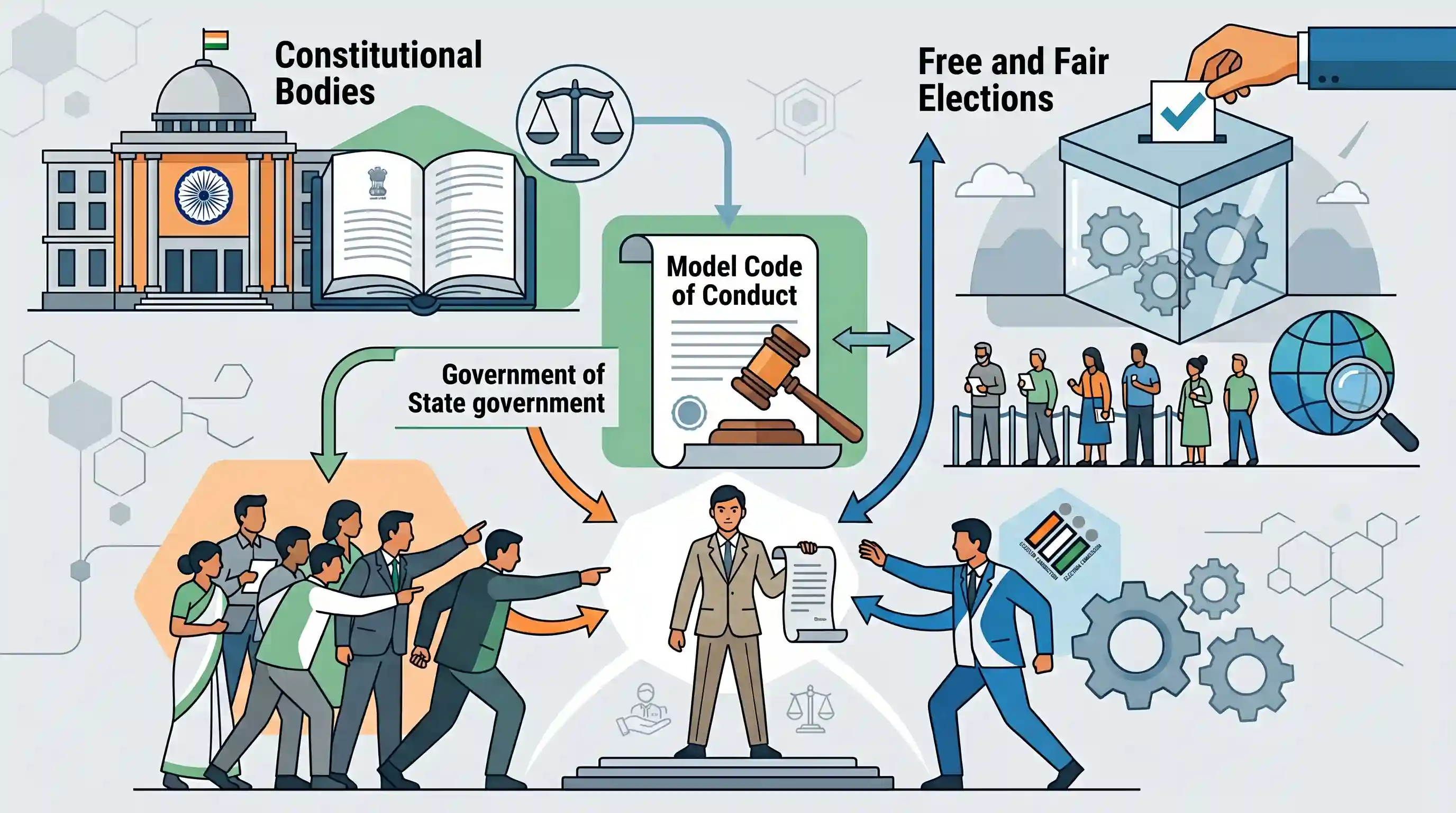
Why It Matters
This development is highly relevant for aspirants as it provides a practical case study of the challenges faced by the Election Commission and its officers in enforcing the Model Code of Conduct. It directly touches upon GS2 (Constitutional Bodies, Elections) and GS4 (Impartiality and Non-partisanship in Civil Services).
Summary
The article examines the political controversy surrounding Manoj Agarwal, a top election officer in West Bengal who has been targeted by the Trinamool Congress (TMC) amid the ongoing electoral disputes. This situation highlights the recurring tensions between the Election Commission of India (ECI) and state governments. The standoff brings to the forefront critical UPSC themes such as the role of the ECI in conducting free and fair elections, the enforcement of the Model Code of Conduct, and the challenges of maintaining civil service neutrality and impartiality under intense political pressure.
Key Points
- Manoj Agarwal, a senior election officer in West Bengal, has become the center of a political storm, drawing sharp criticism from the ruling Trinamool Congress (TMC).
- The standoff underscores the frequent friction between the Election Commission of India (ECI) and state governments during poll seasons, especially in politically volatile regions.
- Such controversies highlight the severe political pressure faced by civil servants and election officials tasked with enforcing the Model Code of Conduct (MCC).
- The episode raises broader questions regarding bureaucratic neutrality, the independence of electoral officers, and the ECI's mandate to ensure free and fair elections.
Important Terms
Election Commission of India (ECI)

A permanent constitutional body established under Article 324 to ensure the superintendence, direction, and control of elections to Parliament, State Legislatures, and the offices of President and Vice-President.
UPSC context
GS Paper-2: Constitutional Bodies. It tests the authority, independence, and challenges of the ECI in maintaining democratic integrity.
Model Code of Conduct (MCC)
A set of non-statutory guidelines issued by the ECI to regulate the behavior of political parties and candidates during elections, ensuring a level playing field and fair play.
UPSC context
GS Paper-2: Electoral Reforms and Representation of the People Act. It examines the ECI's enforcement powers and administrative ethics.
Civil Service Neutrality
The ethical requirement that civil servants remain politically impartial and non-partisan, serving the government of the day without being influenced by personal or political affiliations.
UPSC context
GS Paper-4: Ethics in Public Administration. It focuses on the 'Role of Civil Services in a Democracy' and institutional impartiality.
Special Intensive Revision (SIR)
A comprehensive door-to-door electoral roll verification process used to remove 'Absentee, Shifted, Dead, and Duplicate' (ASDD) names and ensure an accurate, verified list of eligible voters.
UPSC context
GS Paper-2: Electoral Process. It highlights the administrative challenges of roll management and the tension between cleansing rolls and voter disenfranchisement.
Chief Electoral Officer (CEO)
An officer of the State Government designated by the ECI, in consultation with the State Government, to supervise election work within a specific State or Union Territory.
UPSC context
GS Paper-2: Election machinery and administration. It tests the hierarchical relationship between the ECI and state administrative cadres during polls.
Free and Fair Elections
A fundamental democratic doctrine and part of the 'basic structure' of the Indian Constitution, ensuring that the electoral process is transparent, inclusive, and free from coercion.
UPSC context
GS Paper-2: Indian Constitution and its features. It represents the core objective of Article 324 and the electoral system.
Prelims Trap
The Chief Electoral Officer is an independent ECI employee, appointed without state government involvement.
The CEO is actually a State Government officer designated by the ECI in consultation with the State Government under Section 13A of the RPA, 1950.
Static Concepts Connected
How does the ECI regulate state officers during elections?
- Deemed Deputation: Under Sections of the RPA 1950 and 1951, designated state officers are deemed to be on deputation to the ECI for the duration of the election period.
- Disciplinary Powers: The ECI exercises direct superintendence, direction, and control over these officers. It can suspend or recommend disciplinary action against them for bias or misconduct.
What is the legal standing of the Model Code of Conduct (MCC)?
- Consensus Origin: It is a set of consensual, non-statutory guidelines for political parties and candidates that first originated during the 1960 Kerala Legislative Assembly elections.
- Indirect Enforcement: While it lacks direct statutory backing, many MCC provisions are indirectly enforceable through existing statutes like the IPC, BNS, and RPA 1951 (e.g., corrupt practices).
Cross-Topic Patterns
Federalism vs Electoral Neutrality
Disputes over state officer suspensions by the ECI often invite Mains questions linking electoral integrity with the dual-control structure of All India Services under India's federal framework.

Prelims 2026 will likely test the legal standing of the MCC alongside the specific statutory mechanism for appointing state CEOs.
Linked PYQs · 4
Linked PYQs · 4
- 2022MainsGS2
Discuss the role of the Election Commission of India in the light of the evolution of the Model Code of Conduct.
- 2016MainsGS4
Why should impartiality and non-partisanship be considered as foundational values in public services, especially in the present day socio-political context ? Illustrate your answer with examples.
- 2021MainsGS4
Should impartial and being non-partisan be considered as indispensable qualities to make a successful civil servant? Discuss with illustrations.
- 2017PrelimsGS1
Consider the following statements: 1. The Election Commission of India is a five-member body. 2. Union Ministry of Home Affairs decides the election schedule for the conduct of both general elections and bye-elections. 3. Election Commission resolves the disputes relating to splits/mergers of recognised political parties. Which of the statements given above is/are correct?
