TMC Alleges Law and Order Collapse and Demands Article 356
Source:The Hindu ↗
Why It Matters
Article 356 and the domain of 'Law and Order' under the State List are frequently tested constitutional topics, particularly relevant during political conflicts between political parties at the Centre and in states.
Summary
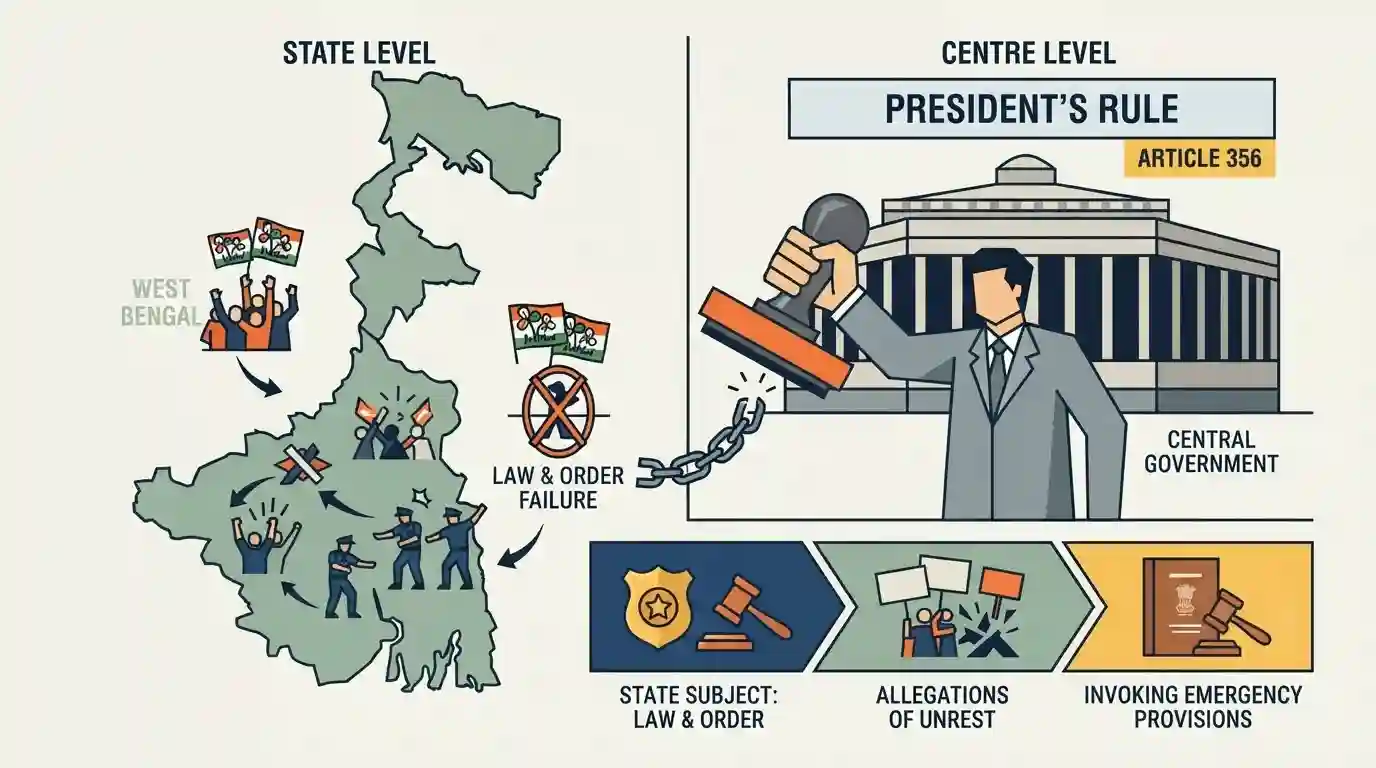
The Trinamool Congress (TMC) has alleged widespread attacks on its party workers in West Bengal and questioned why President's Rule under Article 356 should not be imposed. The party claims that the state administration has failed to maintain law and order—a state subject—justifying the need to invoke constitutional emergency provisions.
Key Points
- The Trinamool Congress (TMC) has alleged violence against its party workers in West Bengal under the current administration.
- TMC leaders have asserted that law and order has entirely collapsed in the state, prompting calls for the imposition of President's Rule.
- The invocation of Article 356 (President's Rule) hinges on a failure of constitutional machinery within a state.
- Law and Order is explicitly designated as a State subject under the State List of the Seventh Schedule.
Important Terms
Article 356 (President's Rule)

A constitutional provision allowing the President to suspend an elected state government and impose direct Union rule via the Governor upon the failure of the state's constitutional machinery.
UPSC context
Crucial for WBCS Polity; tests Centre-State relations, emergency provisions, federalism, and the Governor's discretionary powers.
Constitution of India
The supreme legal framework of India that outlines the foundational political code, structure, powers, and duties of government institutions, and secures fundamental rights.
UPSC context
The core text for WBCS Mains Paper V, encompassing all governance laws and structural federal mechanisms.
Law and Order (State Subject)
Under the Seventh Schedule of the Indian Constitution, "Public Order" and "Police" are placed in the State List, making state governments exclusively responsible for their administration.
UPSC context
Frequently tested in WBCS Paper V concerning Centre-State legislative relations and the 7th Schedule.
Trinamool Congress (TMC)
An Indian political party founded by Mamata Banerjee in 1998, recognized as a State Party by the Election Commission, and historically the primary ruling force in West Bengal.
UPSC context
Relevant for polity questions on state elections, regional dynamics, and criteria for 'State Party' status.
Bharatiya Janata Party (BJP)
One of India's principal political parties, holding National Party status. It acts as a dominant legislative force at the Centre and a key opposition party in West Bengal.
UPSC context
Important for WBCS exams covering the national party system, electoral politics, and ruling/opposition dynamics.
Prelims Trap
"A breakdown of law and order in a state is a sufficient and absolute ground for imposing President's Rule."
The Supreme Court (Bommai case) distinguishes ordinary law and order problems from a breakdown of constitutional machinery. Mere violence doesn't automatically trigger Article 356.
Static Concepts Connected
What key principles did the S.R. Bommai case (1994) establish regarding Article 356?
- Judicial Review: The President's satisfaction in invoking Article 356 is not absolute and remains subject to judicial review.
- Floor Test: A government's majority must be tested on the floor of the Legislative Assembly, not based on the Governor's subjective assessment.
- Secularism as Ground: State actions that violate the basic feature of secularism can be a valid ground for the dismissal of the state government.
How does Article 355 relate to the imposition of President's Rule?
- Union's Duty: It imposes a duty on the Union to protect every state against external aggression and internal disturbance.
- Constitutional Compliance: It mandates the Union to ensure that the government of every State is carried on in accordance with the provisions of the Constitution.
- Precursor to 356: A failure to maintain this constitutional compliance often serves as the precursor or justification for invoking Article 356.
Cross-Topic Patterns
Governor's Role & Centre-State Friction
Disputes over the Governor's discretionary powers (Article 163) and withholding assent to bills (Article 200) often precede political demands for invoking Article 356, highlighting broader Centre-State friction.
44th Amendment & Emergency Terminology
While the 44th Amendment replaced 'internal disturbance' with 'armed rebellion' for National Emergency (Article 352), Article 355 still retains 'internal disturbance' regarding the Union's duty towards States.

Expect a multi-statement question distinguishing 'internal disturbance' under Article 355 from 'armed rebellion' under Article 352.
Linked PYQs · 5
Linked PYQs · 5
- 2022WBCS_PRELIMSGS1
Under which article of the Constitution the President can take over the administration of a State in his own hand?
- 2003WBCS_PRELIMSGS1
The President can promulgate Presidential Rule in a State under Article
- 2019WBCS_PRELIMSGS1
Which Schedule of the Constitution of India distributes power between the Union and the States?
- 2017WBCS_PRELIMSGS1
'Law and Order' is included in the
- 2019WBCS_PRELIMSGS1
Executive power of the state is bestowed on the Governor by which article of the Indian Constitution?
