Temple Safety Reforms Remain Unimplemented Due to Policy Inertia
Source:Indian Express ↗
Why It Matters
The article is relevant for understanding the practical challenges in disaster preparedness and crowd management at religious mass gatherings in India. It serves as a case study for GS Paper II (Governance - policy implementation gaps) and GS Paper III (Disaster Management - preventing stampedes and urban/infrastructure safety).
Summary
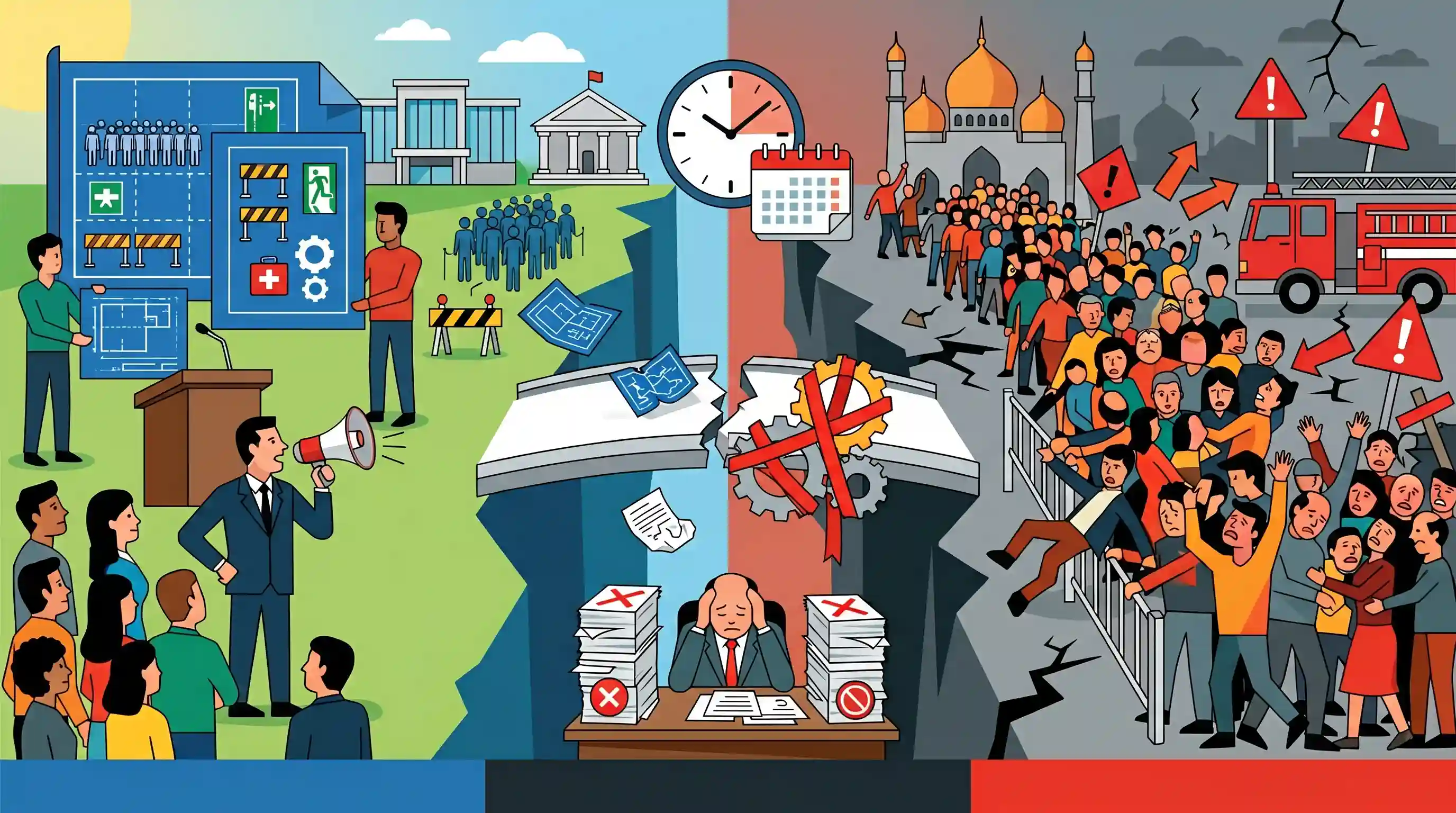
After a stampede incident at the Tirupati temple in January, the Andhra Pradesh government announced ambitious plans to improve crowd management, safety infrastructure, and disaster preparedness at major religious sites. However, recent assessments reveal that most of these proposals have largely remained on paper. The failure to implement these critical safety upgrades highlights a significant gap in governance and administrative accountability, underscoring the ongoing challenge of ensuring proactive disaster mitigation and effective crowd control at places of mass congregation.
Key Points
- Following a stampede at Tirupati in January, the Andhra Pradesh government announced comprehensive plans to upgrade crowd management and safety infrastructure at major temples.
- The proposed measures aimed to prevent overcrowding through better monitoring systems, strict capacity controls, and infrastructure improvements.
- Despite initial commitments, a review shows that most of these safety and administrative proposals have remained on paper.
- The lack of follow-through highlights systemic governance challenges, including poor implementation, administrative inertia, and a reactive rather than proactive approach to disaster management at mass gathering sites.
Important Terms
Crowd Management

Systematic planning and guidance of large gatherings to ensure safety. It involves understanding crowd dynamics, monitoring behavior, and using infrastructure like barricades to prevent stampedes.
UPSC context
GS Paper III (Disaster Management). Tests knowledge of NDMA guidelines for mass congregations and proactive safety measures at religious sites.
Disaster Mitigation
Proactive measures taken before a disaster occurs to minimize its potential impact, including structural modifications (e.g., separate entry/exit points) and policy interventions to reduce vulnerability.
UPSC context
GS Paper III (Disaster Management). A core concept emphasizing the shift from reactive relief to proactive risk reduction.
Administrative Accountability
The obligation of public officials to explain their actions and accept responsibility for implementation failures, often monitored through judicial inquiries or departmental audits.
UPSC context
GS Paper II (Governance) and Paper IV (Ethics). Tests understanding of implementation gaps and bureaucratic responsibility in public safety.
State Disaster Management Authority (SDMA)
An apex state-level body chaired by the Chief Minister, responsible for formulating policies and implementing plans for disaster preparedness under the Disaster Management Act, 2005.
UPSC context
GS Paper II (Statutory Bodies) and Paper III. Focuses on the institutional framework for state-led disaster risk reduction.
National Disaster Management Authority (NDMA)
The primary central agency for disaster management in India, chaired by the Prime Minister. It issues national guidelines that states are mandated to implement for disaster resilience.
UPSC context
GS Paper III. Fundamental for discussing the legal-institutional framework and central-state coordination in disaster management.
Standard Operating Procedures (SOPs)
Detailed, written instructions designed to achieve uniformity and safety in specific tasks, such as managing visitor flow or executing emergency evacuations at mass gatherings.
UPSC context
GS Paper II and III. Evaluates practical administrative solutions and the translation of "paper plans" into field-level execution.
Prelims Trap
Most fatalities during religious stampedes and crowd disasters occur due to trampling.
According to NDMA guidelines, the primary cause of death in crowd crushes is 'compressive asphyxia' (suffocation from extreme pressure), not trampling.
Static Concepts Connected
What are the key elements of NDMA guidelines on crowd management?
- Density Threshold: Disasters trigger when crowd density exceeds 5 persons per square meter, leading to loss of control and compressive asphyxia.
- Types of Stampedes: Classified as unidirectional (moving crowd hitting a bottleneck or exit) and turbulent (caused by panic or multi-directional surges).
- Technology Integration: Emphasizes proactive monitoring via AI analytics, UAV (drone) surveillance, and GIS mapping for real-time crowd density detection.
How is disaster governance institutionalized under the DM Act, 2005?
- Tiered Structure: Establishes NDMA at the national level (headed by PM), SDMAs at the state level (CM), and DDMAs at the district level.
- Paradigm Shift: Mandates a legally binding shift from a reactive relief-centric approach to a proactive prevention, mitigation, and preparedness model.
Cross-Topic Patterns
Tech & Disaster Mitigation
Using AI-based crowd analytics, drones, and Integrated Command and Control Centres bridges GS3 Disaster Management with GS3 Science & Technology applications.
Governance Deficits in Public Safety
The failure to implement safety protocols despite initial commitments serves as a prime GS2 Governance or GS4 Ethics case study on administrative inertia and accountability.

GS3 Mains may link NDMA crowd management guidelines with AI/UAV tech integration to prevent mass congregation disasters at religious sites.
Linked PYQs · 3
Linked PYQs · 3
- 2019MainsGS3
Disaster preparedness is the first step in any disaster management process. Explain how hazard zonation mapping will help disaster mitigation in the case of landslides.
- 2019MainsGS2
Implementation of Information and Communication Technology (ICT) based Projects/Programmes usually suffers in terms of certain vital factors. Identify these factors, and suggest measures for their effective implementation.
- 2025MainsGS2
"In contemporary development models, decision-making and problem-solving responsibilities are not located close to the source of information and execution defeating the objectives of development." Critically evaluate.
