Gujarat Inc Trade Strategy Leveraging Free Trade Agreements
Source:timesofindia-indiatimes ↗
Why It Matters
The article highlights the strategic pivot of Gujarat's industrial sector toward Free Trade Agreements (FTAs) to boost exports, which is directly relevant to understanding India's foreign trade policy, export-led growth, and regional economic contributions in GS Paper III.
Summary
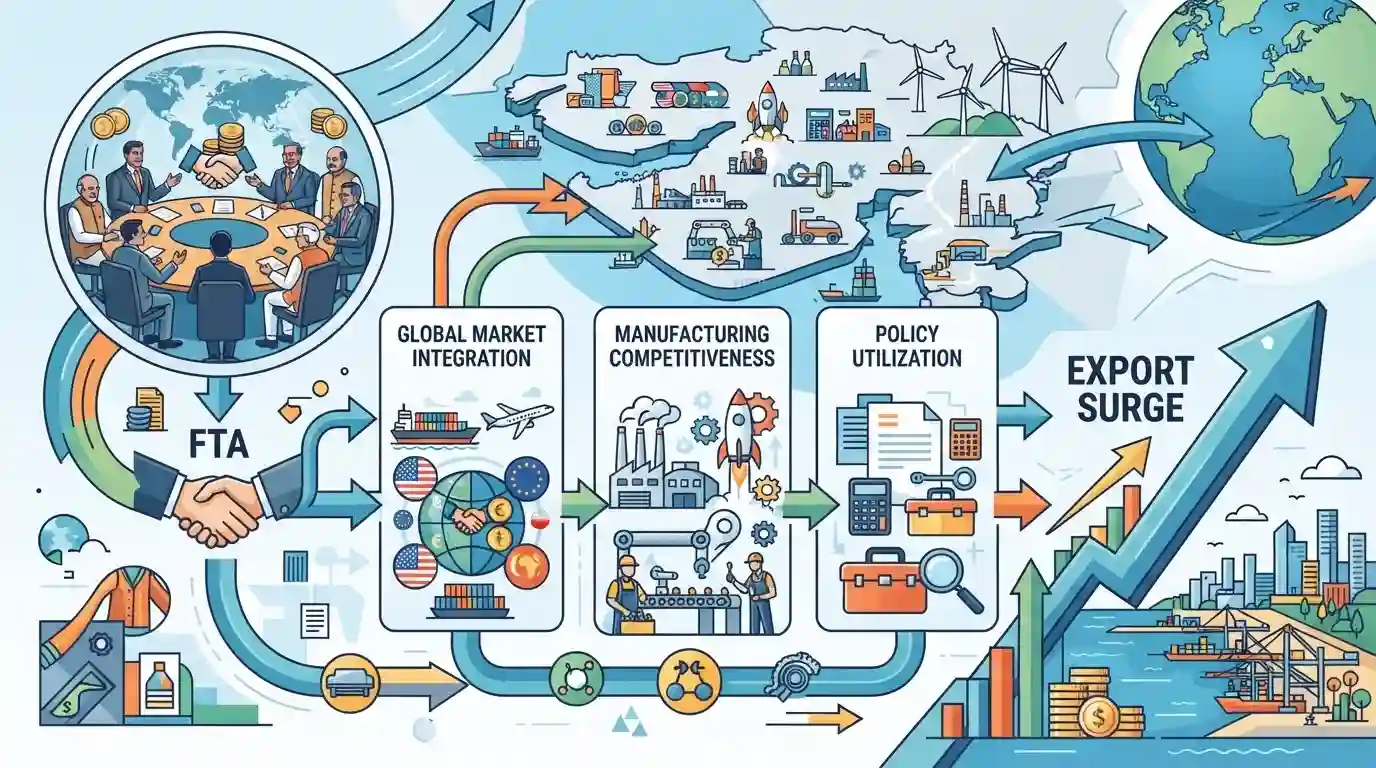
At the 'Times Dhandho' event, industry leaders and stakeholders in Gujarat discussed how Gujarat Inc is betting big on Free Trade Agreements (FTAs) to drive the next major surge in exports, focusing on global market integration, manufacturing competitiveness, and policy utilization.
Key Points
- Gujarat businesses and industries ('Gujarat Inc') are increasingly focusing on Free Trade Agreements (FTAs) to fuel the state's next wave of export growth.
- The discussions emphasize leveraging international trade pacts, expanding global market access, and enhancing the competitiveness of manufacturing and MSME sectors in Gujarat.
- Strategic export diversification and utilization of bilateral/multilateral trade frameworks are viewed as vital tools for achieving ambitious economic targets.
Important Terms
Free Trade Agreements (FTAs)

Treaties between two or more countries that reduce or eliminate import duties and non-tariff barriers to facilitate cross-border trade and investment.
UPSC context
Important for GS Paper 3 (International Trade and Economy). Tests understanding of global market integration and export-led growth policies.
Gujarat Inc
A collective term representing the corporate sector, business community, and industrial ecosystem of Gujarat.
UPSC context
Relevant for state-level economic development, industrial clusters, and regional contributions to India's manufacturing and export targets.
Times Dhandho
A prominent business conclave and platform that brings together industry leaders, policymakers, and stakeholders to discuss economic trends and enterprise strategies.
UPSC context
Tests knowledge of regional economic dialogues, entrepreneurship models ('dhandho'), and public-private discourse in Gujarat's industrial growth.
Static Concepts Connected
What are the key mechanisms and classifications of Free Trade Agreements (FTAs) under international trade law?
- PTA Level: Preferential Trade Agreement offers reduced tariffs on a restricted list of goods between partner nations.
- FTA Scope: Free Trade Agreement eliminates or significantly reduces tariffs across a vast majority of tariff lines.
- CEPA Depth: Comprehensive Economic Partnership Agreement includes trade in goods, services, investment, and economic cooperation.
What are the primary drivers and sectoral strengths of Gujarat's external merchandise trade?
- Export Share: Gujarat accounts for over 25% of India's total merchandise exports, leading all states consistently.
- Key Sectors: Petroleum products, chemicals, pharmaceuticals, gems and jewellery, and textiles constitute the core export basket.
- Port Infrastructure: Extensive coastline with major ports like Mundra and Hazira facilitates seamless global market integration.
Cross-Topic Patterns
State Export Hubs & National Trade Policy
Gujarat's export leadership relies heavily on SEZs, DMIC nodes, and port connectivity, which interact directly with national trade pacts under the Ministry of Commerce.
MSME Competitiveness & Global Value Chains
Surat's textile and MSME sectors leverage FTAs to diversify from traditional commodity goods into technical textiles and high-value garments.

Expect statement-based questions on Gujarat's export share, FTA utilization rates, and key merchandise drivers like gems and chemicals.
Linked PYQs · 3
Linked PYQs · 3
- 2025GPSC_PRELIMSGS1
Which one of the following is not a factor responsible for overall balance of payment imbalance in India since 1991?
- 2025GPSC_PRELIMSGS1
Consider the following statements: 1. The first SEZ policy in India was announced in 2000 2. The objective of SEZ policy was to increase foreign investment in India and to provide an internationally competitive environment for exports 3. The SEZ Act was passed in 2010 Which of the statements given above is/are correct?
- 2025GPSC_PRELIMSGS1
According to the Socio-Economic Review, 2024-2025 of Gujarat, Gujarat comes in ______ category in Logistic Ease Across Different States (LEADS), 2024.
