Rationale Behind Reserve Bank Decision to Hold Repo Rate Steady
Source:The Hindu ↗
Why It Matters
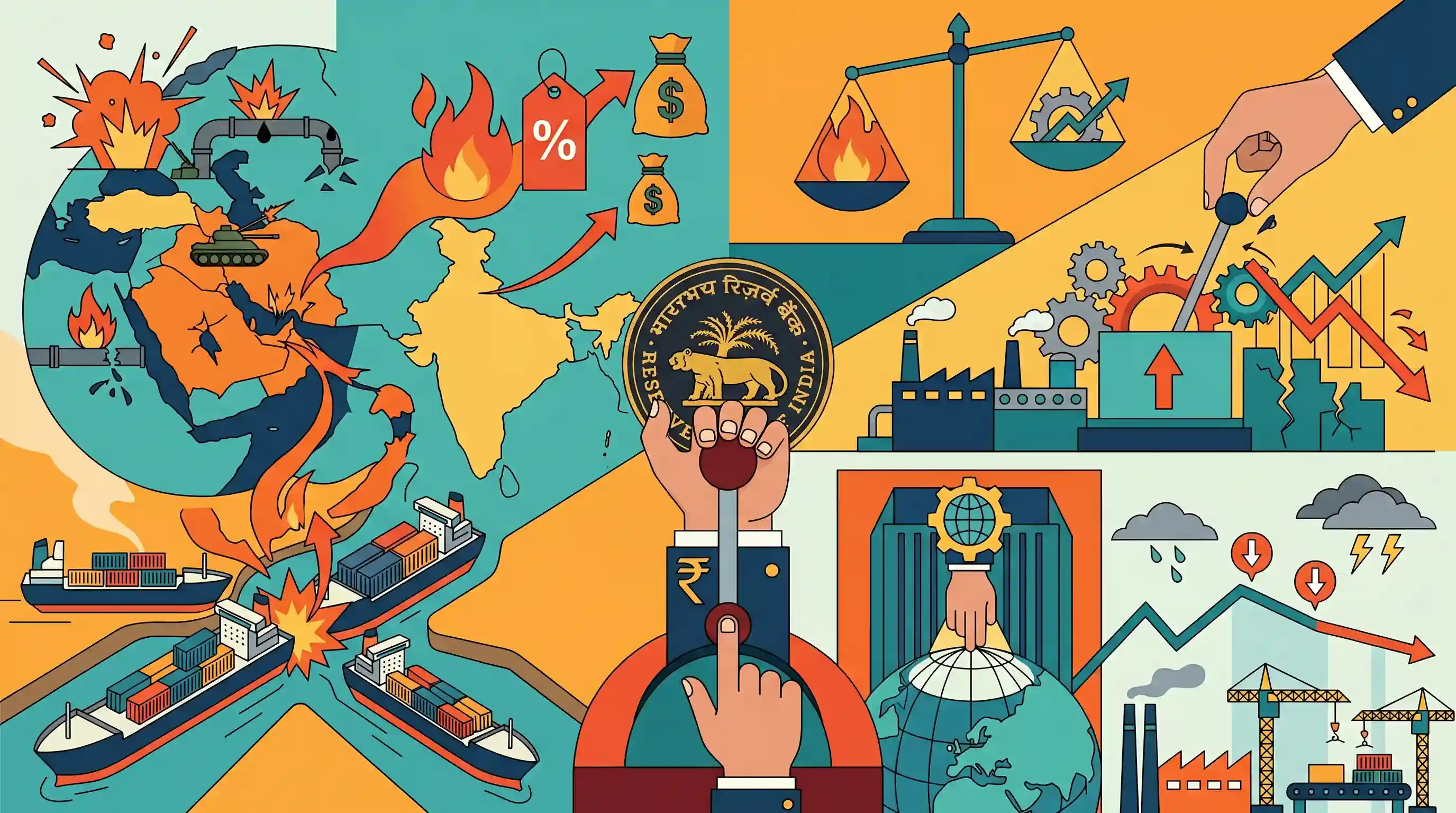
The distinction between supply-side (cost-push) and demand-pull inflation is a foundational macroeconomic concept for UPSC aspirants. This editorial perfectly illustrates the limitations of monetary policy tools (like the repo rate) when inflation is driven by external geopolitical supply shocks—such as conflicts in West Asia and disruptions in critical maritime chokepoints like the Strait of Hormuz. It also highlights the RBI's growth-inflation trade-off, directly addressing frequently tested GS3 themes.
Summary
The Hindu editorial supports the Reserve Bank of India's decision to maintain the repo rate, arguing it is the correct approach given current macroeconomic conditions. The RBI faces a classic dilemma: balancing the need for economic growth against rising inflation. However, because the current inflationary pressures are predominantly supply-side—stemming from geopolitical disruptions in West Asia, shipping bottlenecks in the Strait of Hormuz, and fuel constraints—traditional monetary tightening (raising rates) would be ineffective. Instead of curbing inflation, a rate hike would merely suppress already-slowing economic growth, which has been revised down to 6.9% for 2026-27 amid further global headwinds highlighted by the World Bank.
Key Points
- The RBI's Monetary Policy Committee (MPC) decided to keep the repo rate unchanged, adopting a wait-and-watch approach to balance growth and inflation.
- The editorial highlights that raising interest rates curbs inflation but hurts economic growth, while lowering rates boosts growth but fuels inflation.
- RBI Governor Sanjay Malhotra revised India's 2026-27 GDP growth forecast down to 6.9%, attributing the slowdown to global uncertainties, including the West Asia war and shipping hesitations in the Strait of Hormuz.
- Current inflationary pressures (expected to hit 4.6%) are driven by supply-side constraints rather than demand-pull factors. Consequently, raising the repo rate would fail to solve the inflation issue and would only stifle growth further.
- The World Bank's 'India Development Update' corroborates a slowdown in industrial growth, pointing to external risks like U.S. tariff investigations and El Nino impacts on the monsoon.
Important Terms
Repo Rate

The interest rate at which the Reserve Bank of India (RBI) lends money to commercial banks against government securities. It is the primary tool for managing liquidity and controlling inflation.
UPSC context
GS Paper 3 (Indian Economy); critical for understanding monetary policy transmission and inflation management.
Monetary Policy Committee (MPC)
A six-member statutory body established under the RBI Act, 1934, responsible for fixing the benchmark interest rate (repo rate) to maintain price stability while supporting economic growth.
UPSC context
GS Paper 3 (Indian Economy); tests knowledge of institutional frameworks for inflation targeting.
Supply-side Inflation
Inflation caused by a decrease in the aggregate supply of goods, often due to rising production costs like fuel prices or supply chain disruptions, rather than excessive demand.
UPSC context
GS Paper 3 (Indian Economy); distinguishes between cost-push and demand-pull factors in macroeconomic stability.
India Development Update
A biannual flagship report by the World Bank that analyzes recent economic developments, provides growth forecasts, and identifies structural challenges for the Indian economy.
UPSC context
GS Paper 3 (Indian Economy/Current Affairs); useful for citing credible growth projections and macroeconomic data.
Strait of Hormuz
A strategically vital maritime chokepoint between the Persian Gulf and the Gulf of Oman, through which approximately 20% of the world’s total oil consumption transits.
UPSC context
GS Paper 2 (International Relations) and Paper 1 (Geography); tests energy security and global geopolitical chokepoints.
Reserve Bank of India (RBI)
India's central bank and regulatory body, established in 1935, mandated to ensure monetary stability, manage the currency system, and supervise the nation's financial and banking sectors.
UPSC context
GS Paper 3 (Indian Economy); essential for questions on banking regulation and the Indian financial system.
Prelims Trap
Raising the repo rate is the primary RBI tool to control all forms of inflation, including external supply-shock inflation.
Monetary policy tools primarily target demand-side inflation. Rate hikes are largely ineffective against imported, supply-side (cost-push) inflation and only serve to suppress economic growth.
Static Concepts Connected
Why is monetary policy ineffective against cost-push inflation?
- Demand-pull inflation: Caused by excess money supply and high consumer demand; effectively controlled by RBI raising repo rates to curb borrowing.
- Cost-push inflation: Driven by supply constraints (e.g., West Asia fuel shocks); repo rate hikes cannot fix physical supply chains but will severely choke domestic growth.
- MPC dilemma: The dual mandate of the MPC is to maintain price stability while keeping in mind the objective of growth. In supply-side shocks, growth takes priority.
What is the geographical and strategic significance of the Strait of Hormuz?
- Strategic location: It connects the Persian Gulf to the Gulf of Oman and the broader Arabian Sea.
- Bordering nations: It is bounded by Iran to the north and the Musandam Peninsula (shared by Oman and the UAE) to the south.
- Economic value: It is a critical maritime chokepoint serving as the transit route for roughly 20-25% of the world's seaborne oil and LNG.
Cross-Topic Patterns
Monetary policy limits & maritime chokepoints
Global shipping chokepoints like the Strait of Hormuz directly dictate domestic monetary policy limits by triggering external cost-push inflation that RBI rate hikes cannot cure.
World Bank vs IMF flagship reports
UPSC often tests report publishers. Differentiate the World Bank's biannual 'India Development Update' from the IMF's 'World Economic Outlook' or the RBI's domestic 'Monetary Policy Report'.

Expect a 2026 Prelims question mapping West Asian chokepoints (Hormuz) directly to their domestic macroeconomic cost-push inflation effects.
Linked PYQs · 5
Linked PYQs · 5
- 2017PrelimsGS1
Which of the following statements is/are correct regarding the Monetary Policy Committee (MPC)? 1. It decides the RBI's benchmark interest rates. 2. It is a 12-member body including the Governor of RBI and is reconstituted every year. 3. It functions under the chairmanship of the Union Finance Minister. Select the correct answer using the code given below:
- 2022PrelimsGS1
In India, which one of the following is responsible for maintaining price stability by controlling inflation?
- 2024MainsGS3
What are the causes of persistent high food inflation in India? Comment on the effectiveness of the monetary policy of the RBI to control this type of inflation.
- 2021PrelimsGS1
With reference to Indian economy, demand-pull inflation can be caused/ increased by which of the following? 1. Expansionary policies 2. Fiscal stimulus 3. Inflation-indexing wages 4. Higher purchasing power 5. Rising interest rates Select the correct answer using the code given below.
- 2013PrelimsGS1
A rise in general level of prices may be caused by
