Administrative reforms and tourism revival in Jammu and Kashmir
Source:The Hindu ↗
Why It Matters
Provides a candid case study on governance deficits, showing how red tape and corruption hamper public service delivery and ease of doing business. It also illustrates the direct impact of internal security (terrorism) on economic development and local livelihoods in Jammu and Kashmir.
Summary
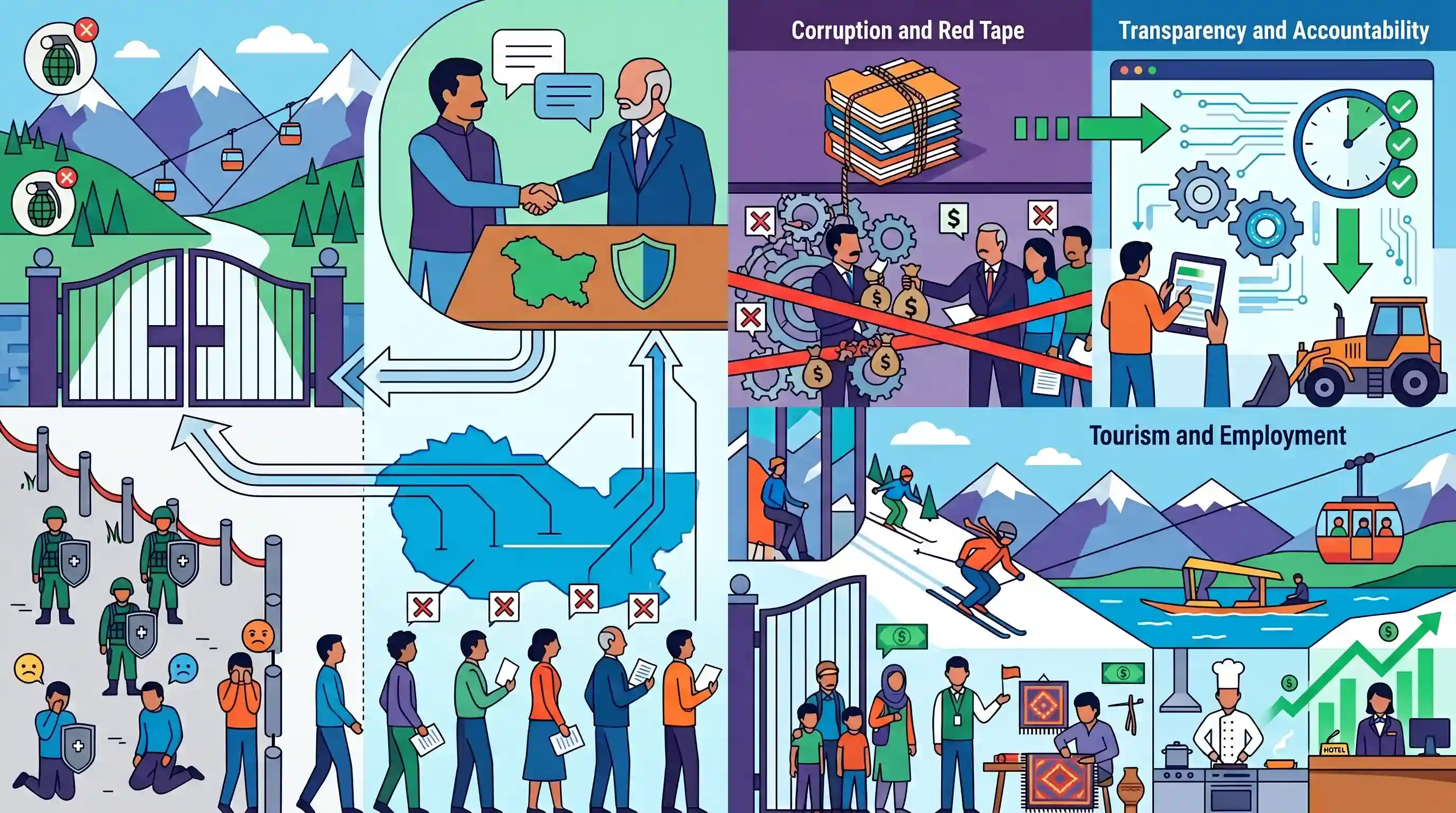
Jammu and Kashmir Chief Minister Omar Abdullah has emphasized the urgency of reopening tourist destinations that were shuttered following the April 2025 Pahalgam terror attack, an issue he plans to take up with Union Home Minister Amit Shah. Recognizing tourism as a critical engine for local employment, the J&K government is actively revising the outdated 1978 Tourist Trade Rules to streamline and digitize operations. By placing registrations under the Public Service Guarantee Act, the administration aims to ensure 30-day time-bound clearances. Notably, Abdullah acknowledged systemic governance issues, stating that bureaucratic hurdles and delays in issuing No Objection Certificates (NOCs) are often intentionally created by officials to solicit bribes, highlighting the pressing need for structural administrative reforms alongside economic development.
Key Points
- J&K Chief Minister Omar Abdullah plans to urge the Union Home Minister to reopen tourist destinations closed after the April 2025 Pahalgam terror attack.
- The archaic 1978 J&K Tourist Trade Rules are being overhauled to simplify, rationalize, and digitize the registration of tourism units.
- To enhance the ease of doing business, the tourism registration and renewal processes have been brought under the Public Service Guarantee Act, mandating clearance within 30 days.
- The Chief Minister candidly admitted that bureaucratic delays and withheld No Objection Certificates (NOCs) are frequently deliberate tactics used by officials to extract bribes.
- The government is proposing to develop new tourist destinations in Ramban district to boost local direct and indirect employment.
Important Terms
J&K Public Services Guarantee Act, 2011

A state law ensuring time-bound delivery of notified government services. It empowers citizens to seek compensation for delays and penalizes negligent officials to ensure administrative accountability and curb corruption.
UPSC context
GS Paper 2: Governance—tests mechanisms for transparency, accountability, and the effectiveness of public service delivery models.
J&K Registration of Tourist Trade Act, 1978
The foundational legislative framework for regulating tourism businesses (hotels, travel agents) in J&K. Current revisions aim to modernize these rules to streamline registrations and support local employment.
UPSC context
GS Paper 3: Indian Economy—relevant for regional development, employment generation, and sector-specific industrial regulation.
Security-Development Nexus
The strategic concept that economic prosperity and peace are interdependent. In J&K, security is vital for tourism (the economic lifeline), while development helps address alienation and radicalization.
UPSC context
GS Paper 3: Internal Security—analyzes linkages between development and the spread of extremism in conflict zones.
Administrative Red Tape
Excessive adherence to formal rules or bureaucratic procedures that causes delays. CM Abdullah identified it as a deliberate hurdle used by officials to solicit bribes through delayed NOCs.
UPSC context
GS Paper 2 & 4: Governance/Ethics—tests understanding of corruption, civil service reform, and Ease of Doing Business.
No Objection Certificate (NOC) Reform
A mandatory certificate issued by various departments (e.g., fire, environment) for business registration. Streamlining NOCs through digitization is a key administrative reform to reduce rent-seeking behavior.
UPSC context
GS Paper 2: Governance—evaluates administrative hurdles and "Ease of Doing Business" initiatives in public administration.
Public Service Delivery
The mechanism by which governments provide essential services to citizens. Effective delivery requires a "citizens-first" approach, often utilizing e-governance and legal guarantees to ensure quality and speed.
UPSC context
GS Paper 2: Role of Civil Services—central to the theme of responsive governance and citizen charters.
Prelims Trap
"The Public Service Guarantee Act is a uniform central legislation applicable across all Indian states and Union Territories."
There is no Central PSGA. Right to Public Services are state-specific statutory laws (first enacted by Madhya Pradesh in 2010) that guarantee time-bound delivery of notified services.
Static Concepts Connected
What are the core features of Right to Public Services (RTPS) legislations?
- State-level statutes: Enacted individually by states (pioneered by Madhya Pradesh in 2010) to shift public service delivery from a privilege to a statutory right.
- Designated officers: The acts notify specific services, fixed time limits, and the designated officials responsible for delivering those clearances.
- Penal provisions: Imposes statutory fines on public servants for unjustified delays or arbitrary rejections, often compensating the aggrieved citizen.
How does administrative discretion foster systemic rent-seeking?
- Monopoly and Discretion: Robert Klitgaard's formula (Corruption = Monopoly + Discretion - Accountability) explains how centralized control over NOC approvals directly breeds bribery.
- Weaponized delays: Archaic rules allow corrupt officials to weaponize deliberate administrative bottlenecks, coercing citizens and businesses into paying 'speed money'.
- E-governance mitigation: Digitization and single-window clearances limit arbitrary bureaucratic power, standardize procedures, and provide transparent audit trails.
Cross-Topic Patterns
Tourism as Counter-Insurgency (WHAM)
Terror groups target regional economic pillars to perpetuate alienation. Developing tourism generates direct employment, acting as a crucial economic counter-measure against youth radicalization under the 'Winning Hearts and Minds' strategy.
Statutory EODB via PSGA
Linking business registrations to the Public Service Guarantee Act uses a rights-based framework to enforce time-bound MSME clearances, turning administrative accountability into a direct driver for Ease of Doing Business.

GS-4 2026 could test 'deliberate bureaucratic delays' as corruption, asking candidates to evaluate statutory remedies like the PSGA.
Linked PYQs · 5
Linked PYQs · 5
- 2025MainsGS3
Terrorism is a global scourge. How has it manifested in India? Elaborate with contemporary examples. What are the counter measures adopted by the State? Explain.
- 2023MainsGS3
Winning of 'Hearts and Minds' in terrorism-affected areas is an essential step in restoring the trust of the population. Discuss the measures adopted by the Government in this respect as part of the conflict resolution in Jammu and Kashmir.
- 2023MainsGS2
e-governance, as a critical tool of governance, has ushered in effectiveness, transparency and accountability in governments. What inadequacies hamper the enhancement of these features ?
- 2022MainsGS4
Discuss the challenges of 'Digitalization' in the context of public service delivery.
- 2019MainsGS4
"Non-performance of duty by a public servant is a form of corruption". Do you agree with this view? Justify your answer.
