USIBC Urges Stronger Bilateral Ties Amid Tariff Dispute
Source:The Hindu ↗
Why It Matters
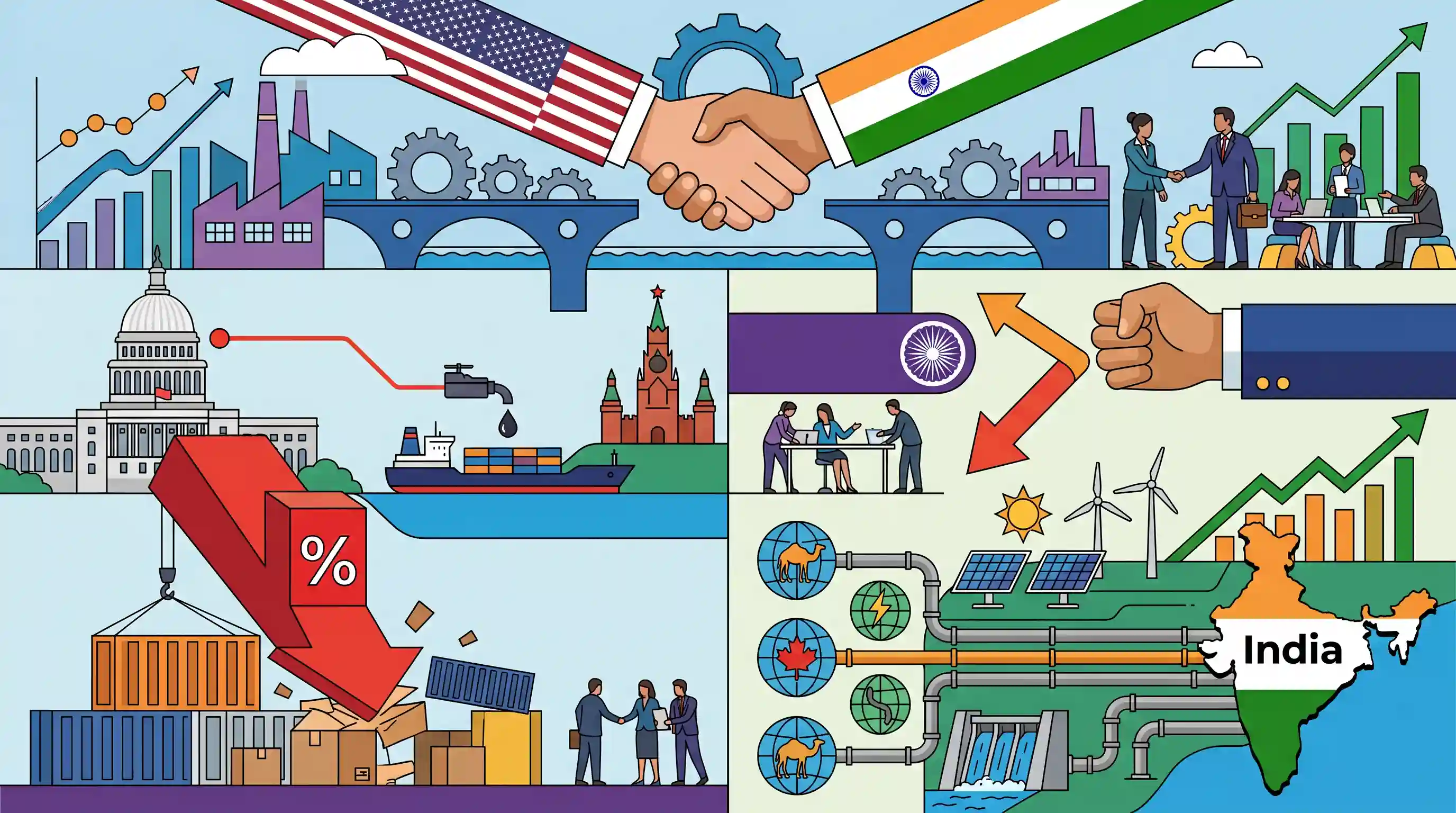
The tariff dispute illustrates the complex balancing act in India's foreign policy—maintaining strategic autonomy and energy security by purchasing Russian oil while managing crucial strategic and economic partnerships with the United States. It highlights vulnerabilities in Indo-US trade ties due to geopolitical friction.
Summary
The U.S.-India Business Council (USIBC) has advocated for strengthening U.S.-India ties amidst an escalating tariff dispute. Following the Trump administration's decision to levy an additional 25% tariff on Indian imports—aimed at penalizing India for importing Russian oil—India's Ministry of External Affairs labeled the tariffs as unfair and unjustified. USIBC President Atul Keshap emphasized the critical nature of the bilateral strategic and economic partnership, urging both governments to resolve their differences diplomatically and highlighting the role of the business community in maintaining stability between the two nations.
Key Points
- The U.S. imposed an additional 25% tariff on Indian imports as a penalty for India's continued purchase of Russian oil.
- India's Ministry of External Affairs (MEA) strongly condemned the move, calling the tariffs "unfair, unjustified, and unreasonable."
- The U.S.-India Business Council (USIBC), led by Atul Keshap, urged both nations to "redouble efforts" to bridge differences through diplomacy rather than "pull apart."
- The episode underscores the tension between India's pursuit of energy security through discounted Russian oil and the geopolitical pressures from the U.S. and its allies.
Important Terms
U.S.-India Business Council (USIBC)

A premier business advocacy group representing global companies operating in India and the U.S. It facilitates trade, investment, and strategic dialogue between the two nations' private sectors.
UPSC context
GS Paper II: Important for International Relations, highlighting the role of non-state actors and business groups in diplomacy.
Ministry of External Affairs (MEA)
The government agency responsible for managing India's foreign relations. It formulates and executes foreign policy, manages diplomatic missions, and represents India in international forums and trade disputes.
UPSC context
GS Paper II: Essential for understanding India’s institutional framework for foreign policy and bilateral dispute resolution.
Strategic Autonomy
India’s foreign policy doctrine emphasizing independent decision-making based on national interest, allowing it to engage with multiple rival powers (like the U.S. and Russia) without joining formal military alliances.
UPSC context
GS Paper II: A core concept in International Relations, testing India’s shift from non-alignment to multi-alignment.
Trade Protectionism
Economic policy of restricting imports through tariffs, quotas, or subsidies to shield domestic industries from foreign competition, often sparking trade disputes and impacting global supply chains.
UPSC context
GS Paper III: Relevant to the Indian Economy, focusing on the effects of global trade policies on domestic growth.
Energy Security
The uninterrupted availability of energy sources at an affordable price. For India, it involves diversifying suppliers and managing geopolitical risks, such as those involving Russian oil imports.
UPSC context
GS Paper III: Important for Economy and Environment, testing resource management and foreign policy trade-offs.
Comprehensive Global Strategic Partnership
The multi-faceted cooperation between India and the U.S. covering defense, trade, and technology, aimed at maintaining a rules-based order and stability in the Indo-Pacific region.
UPSC context
GS Paper II: A key topic in International Relations, focusing on India’s most consequential bilateral ties.
Prelims Trap
"WTO rules strictly prohibit unilateral tariffs and automatically invalidate any trade barriers imposed for geopolitical reasons."
Countries frequently bypass standard rules by invoking GATT Article XXI (National Security Exception) to unilaterally justify geopolitical tariffs, making immediate enforcement difficult.
Static Concepts Connected
What is the difference between primary and secondary economic sanctions?
- Primary Sanctions: Prohibit citizens and companies of the sanctioning country from conducting business with the targeted nation.
- Secondary Sanctions: Penalize third-country governments, financial institutions, or entities for engaging in trade with the targeted nation.
How do countries legally justify geopolitical trade barriers under WTO rules?
- GATT Article XXI: The National Security Exception allows member states to breach WTO trade obligations if deemed necessary to protect their essential security interests.
- Growing Misuse: Developed nations increasingly use this "self-judging" loophole to justify unilateral tariffs and secondary sanctions, undermining the WTO's dispute settlement mechanism.
Cross-Topic Patterns
Energy Security trumps allied geopolitics
India prioritizes domestic inflation control and macroeconomic stability via cheap Russian crude over the geopolitical demands of its US partnership, defining the modern application of its 'strategic autonomy'.
Friend-shoring vs Trade weaponization
The sudden imposition of unilateral tariffs exposes the fragility of the "China-plus-one" strategy, proving that geopolitical disagreements can rapidly derail Western attempts at supply chain integration with India.

Expect a Mains question evaluating the limits of 'friend-shoring' when India's strategic autonomy clashes with Western trade barriers.
Linked PYQs · 3
Linked PYQs · 3
- 2019MainsGS2
‘What introduces friction into the ties between India and the United States is that Washington is still unable to find for India a position in its global strategy, which would satisfy India's national self-esteem and ambitions.’ Explain with suitable examples.
- 2012MainsGS2
Discuss the likely negative impact of the protectionist measures proposed by the US on India's software industry.
- 2025MainsGS2
"Energy security constitutes the dominant kingpin of India's foreign policy, and is linked with India's overarching influence in Middle Eastern countries.” How would you integrate energy security with India's foreign policy trajectories in the coming years?
