Soil Health Restoration Through Natural and Organic Farming
Source:The Hindu ↗
Why It Matters
Highlights the practical distinctions between natural and organic farming with an emphasis on soil health and organic carbon, vital for UPSC GS3 topics on sustainable agriculture, ecological conservation, and government initiatives promoting chemical-free farming.
Summary
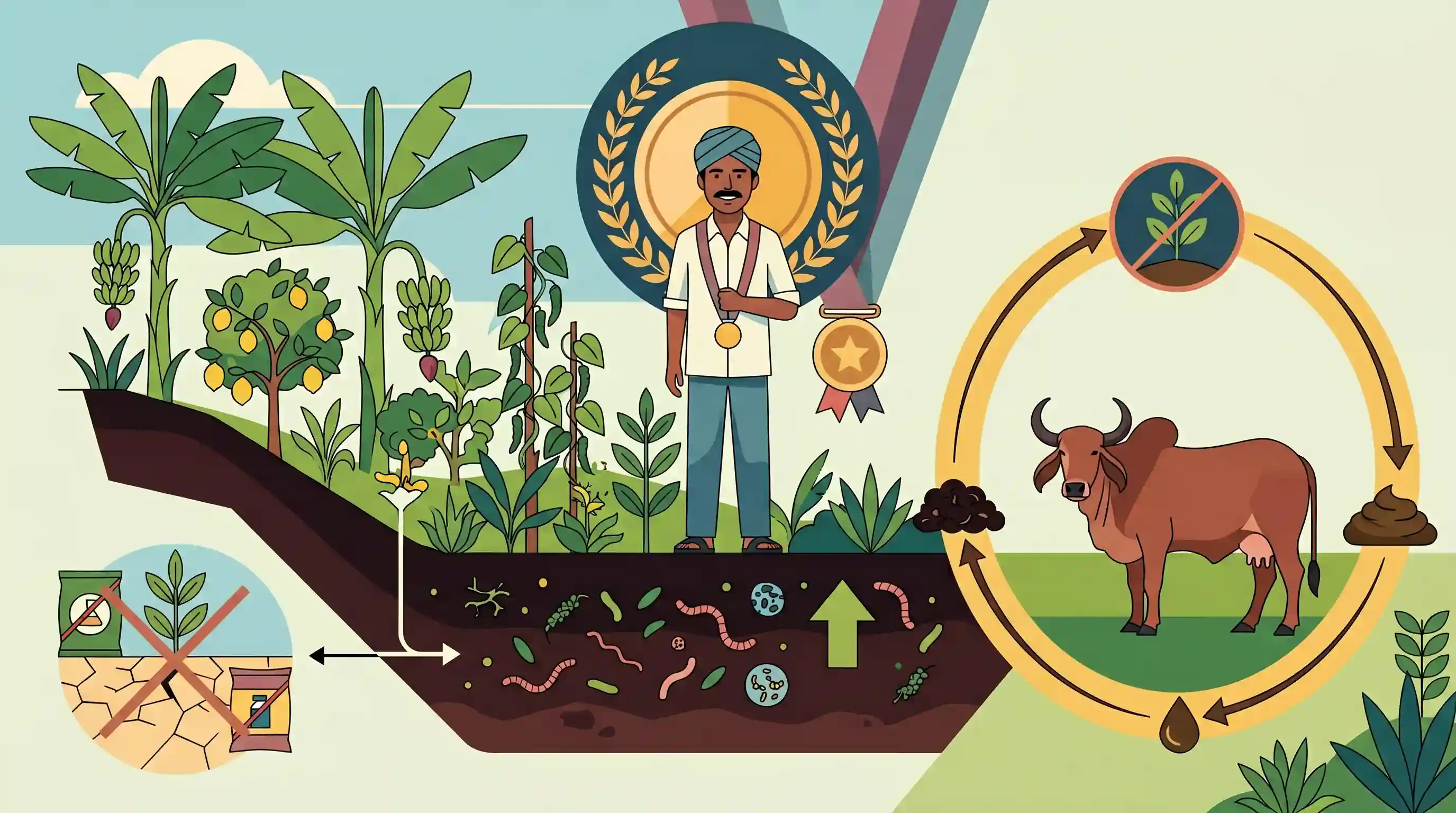
A farmer from Tiruchi, T.R. Ammiahraj, was felicitated at the South India Natural Farming Summit 2025 for his success in natural farming. He highlighted the fundamental difference between natural and organic farming, emphasizing that natural farming inherently builds soil health and organic carbon content, unlike organic farming which often relies on heavy inputs without restoring carbon. By integrating multi-cropping (bananas, lemon, pepper) with native Gir cow rearing, he has established a self-sustaining ecosystem that requires minimal external inputs, advocating for a transition away from chemical fertilizers to promote long-term agricultural sustainability.
Key Points
- T.R. Ammiahraj, a farmer from Tiruchi, was recognized by PM Narendra Modi at the South India Natural Farming Summit 2025 for his successful natural farming practices in Kodaikanal.
- Ammiahraj distinguishes between natural farming and organic farming, arguing that organic farming often depletes organic carbon despite the heavy use of manure, whereas natural farming focuses on enhancing soil health and organic carbon content.
- His integrated approach combines cultivating hill banana, robusta banana, lemon, and pepper with rearing native Gir cows, utilizing their dung and urine to naturally enrich the soil.
- The farmer advocates a gradual shift away from chemical fertilizers, demonstrating that enriching the soil ecosystem reduces the need for external agricultural inputs over time.
Important Terms
Natural Farming

A chemical-free, low-cost agriculture method relying on local biodiversity and cow-based formulations (e.g., Jeevamrutha), avoiding external inputs like synthetic fertilizers or even bulk organic manures.
UPSC context
GS Paper III (Agriculture). Tested under Bhartiya Prakritik Krishi Paddhati (BPKP) and Zero Budget Natural Farming (ZBNF) frameworks.
Integrated Farming System (IFS)
A holistic agricultural approach combining crops, livestock, and other enterprises (like poultry or fisheries) where the waste of one process serves as the input for another to maximize productivity.
UPSC context
GS Paper III (Agriculture/Economy). Key for discussing "doubling farmers' income," climate resilience, and sustainable resource management.
Soil Organic Carbon (SOC)
The carbon component of soil organic matter, serving as a vital indicator of soil health, fertility, water retention capacity, and the soil's potential for carbon sequestration.
UPSC context
GS Paper III (Environment/Agriculture). Relevant for climate change mitigation (carbon sinks) and Soil Health Card scheme assessments.
Multi-cropping
The practice of growing two or more crops on the same piece of land during a single growing season to maximize land use and reduce risk.
UPSC context
GS Paper III (Cropping Patterns). Evaluates agricultural intensity and food security strategies in regions with limited arable land.
South India Natural Farming Summit 2025
A major regional event held in November 2025 in Coimbatore to promote science-backed, chemical-free agricultural transitions and indigenous farming traditions.
UPSC context
Current Affairs (Agriculture). Highlights the government's push for "One Acre, One Season" natural farming adoption.
Organic Farming
A regulated agricultural system that avoids synthetic chemicals and GMOs, relying instead on crop rotation and external organic inputs like compost and bio-fertilizers.
UPSC context
GS Paper III. Contrasted with natural farming regarding input intensity and certification standards (NPOP).
Prelims Trap
"Natural farming and organic farming are identical practices that both rely on off-farm organic composts."
Organic farming allows external organic inputs (composts, purchased manures) and tillage. Natural farming strictly prohibits external inputs, relying purely on on-farm biomass and microbial formulations.
Static Concepts Connected
What are the core differences between Organic and Natural Farming?
- Inputs: Organic allows external organic fertilizers and purchased manures. Natural relies exclusively on in-situ ecological processes and zero external inputs.
- Tillage: Organic farming permits traditional plowing and soil mixing. Natural farming advocates for zero-tillage to preserve soil structure and earthworm activity.
- Cost structure: Organic can be capital-intensive due to input purchases. Natural is essentially zero-budget, making it highly accessible for marginal farmers.
What is the Bhartiya Prakritik Krishi Padhati (BPKP)?
- Parent Scheme: BPKP operates as a dedicated sub-scheme under the Paramparagat Krishi Vikas Yojana (PKVY).
- Core Objective: It promotes traditional, indigenous agricultural practices (like Zero Budget Natural Farming) to completely eliminate synthetic chemical inputs.
- Funding Mechanism: Provides financial assistance of Rs. 12,200/ha for 3 years for cluster formation, capacity building, and continuous handholding.
Cross-Topic Patterns
Soil Carbon & Climate Resilience
Natural farming enhances Soil Organic Carbon (SOC), serving as a vital carbon sink. This links GS3 Agriculture directly with GS3 Climate Change mitigation and India's UNFCCC commitments.
IFS and Smallholder Viability
Integrated Farming Systems (multi-cropping + native livestock) provide a closed-loop economic buffer against climate variability, aligning directly with the Ashok Dalwai Committee's recommendations for smallholder viability.

Expect a multi-statement Prelims question contrasting Natural vs. Organic farming inputs, paired with the mandate of the BPKP scheme.
Linked PYQs · 2
Linked PYQs · 2
- 2018MainsGS3
Sikkim is the first 'Organic State' in India. What are the ecological and economical benefits of Organic State?
- 2022MainsGS3
What is Integrated Farming System ? How is it helpful to small and marginal farmers in India?
