Western Ghats Eco Sensitive Zones Reduction and Conservation
Source:timesofindia-indiatimes ↗
Why It Matters
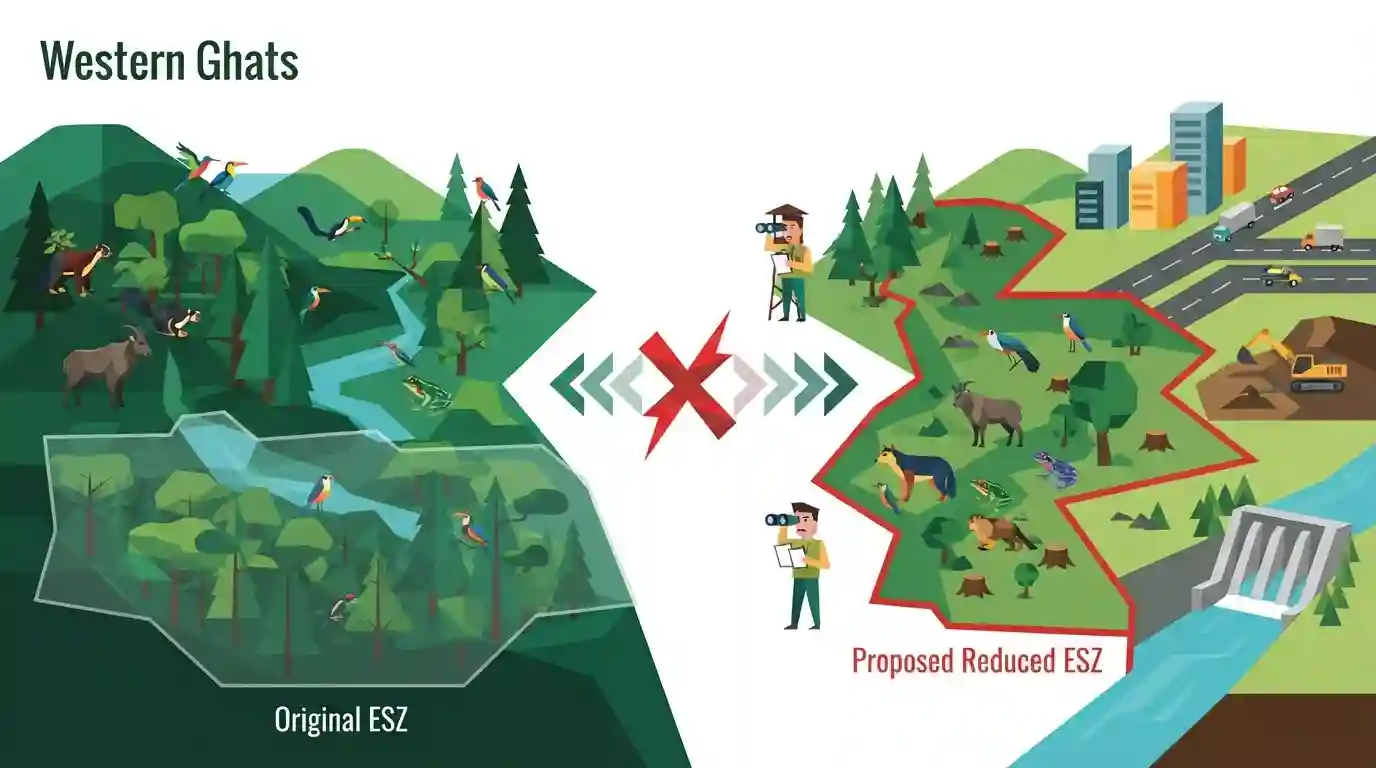
It highlights policy battles over Eco-Sensitive Zones in the Western Ghats, balancing ecological preservation against developmental pressures.
Summary
Conservationists are warning that states pushing to shrink Eco-Sensitive Zones (ESZs) in the Western Ghats for developmental projects pose a critical threat to the ecologically sensitive region and its biodiversity hotspot status.
Key Points
- Conservationists have raised alarms that time is running out to protect the Western Ghats as various states push to shrink Eco-Sensitive Zones (ESZs) for developmental projects.
- The debate highlights the long-standing conflict between ecological conservation of a global biodiversity hotspot and commercial/developmental expansion.
- Committees like the Madhav Gadgil Committee and Kasturirangan Committee previously recommended protective measures for the Western Ghats region, which continue to face state-level resistance.
Important Terms
Eco-Sensitive Zone (ESZ) notifications

Buffer areas notified by the Ministry of Environment, Forest and Climate Change around protected areas like national parks and wildlife sanctuaries to act as a shock absorber for developmental activities.
UPSC context
MPSC / UPSC Environment and Ecology: Tests understanding of conservation laws, Wildlife Protection Act, and balancing development with ecological preservation.
Western Ghats Ecology Expert Panel (Gadgil Committee)
A panel chaired by ecologist Madhav Gadgil that recommended designating the entire Western Ghats as an Ecologically Sensitive Area with a bottom-up decentralized governance model.
UPSC context
MPSC / UPSC Biodiversity Conservation: Tests knowledge of expert committee recommendations, environmental governance, and regional ecological disputes.
High Level Working Group (Kasturirangan Committee)
A committee chaired by K. Kasturirangan that recommended bringing roughly 37% of the Western Ghats under an Ecologically Sensitive Area, balancing conservation with socio-economic development.
UPSC context
MPSC / UPSC Geography & Environment: Tests policy frameworks, satellite-based remote sensing applications in conservation, and federal challenges in India.
Static Concepts Connected
What are the key differences between the Gadgil and Kasturirangan committees on the Western Ghats?
- Gadgil Committee:: Headed the Western Ghats Ecology Expert Panel (2010), recommending ~64% of the region as Ecologically Sensitive Area (ESA) with a strict developmental ban.
- Kasturirangan Committee:: Chaired the High Level Working Group (2013), recommending ~37% of the Ghats as ESA using satellite mapping with calibrated, development-friendly zoning.
- Legal Provision:: Both frameworks derive legal footing from the Environment (Protection) Act, 1986, though states have pushed back against both drafts.
Cross-Topic Patterns
Western Ghats ESZs vs. Cooperative Federalism
State governments often resist central ESZ notifications using federalism arguments, mirroring disputes seen in coastal regulation zones and forest clearance approvals.

Gadgil vs Kasturirangan committee recommendations, ESZ percentages, and statutory backing under EPA 1986 are prime MPSC matches.
Linked PYQs · 3
Linked PYQs · 3
- 2017MPSC_PRELIMSGS1
Which of the following mountains are considered as one of the top biodiversity hot spots ?
- 2022MPSC_PRELIMSGS1
In India, which of the following has become a hot-spot with reference to threats to biodiversity ?
- 2025MPSC_PRELIMSGS1
Match the following. | Biosphere Reserve | Establishment Year | |---|---| | a. Nilgiri | I. 2011 | | b. Sundarban | II. 2008 | | c. Kutch | III. 1989 | | d. Panna | IV. 1986 | Code: a b c d
