Monetary Policy Pause and Fiscal Policy Needs for Economic Growth
Source:The Hindu ↗
Why It Matters
Understanding the interplay between monetary policy (RBI's rate decisions) and fiscal policy (government interventions like tax adjustments) is crucial for the UPSC syllabus. This article provides a practical example of the limitations of monetary policy in stimulating demand and highlights the geopolitical risks impacting India's macroeconomic stability.
Summary
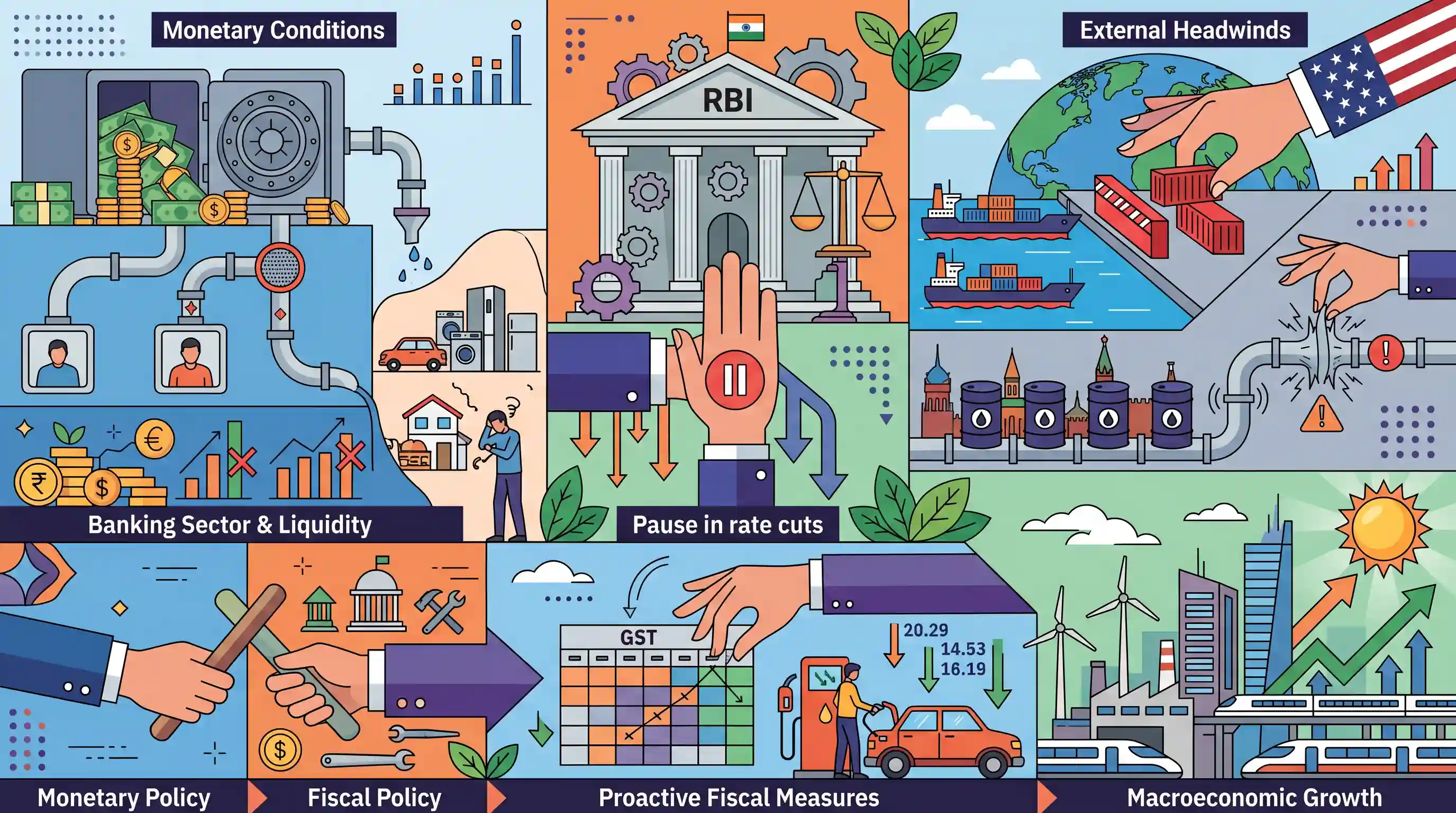
The editorial discusses the Reserve Bank of India's (RBI) decision to pause interest rate cuts amidst a complex domestic and global economic landscape. While domestic liquidity is ample, the transmission of previous rate cuts remains incomplete, and credit growth in consumer segments has noticeably slowed. Simultaneously, external headwinds are mounting due to unexpected U.S. tariffs on Indian imports and geopolitical pressures regarding Russian oil purchases. The piece concludes that to sustainably boost economic growth and stimulate demand, the onus must shift from monetary policy to proactive government fiscal measures, such as rationalising GST rates and lowering fuel prices.
Key Points
- The RBI's Monetary Policy Committee sensibly paused further interest rate cuts to allow the previous 100 basis points of reductions to fully transmit through the banking system.
- Credit growth in key areas like housing, vehicles, and consumer durables has slowed despite ample liquidity, indicating weak consumer demand.
- External risks have escalated due to new U.S. reciprocal tariffs on Indian imports and threats of penalties for countries purchasing Russian oil, which could erode India's comparative advantages.
- The editorial argues that monetary policy alone cannot drive growth; targeted government interventions like GST rate rationalisation and lower fuel prices are needed to boost consumption.
Important Terms
Reserve Bank of India (RBI)

India's central bank and regulatory body responsible for managing the money supply, overseeing the banking sector, and maintaining financial stability and price control.
UPSC context
Core GS3 topic; tests knowledge of banking regulation, monetary tools, and the central bank's role as 'lender of last resort.'
Monetary Policy Committee (MPC)
A six-member statutory committee, chaired by the RBI Governor, mandated to fix the benchmark repo rate to keep inflation within a target band (4% +/- 2%).
UPSC context
GS3 Indian Economy; essential for understanding institutional frameworks for inflation targeting and rule-based policy-making.
Monetary Policy Transmission
The process by which central bank policy rate changes (e.g., Repo rate) influence market interest rates, bank lending, and eventually consumption and investment.
UPSC context
GS3 Banking; tests understanding of why interest rate cuts may fail to stimulate growth if banks do not pass on benefits.
Fiscal Policy
The use of government spending, taxation, and borrowing to influence economic conditions, manage demand, and promote sustainable growth.
UPSC context
GS3 Budgeting; focuses on the government’s role in stimulating the economy when monetary policy reaches its limits.
Goods and Services Tax (GST)
A comprehensive destination-based indirect tax levied on value addition, aimed at unifying the national market and reducing the cascading effect of taxes.
UPSC context
GS3 Taxation; rationalisation tests concepts of tax structure simplification, consumption stimulus, and cooperative federalism.
Protectionism
An economic policy of restricting imports from other countries through tariffs, quotas, or regulations to protect domestic industries from foreign competition.
UPSC context
GS2 International Relations; tests the impact of global trade policies and 'tariff wars' on India’s export-led growth.
Prelims Trap
A decrease in the RBI's repo rate proportionally and automatically reduces all commercial lending rates.
Monetary transmission is often delayed. While new retail loans use External Benchmarks (EBLR), legacy corporate loans use MCLR, which relies on a bank's cost of funds and doesn't adjust immediately.
Static Concepts Connected
What factors hinder the complete transmission of monetary policy in India?
- Rigid deposit rates: Banks cannot quickly lower deposit rates due to fixed-term contracts and competition from government-backed small savings schemes.
- Legacy MCLR loans: While new retail loans are EBLR-linked, older and corporate loans depend on the Marginal Cost of Funds Based Lending Rate, which adjusts slowly.
- Risk premiums: In uncertain economic environments, banks maintain higher interest spreads to cover potential defaults, blocking full rate transmission to consumers.
How do reciprocal tariffs challenge the core principles of the WTO?
- MFN violation: The Most-Favored-Nation (MFN) principle mandates equal tariff treatment for all WTO members; reciprocal tariffs inherently target and discriminate against specific nations.
- Tariff bindings: Retaliatory or reciprocal tariffs often breach the maximum "bound rates" a country explicitly committed to upholding at the WTO.
- Unilateral action: Implementing these tariffs bypasses the multilateral WTO Dispute Settlement Mechanism, relying instead on unilateral domestic trade laws.
Cross-Topic Patterns
Monetary limits + Fiscal stimulus synergy
When rate cuts fail to spur credit due to incomplete transmission, fiscal tools like GST rationalisation and fuel excise cuts become essential to directly boost household disposable income.
Protectionism + Energy Security risks
US reciprocal tariffs threaten Indian export competitiveness, while secondary sanctions on Russian 'shadow fleets' jeopardise India's access to discounted crude, creating dual macroeconomic headwinds.

Expect a multi-statement Prelims question testing the difference between MCLR/EBLR transmission alongside the limits of RBI's MPC mandate.
Linked PYQs · 4
Linked PYQs · 4
- 2024MainsGS3
What are the causes of persistent high food inflation in India? Comment on the effectiveness of the monetary policy of the RBI to control this type of inflation.
- 2020PrelimsGS1
If the RBI decides to adopt an expansionist monetary policy, which of the following would it not do ? 1. Cut and optimize the Statutory Liquidity Ratio 2. Increase the Marginal Standing Facility Rate 3. Cut the Bank Rate and Repo Rate Select the correct answer using the code given below:
- 2013PrelimsGS1
An increase in the Bank Rate generally indicates that the
- 2022PrelimsGS1
Consider the following statements: 1. Tight monetary policy of US Federal Reserve could lead to capital flight. 2. Capital flight may increase the interest cost of firms with existing External Commercial Borrowings (ECBs). 3. Devaluation of domestic currency decreases the currency risk associated with ECBs. Which of the statements given above are correct?
