US and China Reach Restructuring Deal for TikTok US Operations
Source:Indian Express ↗
Why It Matters
The resolution provides a crucial case study in how global powers are managing the intersection of national security, foreign direct investment, and data privacy. For India—which has previously implemented outright bans on Chinese apps like TikTok—this 'forced divestment' model presents an alternative strategy for securing digital sovereignty without completely shutting down popular consumer technologies.
Summary
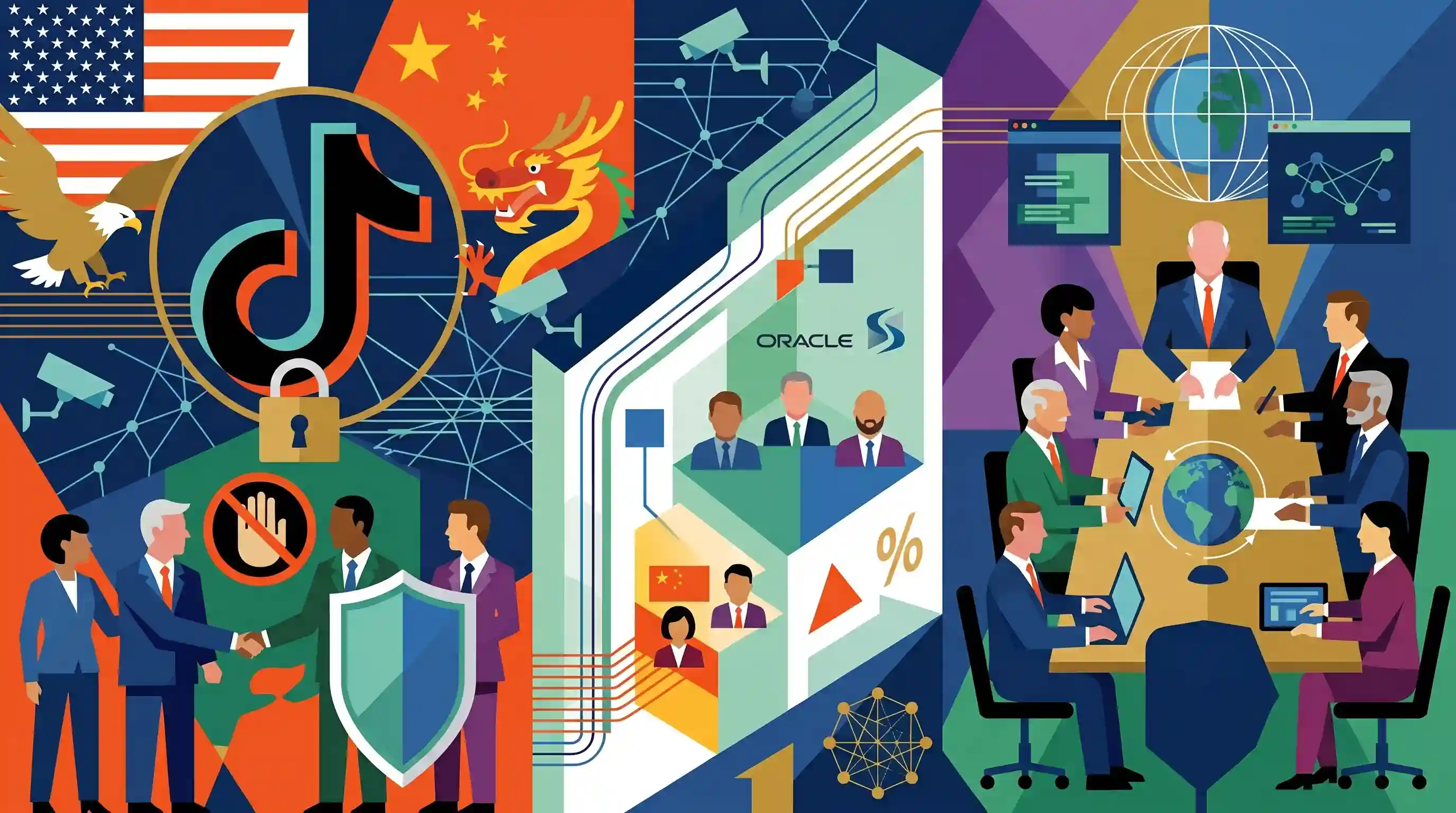
The US and China have reached a deal to restructure TikTok’s operations in the United States, averting a looming ban over national security concerns. Under the agreement, a new US-based entity will be formed with American investors—expected to include Oracle, Silver Lake, and Andreessen Horowitz—taking an 80% majority stake. Chinese shareholders will retain 20%, strictly adhering to a US law that limits ownership by adversarial nations. Control will further shift to the US via a reconstructed board, where Americans will occupy six of seven seats. The deal, spearheaded by Treasury Secretary Scott Bessent, underscores the intensifying geopolitics of technology and the securitization of digital infrastructure.
Key Points
- The US and China have finalized an agreement enabling TikTok to maintain its operations in the United States by restructuring its ownership.
- A new US-based company will manage the app locally, with American investors securing an 80% controlling stake to alleviate data security concerns.
- Chinese shareholders will retain a 20% stake, conforming to a US law signed by former President Biden that restricts ownership by entities from adversarial nations.
- The newly established board will be dominated by Americans, who will hold six out of seven seats, leaving ByteDance with the power to appoint just one member.
- The diplomatic and corporate breakthrough, negotiated by US Treasury Secretary Scott Bessent, averts an outright ban on the platform while addressing national security vulnerabilities.
Important Terms
TikTok

A short-video platform owned by ByteDance, central to global debates on data privacy, algorithmic influence, and national security in major markets like India and the US.
UPSC context
GS Paper III: Internal Security; tests knowledge of social media's role in security and data privacy.
ByteDance
A Beijing-based technology company and parent of TikTok. It exemplifies the intersection of global tech expansion and national security scrutiny regarding data-sharing with foreign governments.
UPSC context
GS Paper II: International Relations; tests understanding of foreign ownership in critical digital infrastructure.
Data Sovereignty
The legal principle that data is subject to the laws and governance of the country where it is collected or stored, often requiring local data residency.
UPSC context
GS Paper III: Cybersecurity; critical for understanding jurisdictional control over user data and the IT Act.
US Treasury Department
The executive department managing US government revenue, which oversees national security reviews of foreign investments in technology through regulatory committees.
UPSC context
GS Paper II: International Relations; tests awareness of regulatory bodies managing cross-border economic security.
Geopolitics of Technology
The strategic competition between nations to control critical technologies, standards, and digital platforms as a means of asserting national power and influence.
UPSC context
GS Paper II: Bilateral Relations; tests ability to analyze tech as a frontier for diplomacy and power.
Digital Protectionism
Policy measures such as bans or ownership mandates used by governments to restrict international digital trade to protect national security or domestic interests.
UPSC context
GS Paper III: Economy/Trade; tests awareness of non-tariff barriers in the global digital economy.
Prelims Trap
India and the USA both enforced complete bans on Chinese social media apps like TikTok to protect data sovereignty.
India enacted an outright ban under Section 69A of the IT Act, whereas the US mandated corporate restructuring (majority American ownership) rather than a complete ban.
Static Concepts Connected
What is Section 69A of the Information Technology Act, 2000?
- Core provision: Empowers the Central Government to block public access to any online information to protect India's sovereignty and integrity.
- Constitutional grounds: Restricted to defense of India, security of the State, friendly relations with foreign states, or public order (mirroring Article 19(2)).
- Procedural safeguards: Blocking orders are generally confidential, but must follow procedures like providing a hearing, except in emergencies, under the 2009 Blocking Rules.
What does 'Splinternet' mean in global geopolitics?
- Cyber balkanization: The fragmentation of the globally integrated internet into isolated, politically polarized tech blocs governed by distinct, incompatible national regulations.
- Primary drivers: Fueled by techno-nationalism, data localization laws, state censorship (e.g., China's Great Firewall), and geopolitical tech-decoupling.
- Economic impact: Creates overlapping regulatory compliances, disrupts global supply chains, and threatens open cross-border data flows vital for the globalized digital economy.
Cross-Topic Patterns
Data Sovereignty vs. Osaka Track
The TikTok restructuring highlights rigid data localization, contrasting with the WTO's Osaka Track concept of "Data Free Flow with Trust" (DFFT), which India famously opposed due to digital sovereignty concerns.
FDI curbs and National Security
The US capping adversarial ownership directly mirrors India's Press Note 3 (2020), which mandated prior government approval for FDI from nations sharing land borders with India to prevent opportunistic takeovers.

Expect a GS3 Mains question comparing India's outright app bans under Sec 69A with Western models of forced corporate restructuring.
Linked PYQs · 4
Linked PYQs · 4
- 2021MainsGS2
“The USA is facing an existential threat in the form of a China, that is much more challenging than the erstwhile Soviet Union.” Explain.
- 2012MainsGS2
Discuss the likely negative impact of the protectionist measures proposed by the US on India's software industry.
- 2024MainsGS3
Social media and encrypting messaging services pose a serious security challenge. What measures have been adopted at various levels to address the security implications of social media? Also suggest any other remedies to address the problem.
- 2021MainsGS3
Analyse the multidimensional challenges posed by external state and non-state actors, to the internal security of India. Also discuss measures required to be taken to combat these threats.
