Buxa Tiger Reserve readies for tiger reintroduction from October
Source:The Hindu ↗
Why It Matters
Questions regarding the geographical location of National Parks and Tiger Reserves (like Buxa, Valmiki, Sariska, and Satkosia) are frequently asked in preliminary exams. The article also highlights important ecological nuances, such as why tigers from mangrove ecosystems cannot be relocated to terrestrial forests, which tests a candidate's understanding of habitat adaptation.
Summary
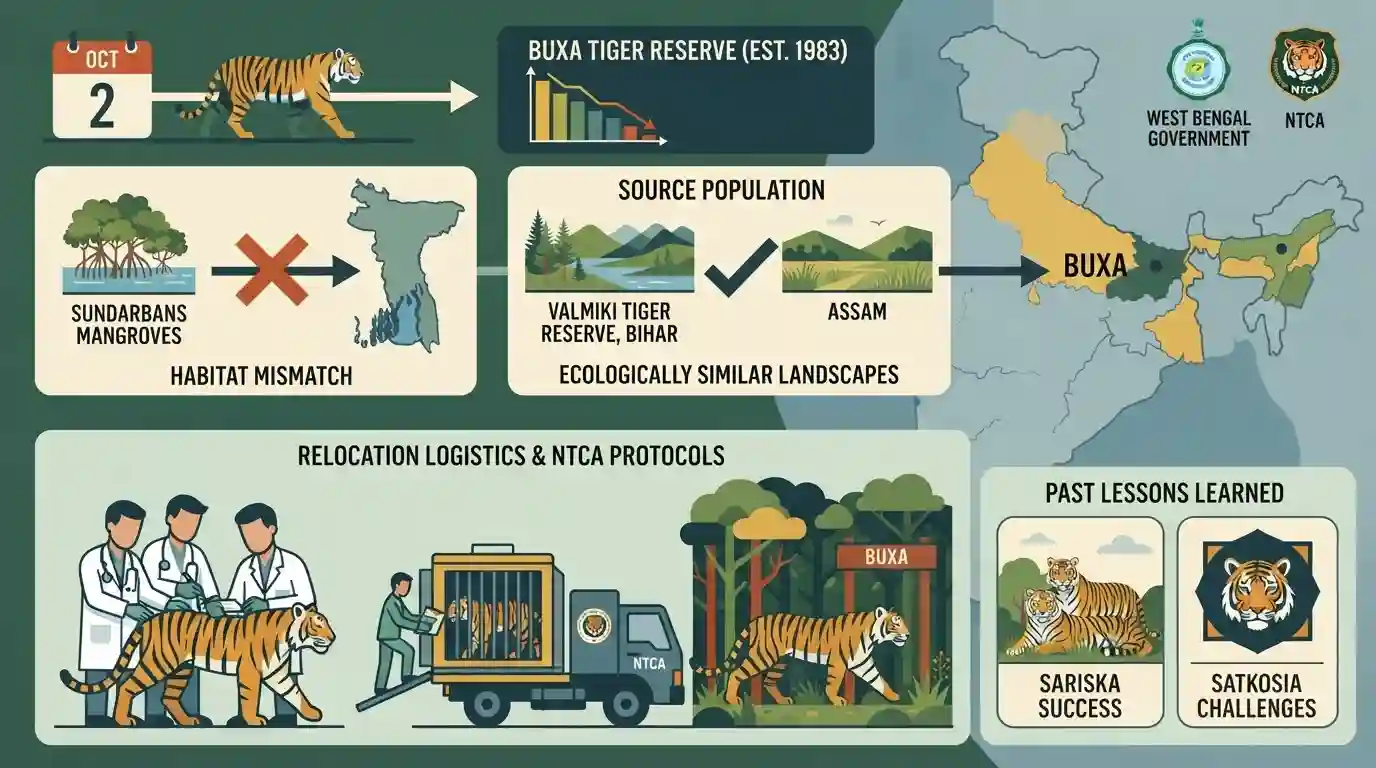
The West Bengal government and the National Tiger Conservation Authority (NTCA) are planning to reintroduce tigers to the Buxa Tiger Reserve in the Dooars region starting October 2. Buxa was designated as India's 15th tiger reserve in 1983 but has experienced a severe decline in its tiger population. Drawing on past relocation efforts such as the successful Sariska project and the challenging Satkosia attempt, the NTCA is carefully selecting source tigers. Tigers from the Sundarbans mangrove ecosystem have been ruled out due to habitat mismatches; instead, tigers from ecologically similar landscapes like Bihar's Valmiki Tiger Reserve or Assam are being considered.
Key Points
- The West Bengal government and NTCA will begin reintroducing tigers to the Buxa Tiger Reserve in North Bengal's Dooars region starting October 2.
- Buxa, declared India's 15th Tiger Reserve in 1983, has suffered from a dwindling tiger population in recent years.
- Due to landscape disparities, tigers from West Bengal's Sundarbans (a mangrove ecosystem) are considered unsuitable for relocation to Buxa.
- The plan seeks to source tigers from ecologically similar landscapes, such as Bihar's Valmiki Tiger Reserve or reserves in Assam.
- The initiative follows NTCA protocols, drawing lessons from successful relocations like Sariska (Rajasthan) and challenging ones like Satkosia (Odisha).
Important Terms
National Tiger Conservation Authority (NTCA)

A statutory body under the MoEFCC, established in 2006 by amending the Wildlife (Protection) Act, 1972. It oversees Project Tiger, approves state tiger conservation plans, and regulates tiger relocations and reserve management.
UPSC context
High yield for GS-3 (Environment) and Prelims regarding statutory bodies, environmental legislation, and wildlife conservation frameworks.
Project Tiger
A Centrally Sponsored Scheme launched in 1973 to promote tiger conservation. Supervised by the NTCA, it provides central assistance and funding support to tiger-range states for habitat protection and anti-poaching measures.
UPSC context
Fundamental for GS-3 (Biodiversity). Frequently tested in Prelims regarding its status, funding pattern, and its evolution to statutory backing.
Buxa Tiger Reserve
A protected area in West Bengal's Alipurduar district within the Dooars region, contiguous with Bhutan. Designated as India's 15th tiger reserve in 1983, it is undergoing an NTCA-backed tiger reintroduction due to severe population decline.
UPSC context
Important for GS-3 and Prelims Map-based questions regarding Tiger Reserves, their geographic locations, and transboundary ecological corridors.
Valmiki Tiger Reserve
Bihar's only tiger reserve, located in West Champaran at the Himalayan foothills. Contiguous with Nepal's Chitwan National Park, it features ecologically similar habitats to Buxa, making it a candidate source for tiger translocations.
UPSC context
Relevant for GS-3 and Prelims mapping, testing transboundary protected areas (Terai Arc Landscape) and source-sink wildlife relocation dynamics.
Sariska Tiger Reserve
A tiger reserve in Rajasthan's Aravalli Hills. After losing its tigers to poaching, it became the site of the world's first successful wild-to-wild tiger relocation project starting in 2008, serving as a conservation model.
UPSC context
Essential for GS-3 (Wildlife Conservation) to illustrate successful species recovery models and the history of wildlife relocation in India.
Satkosia Tiger Reserve
A tiger reserve in Odisha where India's first inter-state tiger relocation project (2018) was suspended. The project faced major setbacks due to severe human-wildlife conflict and local resistance, highlighting translocation complexities.
UPSC context
Critical for GS-3 to analyze the socio-ecological challenges of wildlife translocation, human-animal conflict, and community participation in conservation.
Prelims Trap
Tigers for Buxa are being sourced from the Sundarbans to maintain genetic continuity within West Bengal.
Aspirants might assume West Bengal will source tigers from its own high-density reserve, the Sundarbans. However, habitat mismatch makes this ecologically impossible.
Static Concepts Connected
What is the statutory backing and structure of the NTCA?
- Statutory backing: Established as a statutory body under the Wildlife (Protection) Act, 1972, following a 2006 amendment.
- Chairperson: Chaired by the Union Minister of Environment, Forest and Climate Change.
- Relocation mandate: Approves Tiger Conservation Plans prepared by states and lays down normative guidelines for relocations.
What are the geographical markers of Buxa, Valmiki, and Satkosia Tiger Reserves?
- Buxa (West Bengal): Located in the Dooars terai region; acts as a vital transboundary corridor linking India and Bhutan.
- Valmiki (Bihar): Situated in the Gangetic plains along the Gandak River; contiguous with Nepal's Chitwan National Park.
- Satkosia (Odisha): Located in the Eastern Ghats along a massive gorge formed by the Mahanadi River.
Cross-Topic Patterns
Habitat adaptation in wildlife relocation
Rejecting Sundarbans tigers for Buxa highlights that habitat-specific adaptations (mangroves vs. terai) are prioritized over intra-state geographic proximity to ensure translocation survival.
Transboundary conservation landscapes
Buxa (Bhutan border) and Valmiki (Nepal border) highlight the geopolitical dimension of conservation. UPSC frequently tests these international ecological corridors in geography mapping questions.

Mapping question likely in 2026: Match tiger reserves (Buxa, Valmiki, Satkosia) to their specific transboundary borders or river systems.
Linked PYQs · 3
Linked PYQs · 3
- 2022WBCS_PRELIMSGS1
The western part of Teesta river in West Bengal is called
- 2023WBCS_PRELIMSGS1
Forests having no free entry by people in India —
- 2019WBCS_PRELIMSGS1
Sundarban is declared as 'World Heritage Site' for
