Tiger Dispersal Patterns and Wildlife Corridor Protection Challenges
Source:Indian Express ↗
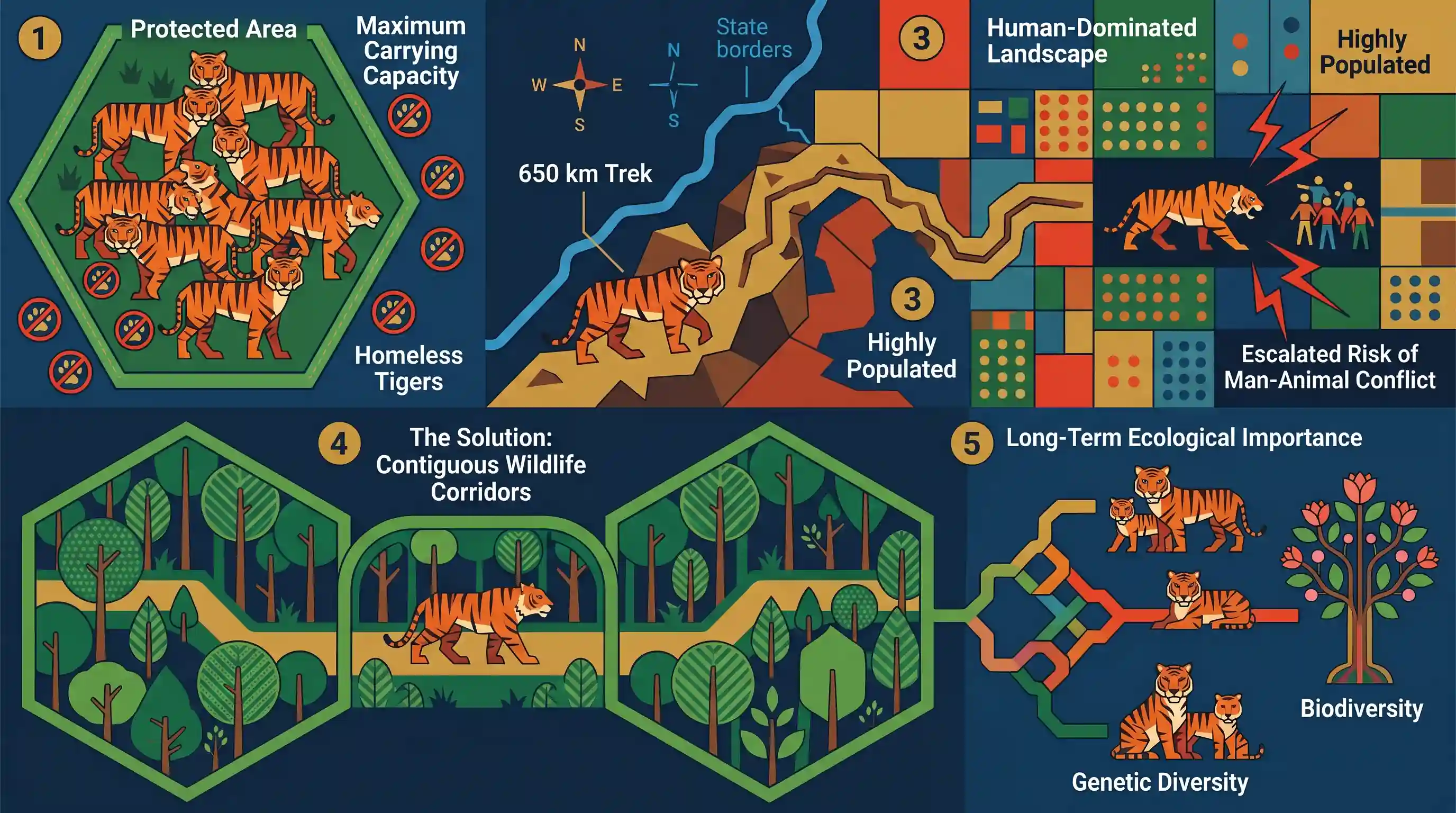
Why It Matters
Understanding the spatial dynamics of apex predators like tigers is crucial for environmental policy and conservation planning. As India's tiger population grows, questions on carrying capacity, habitat fragmentation, and mitigating man-animal conflict are increasingly relevant for both Prelims and Mains (GS3).
Summary
The recent sighting of two tigers undertaking a massive 650-km trek across state borders into Andhra Pradesh and Telangana has raised alarm among wildlife officials and local residents. As prominent tiger reserves near their maximum carrying capacity, transient "homeless" tigers are increasingly forced out of core protected zones to establish new territories. Their journey through highly populated, human-dominated landscapes drastically escalates the risk of man-animal conflict. The incident underscores the critical ecological importance of maintaining contiguous wildlife corridors to allow safe dispersal, reduce human encounters, and ensure long-term genetic diversity in India's tiger populations.
Key Points
- Two tigers have embarked on an unusual 650 km journey across multiple states, entering human-dominated landscapes in Andhra Pradesh and Telangana.
- The dispersal of tigers over such large distances is often driven by the saturation of carrying capacity in their natal tiger reserves, forcing young adults to seek new territories.
- The movement of these "homeless" tigers through non-forest areas and backyards raises significant concerns about man-animal conflict and local panic.
- This phenomenon highlights the urgent need to protect and restore wildlife corridors that facilitate safe passage and genetic exchange between fragmented tiger habitats.
Important Terms
National Tiger Conservation Authority (NTCA)

A statutory body under the MoEFCC established in 2005. It provides legal backing to Project Tiger, oversees reserve management, and conducts the four-yearly All-India Tiger Estimation.
UPSC context
GS Paper II (Statutory Bodies) and Paper III (Environment); tested for administrative oversight and conservation guidelines.
Project Tiger
Launched in 1973, this flagship Centrally Sponsored Scheme aims to ensure a viable tiger population through a core-buffer strategy. It was recently merged with Project Elephant.
UPSC context
GS Paper III (Biodiversity); relevant for flagship species conservation and species-specific protection schemes.
Wildlife (Protection) Act, 1972
India's primary legal framework for protecting wild animals, birds, and plants. It established schedules of protection and authorizes the creation of National Parks and Tiger Reserves.
UPSC context
GS Paper III (Environmental Legislation); essential for understanding legal safeguards and the recent 2022 amendments.
Wildlife Corridors
Ecological links connecting fragmented habitats to facilitate animal movement and gene flow. They are critical for preventing genetic isolation and reducing encounters with humans.
UPSC context
GS Paper III (Environment); vital for habitat connectivity and landscape-level biodiversity conservation strategies.
Carrying Capacity
The maximum population of a species an ecosystem can sustain indefinitely. Exceeding this limit leads to resource competition, forcing individuals to disperse into new territories.
UPSC context
GS Paper III (Ecology); a fundamental principle for population dynamics and resource management.
Man-Animal Conflict
Negative interactions between humans and wildlife arising from habitat loss or fragmentation. It leads to property damage, livestock loss, and threats to human lives.
UPSC context
GS Paper III (Environment); focuses on socio-economic impacts and human-wildlife coexistence challenges.
Prelims Trap
"Critical Tiger Habitats are notified directly by the Central Government via the NTCA."
Under the Wildlife (Protection) Act, 1972, Critical Tiger Habitats are notified by the State Government, not the Centre, though NTCA guidelines are followed.
Static Concepts Connected
What is the legal framework for Critical Tiger Habitats vs Buffer Zones?
- Core Area (CTH): Notified by the State Govt under WPA 1972 to be kept as inviolate areas for tiger conservation, without affecting the rights of Scheduled Tribes.
- Buffer Zone: Peripheral areas aiming to promote coexistence between wildlife and human activity, where a lesser degree of habitat protection is applied alongside regulated forestry.
What is the role and structure of the NTCA?
- Statutory Body: Established in 2006 via an amendment to the Wildlife (Protection) Act, 1972. It is chaired by the Union Environment Minister.
- Conservation Plans: It approves the Tiger Conservation Plans prepared by State Governments and ensures standards for tiger reserve management.
- M-STRIPES: Maintains monitoring software like M-STRIPES (Monitoring System for Tigers - Intensive Protection and Ecological Status) to track patrols and tiger dispersal.
Cross-Topic Patterns
Wildlife Corridors vs Linear Infrastructure
The dispersal of tigers across states often clashes with linear infrastructure. This links ecology directly to NHAI guidelines and Supreme Court mandates for eco-bridges and animal underpasses.
HWC as a State-Specific Disaster
States declaring human-wildlife conflict as a state-specific disaster under the DM Act 2005 bridges ecology with disaster management, allowing quick SDRF deployment for compensation.

Expect a multi-statement question linking tiger carrying capacity, M-STRIPES, and State powers under DM Act for human-wildlife conflict.
Linked PYQs · 3
Linked PYQs · 3
- 2020PrelimsGS1
Among the following Tiger Reserves, which one has the largest area under "Critical Tiger Habitat"?
- 2017PrelimsGS1
The term 'M-STRIPES' is sometimes seen in the news in the context of
- 2017PrelimsGS1
In India, if a species of tortoise is declared protected under Schedule I of the Wildlife (Protection) Act, 1972, what does it imply?
