Kota Wildlife Week Tiger Translocation And Sanctuary Plans
Source:theprint ↗
Why It Matters
Important for RPSC aspirants tracking wildlife reserves, tiger translocations, and environmental updates specific to Rajasthan and districts like Kota.
Summary
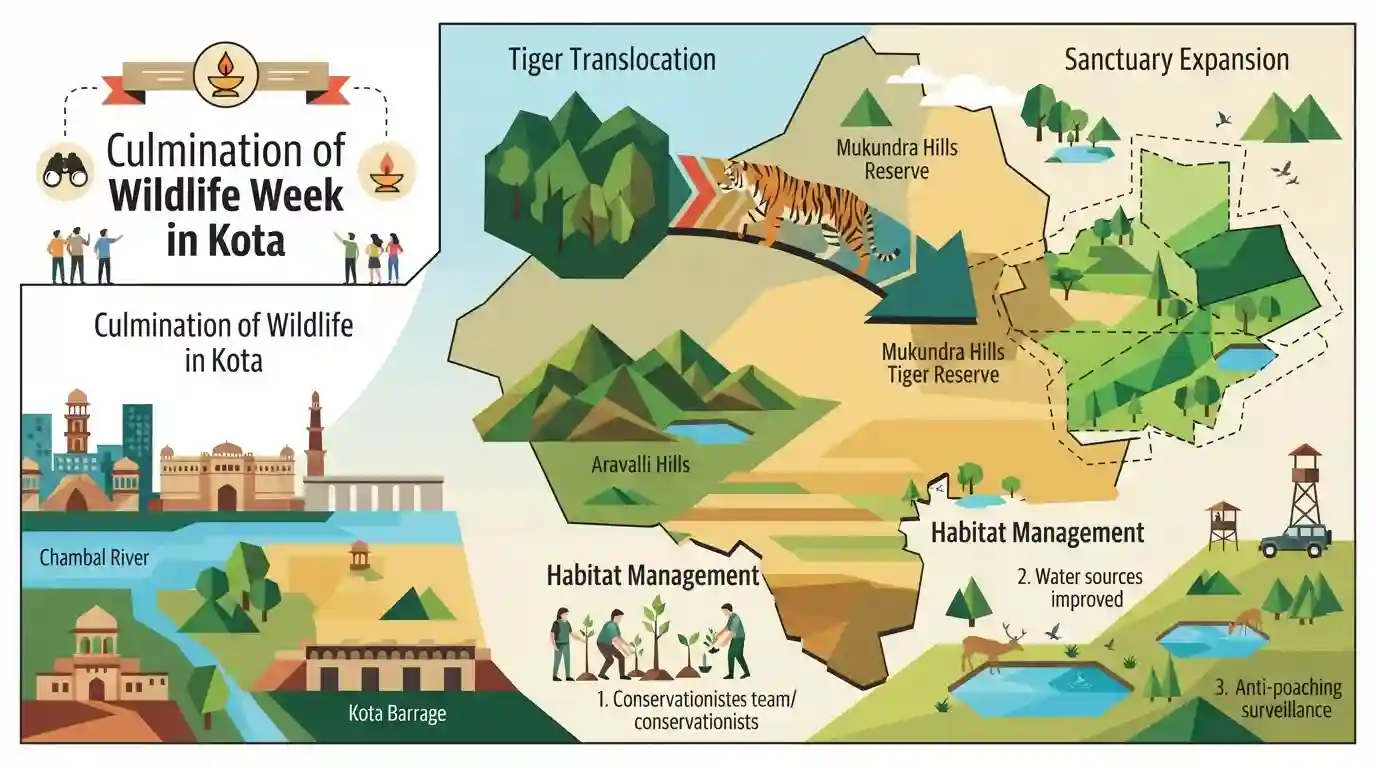
The culmination of Wildlife Week in Kota brought focus to wildlife conservation, specifically highlighting plans for tiger translocation, sanctuary expansion, and habitat management in Rajasthan's protected areas like Mukundra Hills.
Key Points
- Wildlife Week culmination events in Kota highlighted major conservation initiatives including tiger translocation plans and sanctuary expansion.
- Focus on boosting wildlife tourism and ecological protection in the Hadoti region, particularly around Mukundra Hills.
- Efforts to enhance corridors and prey base for big cats in Rajasthan to support expanding tiger populations.
Important Terms
Project Tiger

A centrally sponsored tiger conservation program launched in 1973 by the Government of India to ensure a viable population of Bengal tigers in their natural habitats.
UPSC context
Important for RPSC (Environment & Ecology, Biodiversity Conservation in Rajasthan). Tests knowledge of tiger reserves like Mukundra Hills and Sariska.
National Tiger Conservation Authority
A statutory body under the Ministry of Environment, Forest and Climate Change established in 2006 to provide statutory backing to Project Tiger and manage tiger reserves across India.
UPSC context
Important for RPSC (Environment & Ecology, Governance). Tests institutional framework for wildlife management and national conservation standards.
Forest Department Rajasthan
The state government body responsible for the protection, management, and administration of forests, wildlife sanctuaries, and tiger reserves across Rajasthan.
UPSC context
Important for RPSC (Rajasthan Administration & Geography/Environment). Tests state-level implementation of wildlife policies, sanctuaries, and translocation initiatives.
Prelims Trap
Mukundra Hills Tiger Reserve is situated exclusively within the Kota district of Rajasthan.
Aspirants often assume Mukundra Hills Tiger Reserve is located solely in Kota district, whereas its territory spans across Kota, Bundi, Chittorgarh, and Jhalawar districts.
Static Concepts Connected
What are the key tiger reserves in Rajasthan and their geographical distribution?
- Ranthambore Reserve: Ranthambore Tiger Reserve (Sawai Madhopur) is the state's oldest and most prominent tiger habitat, known for dry deciduous forests.
- Mukundra Hills: Mukundra Hills Tiger Reserve (Kota, Bundi, Chittorgarh, Jhalawar) lies in the Vindhyan range and is drained by the Chambal and Kali Sindh rivers.
- Sariska Reserve: Sariska Tiger Reserve (Alwar) is situated in the Aravalli hills, famous for its historic ruins and successful tiger reintroduction program.
- Ramgarh Vishdhari: Ramgarh Vishdhari Tiger Reserve (Bundi) serves as a vital ecological corridor linking Ranthambore and Mukundra Hills.
Cross-Topic Patterns
Tiger Translocation & Chambal River Basin Ecology
Mukundra Hills' geography as a Vindhyan extension intersected by the Chambal and Kali Sindh rivers links wildlife management directly with river basin ecosystems and irrigation projects in the Hadoti region.
Wildlife Tourism vs. Carrying Capacity in Rajasthan
Expanding tiger sanctuaries like Mukundra Hills intersects with eco-tourism policies and rural employment schemes, balancing revenue generation with ecological carrying capacity in southern Rajasthan.

Mukundra Hills tiger translocations, NTCA guidelines, and Hadoti region geography are prime candidates for a multi-statement RPSC prelims question.
Linked PYQs · 2
Linked PYQs · 2
- 2023RPSC_PRELIMSGS1
The National Tiger Conservation Authority has conferred the status of the fifth tiger sanctuary in Rajasthan, to which of the following sanctuaries?
- 2018RPSC_PRELIMSGS1
Which of the following hills are the extensions of the Vindhyan mountain ranges in Rajasthan?
