Papikondalu Wild Tiger Movement Near Polavaram Project Zone
Source:deccanchronicle ↗
Why It Matters
The incident links infrastructural developments (Polavaram Project) to environmental issues (protected area borders and human-wildlife conflict). This makes it highly relevant for APPSC Group 1 Prelims under both AP Geography (River Projects & Protected Areas) and Environmental Conservation.
Summary
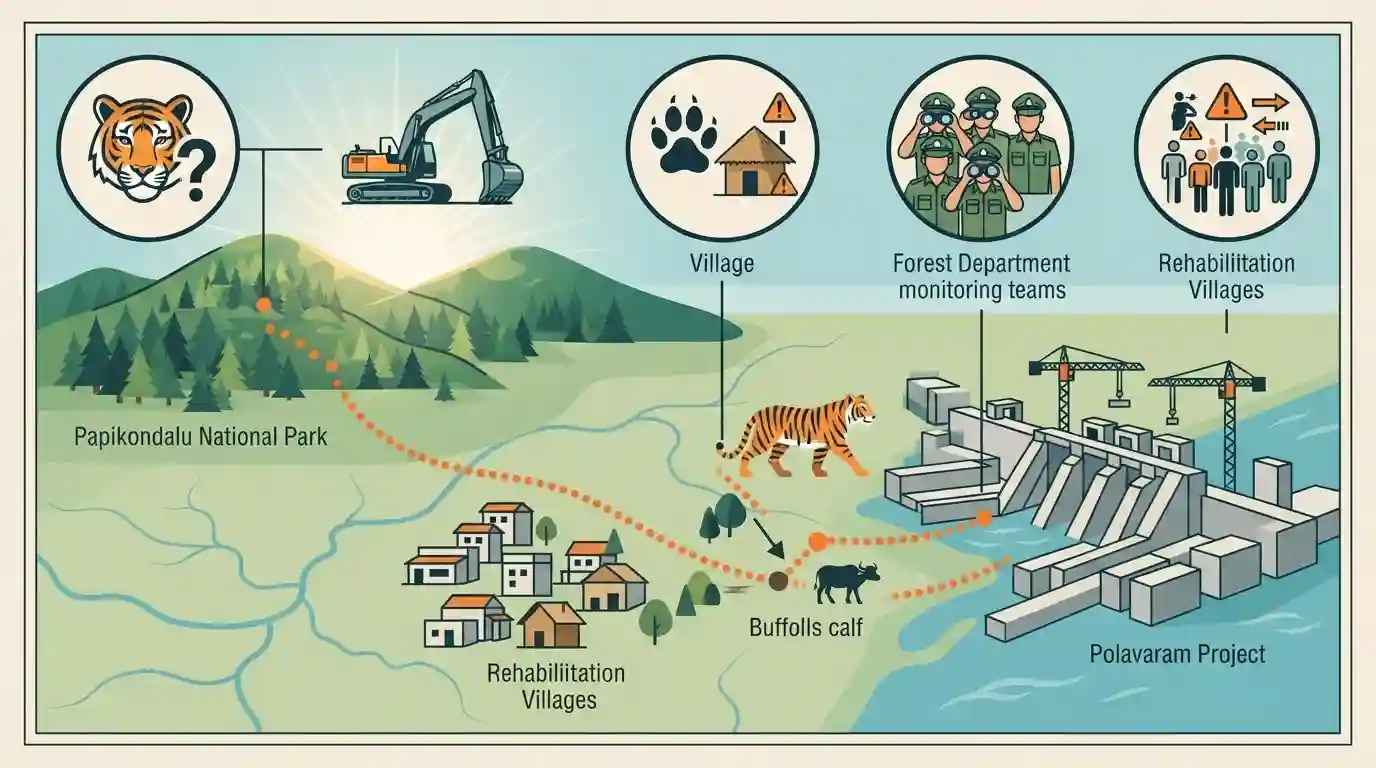
A 220–225 kg wild tiger from Papikondalu National Park (PNP) was spotted roaming near the Polavaram Project construction area and neighboring rehabilitation villages in Andhra Pradesh. After the tiger attacked a buffalo calf in Patha Devaragundi village, the AP Forest Department deployed four teams to monitor its movements. While officials state there is no immediate danger to residents, workers and villagers have been alerted to remain cautious as the animal traverses plain areas near the project site.
Key Points
- A wild tiger, weighing approximately 220–225 kg, migrated from the Papikondalu National Park (PNP) to a plain area near the Polavaram Project construction zone.
- The tiger attacked and critically injured a buffalo calf near Patha Devaragundi, a rehabilitation village, raising safety concerns among project workers and displaced communities.
- AP Forest Department officials, led by Chief Conservator of Forests T. Jyothi, have identified the tiger's pugmarks and deployed four specialized monitoring teams (35 to 40 personnel) to track its movements.
- The incident highlights the ongoing human-wildlife interface issues where infrastructure developments (such as the Polavaram multipurpose project) overlap with ecological corridors and protected forest areas.
Important Terms
Andhra Pradesh Reorganisation Act, 2014

An Act of the Indian Parliament that bifurcated the unified state of Andhra Pradesh into Telangana and the residual state of Andhra Pradesh, effective June 2, 2014.
UPSC context
Tests APPSC Group 1 (Paper II, III & IV) and Group 2 on administrative, political, and socio-economic bifurcation impacts, and water sharing.
Andhra Pradesh Forest Department
The state government department responsible for the protection, conservation, and management of forest resources, wildlife sanctuaries, national parks, and mitigation of human-wildlife conflicts in Andhra Pradesh.
UPSC context
Relevant for APPSC Group 1 Paper II and Group 2 Mains, testing state environmental governance and forest resources.
Polavaram Irrigation Project
A multi-purpose national irrigation project under construction on the Godavari River in Andhra Pradesh, designed to facilitate irrigation, drinking water, hydroelectric power, and inter-basin water transfer to the Krishna basin.
UPSC context
Tested in APPSC Group 1 & 2 Geography and Economy, focusing on AP river basins, water resource management, and bifurcation issues.
Papikondalu National Park
A national park in Andhra Pradesh covering parts of Eluru, East Godavari, and West Godavari districts, characterized by the Godavari River flowing through the picturesque Papi hills and rich biodiversity.
UPSC context
Tested in APPSC Group 1 and 2 Geography (Forests and Wildlife) and Environmental sections, focusing on protected areas.
Human-Wildlife Conflict
Negative interactions between humans and wild animals resulting in crop damage, livestock predation, or loss of life, requiring state-level management strategies like AP's Project HANUMAN.
UPSC context
Tested under environmental and geographical issues in APPSC Group 1 and Group 2, focusing on mitigation policies and biodiversity.
Prelims Trap
Polavaram Project was conceptualized and designed by Sir Arthur Cotton during the Madras Presidency.
Sir Arthur Cotton constructed the Dowleswaram Barrage. The Polavaram (initially Ramapada Sagar) Project was designed much later (1941) by Venkatakrishna Iyer and conceptualized by Sonti Venkata Ramamurthy.
Static Concepts Connected
What is the historical and technical blueprint of the Polavaram Project?
- Historical Origin: Designed in 1941 by Chief Engineer L. Venkatakrishna Iyer and conceptualized in 1942 as 'Ramapada Sagar Project' by Sir Sonti Venkata Ramamurthy.
- National Status: Declared a National Project under Section 90 of the AP Reorganisation Act, 2014, with central funding executed via the Polavaram Project Authority.
- Hydrological Capacity: Designed storage capacity is 194.6 TMC at a Full Reservoir Level (FRL) of 45.72 metres on the Godavari River.
- Inter-basin Transfer: Enables inter-basin transfer of 80 TMC of water to the Krishna River Basin through the Right Main Canal.
What are the geographical and ecological markers of Papikondalu National Park?
- Legal Evolution: Declared a Wildlife Sanctuary in 1978 and upgraded to a National Park in 2008, spanning over 1,012 sq km.
- Terrain & River: Located in the Eastern Ghats (East and West Godavari/Eluru districts), where the Godavari River carves a narrow, scenic gorge.
- Flora Profile: Dominated by Tropical Moist Deciduous and Dry Deciduous species (Teak, Bamboo, Terminalia) along with unique Riparian vegetation.
Cross-Topic Patterns
Infrastructure vs. Eastern Ghats corridors
Linear infrastructure projects like Polavaram disrupt contiguous forest corridors in the Eastern Ghats, driving human-wildlife conflict as tigers disperse into rehabilitation villages.
Submergence, tribal rights, and ecology
Polavaram's reservoir submergence overlaps with Fifth Schedule tribal areas and Papikondalu's eco-sensitive zones, linking forest rights (FRA 2006) to conservation challenges.

AP Reorganisation Act Sec 90 (Polavaram) and Papikondalu's ecological profile are prime for multi-statement APPSC geography MCQs.
Linked PYQs · 3
Linked PYQs · 3
- 2023APPSC_PRELIMSGS1
Polavaram Project is a
- 2024APPSC_PRELIMSGS1
Match the following : | List-I (Wildlife Sanctuary in Andhra Pradesh) | List-II (Region) | |---|---| | A. Coringa | I. Kurnool | | B. Gundla Brahmeswaram | II. Kadapa | | C. Rollapadu | III. East Godavari | | D. Sri Lankamalleswara | IV. Kurnool and Prakasam | Choose the correct answer using the codes given below : Code: A B C D
- 2023APPSC_PRELIMSGS1
Apex Council of Godavari and Krishna river water resources and their management consists of
