Binsar Wildlife Sanctuary Tiger Sighting and High Altitude Migration
Source:indiatimes ↗
Why It Matters
The article is highly relevant for UKPSC prelims as it touches upon specific geographical locations (Binsar Wildlife Sanctuary, Sunderdhunga Glacier) and regional districts (Almora, Bageshwar) frequently mapped in matching questions. It also highlights the ecological shift of tigers moving to higher Himalayan altitudes, a critical issue for wildlife conservation and climate change discussions.
Summary
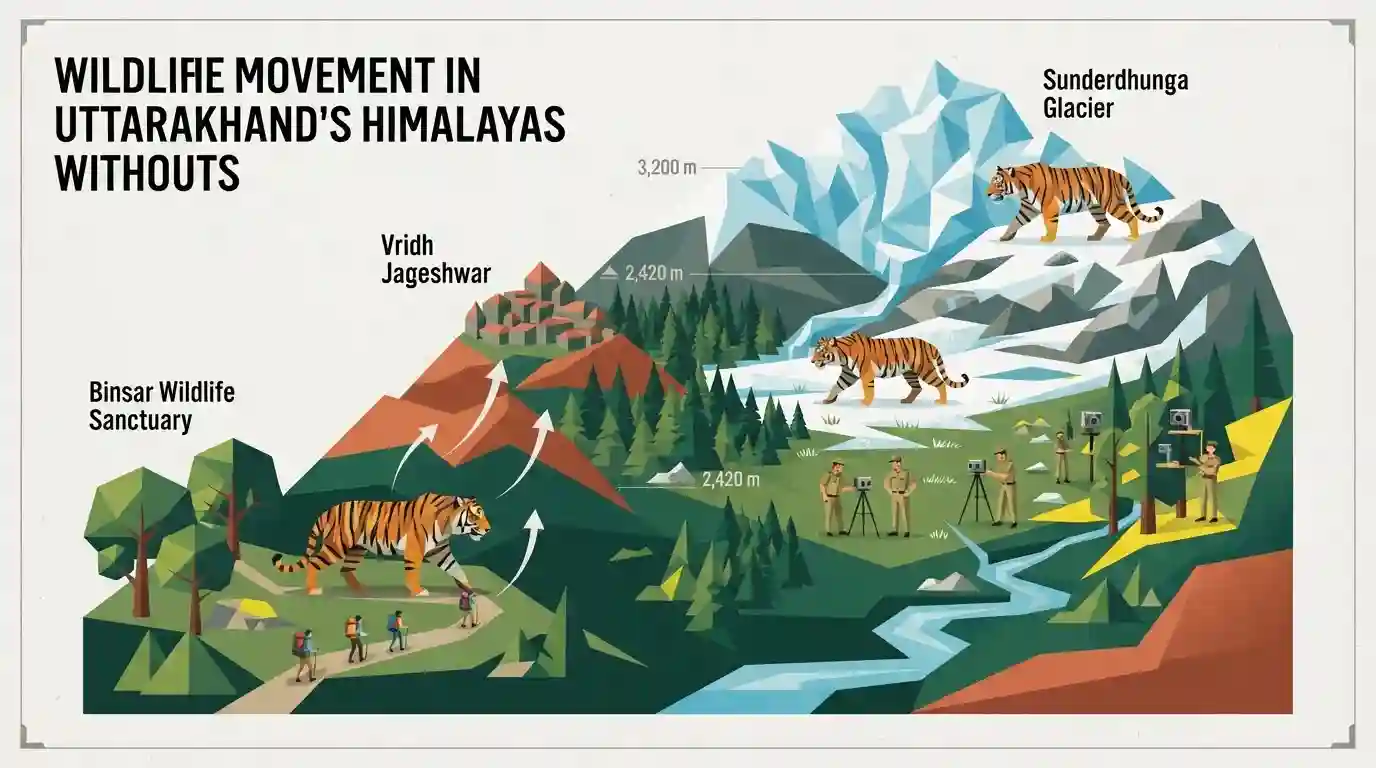
A tiger was sighted by tourists on the trekking route between Binsar Wildlife Sanctuary and Vridh Jageshwar in Almora district, prompting forest officials to issue alerts to surrounding villages. The sighting at an altitude of approximately 2,420 meters reinforces recent observations of tigers migrating to higher elevations in the Himalayas, such as a recent sighting near the Sunderdhunga Glacier in Bageshwar at 3,200 meters. Officials are deploying staff and trap cameras to track the animal's movement and ensure safety.
Key Points
- A tiger was spotted by tourists on the 3.5 km trek route connecting Binsar Wildlife Sanctuary to Vridh Jageshwar in Uttarakhand's Almora district.
- The sighting occurred at a relatively high altitude of approximately 2,420 meters, part of an increasing trend of tigers moving to higher Himalayan elevations.
- The Civil Soyam forest division has issued an alert to local villages and requested trap cameras from the Almora DFO to monitor the tiger's movement.
- This incident follows another recent high-altitude tiger sighting in the Sunderdhunga Glacier area (Bageshwar district) at an elevation of 3,200 meters.
Important Terms
Binsar Wildlife Sanctuary

A protected area in Uttarakhand's Almora district within the Kumaon Himalayas. Characterized by dense oak and rhododendron forests, it provides crucial high-altitude habitat for species like leopards, Himalayan black bears, and a diverse avian population.
UPSC context
Relevant for GS-3 Environment; frequently tested in map-based questions concerning Indian protected areas and unique Himalayan ecosystems.
Sunderdhunga Glacier
A major Himalayan glacier situated in Uttarakhand's Bageshwar district, west of the Pindari glacier. Meaning 'valley of beautiful stones,' it is located at a high elevation and increasingly recognized as a site for high-altitude wildlife sightings.
UPSC context
Important for GS-1 Geography and GS-3 Environment, highlighting topics of Himalayan glacial geography and climate-induced habitat shifts.
Civil Soyam Forests
Unclassed community forests in Uttarakhand managed primarily by the Revenue Department and local village councils (Van Panchayats). They are decentralized reserves utilized sustainably to meet local community needs for fodder, fuelwood, and minor forest produce.
UPSC context
Tests GS-3 Environment and GS-2 Governance, focusing on community forest management, administrative classification, and decentralized resource rights.
Altitudinal Range Shift
The ecological phenomenon where species, such as tigers, migrate to progressively higher elevations. In the Himalayas, this upward shift is primarily driven by global warming, habitat fragmentation in plains, and changing prey availability.
UPSC context
Crucial for GS-3 Environment, illustrating the direct impacts of climate change on biodiversity and emerging challenges in wildlife conservation.
Prelims Trap
"Bengal tigers are entirely restricted to lowland Terai ecosystems and cannot survive above 2,500 meters."
While traditionally lowland species, tigers are increasingly recorded above 3,000m in the Himalayas (e.g., Sunderdhunga) due to climate warming, shifting prey, and habitat saturation.
Static Concepts Connected
What are the key ecological and historical features of Binsar Wildlife Sanctuary?
- Location & History: Located in the Kumaon Himalayas of Uttarakhand; it historically served as the summer capital of the Chand Dynasty rulers.
- Core Vegetation: Established primarily in 1988 to protect and conserve the region's rapidly shrinking mid-altitude broad-leaf oak (Quercus) forests.
What drives the altitudinal migration (range shift) of wildlife in mountain ecosystems?
- Climate Warming: Rising global temperatures push thermal isotherms higher, forcing temperature-sensitive species upward to remain in their optimal climate envelope.
- Prey Base Shifts: Herbivores follow shifting vegetation patterns and tree lines, compelling apex predators like tigers to track their moving prey base.
- Habitat Saturation: Successful conservation leading to rising tiger populations in lowland reserves (like Corbett) forces spillover individuals to seek new high-altitude territories.
Cross-Topic Patterns
Altitudinal range shifts & phenology
The upward migration of tigers closely mirrors changing Himalayan flora dynamics, such as shifting tree lines and early blooming of rhododendrons, driven by global warming.
Historical heritage in Protected Areas
UPSC frequently merges history with geography. Binsar’s dual identity—a modern oak-conservation sanctuary and the historic summer capital of Kumaon's Chand Dynasty—is ripe for hybrid matching questions.

Climate-induced altitudinal migration of flagship species, mapped against Himalayan glaciers (like Sunderdhunga), is a high-probability 2026 Prelims target.
Linked PYQs · 4
Linked PYQs · 4
- 2025UKPSC_PRELIMSGS1
Match List - I with List - II and select the correct answer from the codes given below : | List - I (Wild Life Sanctuary) | List - II (Location) | |---|---| | A. Askot Wild Life Sanctuary | 1. Uttarkashi | | B. Binsar Wild Life Sanctuary | 2. Nainital | | C. Govind Wild Life Sanctuary | 3. Almora | | D. Nandhaur Wild Life Sanctuary | 4. Pithoragarh | Codes :
- 2024UKPSC_PRELIMSGS1
Which of the following pairs is not correctly matched ?
- 2024UKPSC_PRELIMSGS1
Which of the following National Park of Uttarakhand has been included in Project Tiger Scheme in 2015 ?
- 2024UKPSC_PRELIMSGS1
'Untadhura Pass' is situated near which one of the following glaciers of Uttarakhand ?
