Sariska Tiger Reserve and Species Reintroduction Challenges
Source:Indian Express ↗
हे का महत्त्वाचे आहे
Tiger reintroduction programs like the one in Sariska serve as crucial case studies for biodiversity conservation, wildlife management, and the success of legislative frameworks like Project Tiger and the Wildlife (Protection) Act.
सारांश
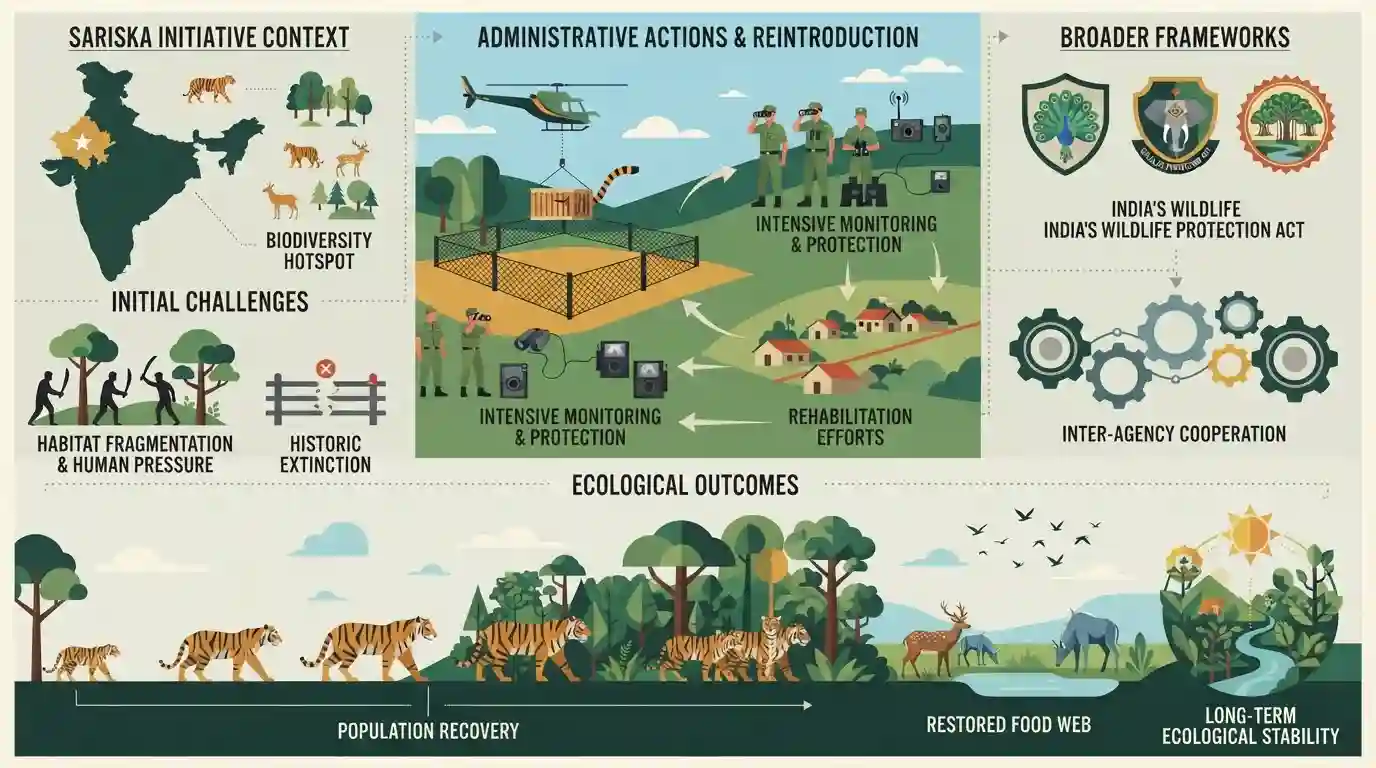
An overview of the tiger reintroduction initiative at Sariska Tiger Reserve, highlighting conservation challenges, administrative actions, and ecological outcomes under India's broader wildlife protection frameworks.
मुख्य मुद्दे
- Sariska Tiger Reserve witnessed historic tiger reintroduction efforts after local extinction due to poaching.
- The article discusses the government initiatives, milestones, and challenges involved in managing and monitoring tiger reintroduction programs in reserves like Sariska.
- Such conservation milestones underscore the role of institutional bodies like the NTCA in reviving apex predator populations.
महत्त्वाच्या संज्ञा
Project Tiger

A centrally sponsored conservation scheme launched in 1973 by the Government of India to ensure a viable tiger population and protect its natural habitats.
UPSC context
GS Paper III (Environment and Ecology) — tests understanding of flagship species conservation, wildlife schemes, and biodiversity management in India.
Wildlife (Protection) Act 1972
India's foundational legislation providing the legal framework for the protection of wild animals, birds, and plants, and establishing national parks and wildlife sanctuaries.
UPSC context
GS Paper III (Environment and Ecology) — core legal framework for protected areas, wildlife crimes, and species protection schedules.
National Tiger Conservation Authority (NTCA)
A statutory body established under the Wildlife (Protection) Act, 1972 (via 2006 amendment) to provide overarching oversight and management for tiger conservation across India.
UPSC context
GS Paper III (Environment and Ecology) — important regulatory body; tests institutional framework for tiger reserves and conservation policies.
Sariska Tiger Reserve
A prominent tiger reserve located in Rajasthan's Alwar district that made history in 2008 by becoming India's first site for successful tiger reintroduction after a local extinction.
UPSC context
GS Paper III (Environment and Ecology) — case study on wildlife relocation, habitat management, and protected area conservation failures and successes.
पूर्वपरीक्षा सापळा
The National Tiger Conservation Authority is a statutory body established under the original Wildlife (Protection) Act, 1972.
Aspirants often assume NTCA was established directly by the original 1972 Wildlife Protection Act, whereas it was added via the 2006 amendment specifically catalyzed by the Sariska tiger crisis.
संबंधित स्थिर संकल्पना
What are the composition, mandate, and statutory powers of the National Tiger Conservation Authority (NTCA)?
- Statutory Body: Statutory Basis: Established in December 2006 following the recommendation of the Tiger Task Force, by amending the Wildlife (Protection) Act, 1972.
- Composition: Chairmanship: Chaired by the Minister for Environment, Forest and Climate Change, with the Minister of State as Vice-Chairperson.
- Mandate: Core Mandate: Approving tiger conservation plans, providing statutory backing to Project Tiger, ensuring normative standards, and addressing livelihood concerns of local people.
- Regulatory Powers: Powers: Can lay down management standards, direct states to eliminate anthropogenic pressures, and oversee translocation and reintroduction operations.
आंतर-विषय नमुने
NTCA Statutory Evolution + Wildlife Governance
The establishment of NTCA in 2006 directly followed the Sariska tiger extinction crisis, altering cooperative federalism in wildlife governance by empowering a central statutory authority over state forest departments.
Tiger Translocation Protocols + Project Cheetah
Translocation protocols tested at Sariska set precedents for subsequent mega-fauna reintroductions like Project Cheetah, blending landscape ecology with intensive radio-collaring and village relocation strategies.

NTCA statutory powers, Schedule I protections, and historical context of Sariska's extinction/reintroduction form a high-yield Prelims target.
संबंधित PYQ · 3
संबंधित PYQ · 3
- 2017PrelimsGS1
In India, if a species of tortoise is declared protected under Schedule I of the Wildlife (Protection) Act, 1972, what does it imply?
- 2026PrelimsGS1
With reference to Madhav National Park, which of the following statements is/are correct ? 1. It was declared a Tiger Reserve in India in 2025. 2. Sakhya Sagar, which is designated as a Ramsar Site, is situated within this National Park. 3. Its area is shared between Madhya Pradesh and Rajasthan. Select the answer using the code given below :
- 2012PrelimsGS1
Consider the following protected areas: 1. Bandipur 2. Bhitarkanika 3. Manas 4. Sunderbans Which of the above are declared Tiger Reserves?
