Madhya Pradesh Tiger Count Projected To Cross Thousand In New Census
Source:deccan-chronicle ↗
Why It Matters
Madhya Pradesh's wildlife statistics are highly relevant for the MPPSC Prelims, as candidates are often tested on the state's national parks, wildlife reserves, and conservation tags (e.g., Tiger State, Leopard State). Understanding the conservation success and associated challenges like human-wildlife conflict at Ratapani is crucial for environment-related questions.
Summary
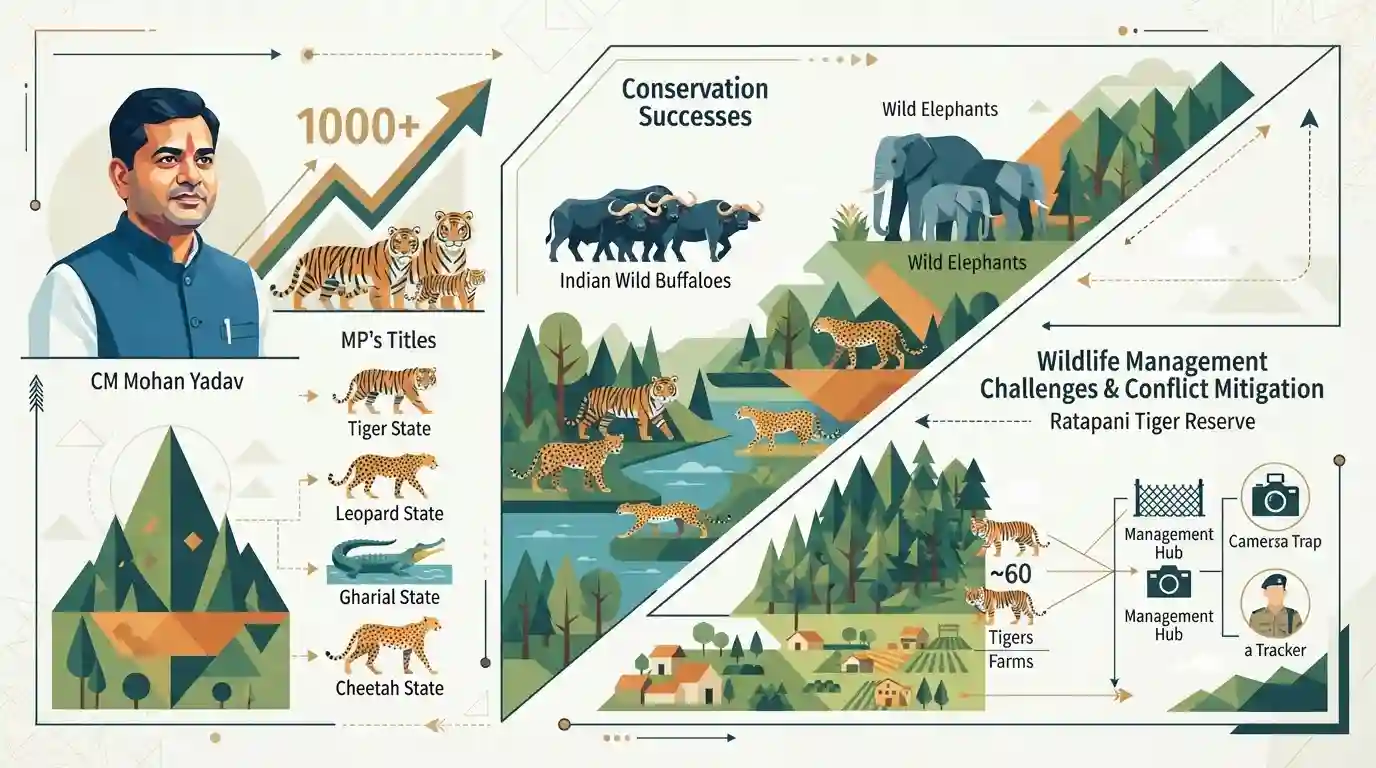
Madhya Pradesh Chief Minister Mohan Yadav has projected that the state's tiger population will exceed 1,000 in the upcoming wildlife census, reinforcing its 'Tiger State' status. Alongside tigers, MP also proudly holds the titles of 'Leopard State', 'Gharial State', and 'Cheetah State'. The article highlights the state's conservation successes, including the return of wild elephants and reintroduction of wild buffaloes, while noting challenges at the Ratapani Tiger Reserve, where the presence of around 60 tigers near human habitats requires careful wildlife management to mitigate conflicts.
Key Points
- Chief Minister Mohan Yadav announced that Madhya Pradesh's tiger population is projected to cross the 1,000 mark in the next census (final report due July 2027).
- Madhya Pradesh currently holds the statuses of 'Tiger State', 'Leopard State', 'Gharial State', and 'Cheetah State', leading the country in these wildlife populations.
- Ratapani Tiger Reserve near Bhopal is dealing with unique challenges, as it houses around 60 tigers and borders human settlements, increasing the risk of human-wildlife conflict.
- MP is also witnessing the natural return of wild elephants and the reintroduction of wild buffaloes to its forests.
Important Terms
Tiger State

An unofficial designation for the Indian state with the highest tiger population according to the All India Tiger Estimation. Madhya Pradesh holds this title, recording 785 tigers in 2022, with projections exceeding 1,000 soon.
UPSC context
Relevant for GS-3 (Environment) and Prelims. Highlights successful state-level wildlife management and biodiversity conservation.
Ratapani Tiger Reserve
India's 57th tiger reserve, designated in 2024 in Madhya Pradesh's Raisen district. Uniquely located near Bhopal's urban fringe, it supports "City Tigers" and encompasses the UNESCO World Heritage site of Bhimbetka Rock Shelters.
UPSC context
Highly testable in Prelims (Geography/Environment). Covers protected areas mapping, urban-wildlife interfaces, and cultural heritage overlaps.
All India Tiger Estimation
A quadrennial scientific census conducted by the NTCA to assess India's tiger population, co-predators, and prey. The 2022 cycle recorded Madhya Pradesh as the top state, with the next cycle expected to conclude in 2027.
UPSC context
Crucial for GS-3. Tests knowledge of environmental monitoring frameworks, NTCA's role, and flagship species conservation data.
Human-Wildlife Conflict
The adverse interaction between humans and wild animals, such as tigers venturing into urban peripheries. Managing this interface around reserves like Ratapani is essential for preventing casualties, protecting livelihoods, and ensuring species survival.
UPSC context
Core GS-3 Environment topic. Often tested in Mains regarding habitat fragmentation, carrying capacity, and community-led conservation strategies.
Project Tiger
A landmark Centrally Sponsored Scheme launched in 1973 to ensure viable tiger populations in their natural habitats. It establishes and funds Tiger Reserves across India, administered by the National Tiger Conservation Authority (NTCA).
UPSC context
Foundational GS-3 concept. Tests knowledge of the umbrella species approach, environmental legislation, and the evolution of India's conservation network.
Prelims Trap
The UNESCO World Heritage Site of Bhimbetka Rock Shelters is located within the Satpura Tiger Reserve.
Bhimbetka lies within the newly notified Ratapani Tiger Reserve/Wildlife Sanctuary, not Satpura or Madhav, which are different protected areas in MP.
Static Concepts Connected
What are the key attributes of the Asiatic Wild Water Buffalo?
- Conservation Status: Classified as 'Endangered' on the IUCN Red List and protected under Schedule I of the Wildlife Protection Act, 1972.
- Habitat Range: Prefers wet grasslands, swamps, and alluvial floodplains; key populations persist in Northeast India, particularly Assam.
- Primary Threats: Interbreeding with domestic buffaloes, habitat degradation, and transmission of diseases from domestic livestock.
What is the ecological significance of the National Chambal Sanctuary?
- Tri-State Jurisdiction: Administered as a tri-state protected area shared by Rajasthan, Madhya Pradesh, and Uttar Pradesh.
- Key Species: Hosts the critically endangered Gharial, endangered Red-crowned roofed turtle, and the endangered Ganges River Dolphin.
- Conservation Focus: Protected riverine habitat critical for conserving over 80% of India's wild gharial population.
Cross-Topic Patterns
Translocation and environmental federalism
Moving wild water buffaloes from Assam to MP highlights how interstate federal coordination is essential for long-distance wildlife recovery programs under the Wildlife Protection Act.
Prehistoric archaeology meets modern conservation
Co-locating Bhimbetka rock shelters within Ratapani Tiger Reserve intersects Archaeological Survey of India (ASI) protection with National Tiger Conservation Authority (NTCA) security protocols.

The intersection of newly notified Tiger Reserves (Ratapani) with UNESCO heritage sites is highly likely to feature in UPSC Prelims.
Linked PYQs · 1
Linked PYQs · 1
- 2021MPPSC_PRELIMSGS1
Corbett Tiger Reserve is located in which Indian State?
