Bandipur Tiger Reserve Human Wildlife Conflict Realities
Source:Indian Express ↗
Why It Matters
Human-wildlife conflict is a critical challenge in India's conservation efforts. This article highlights the ground realities and dangers faced by frontline forest staff, and brings focus to the geographical and ecological significance of the Bandipur and Nagarahole Tiger Reserves, which frequently feature in UPSC Geography and Environment mapping questions.
Summary
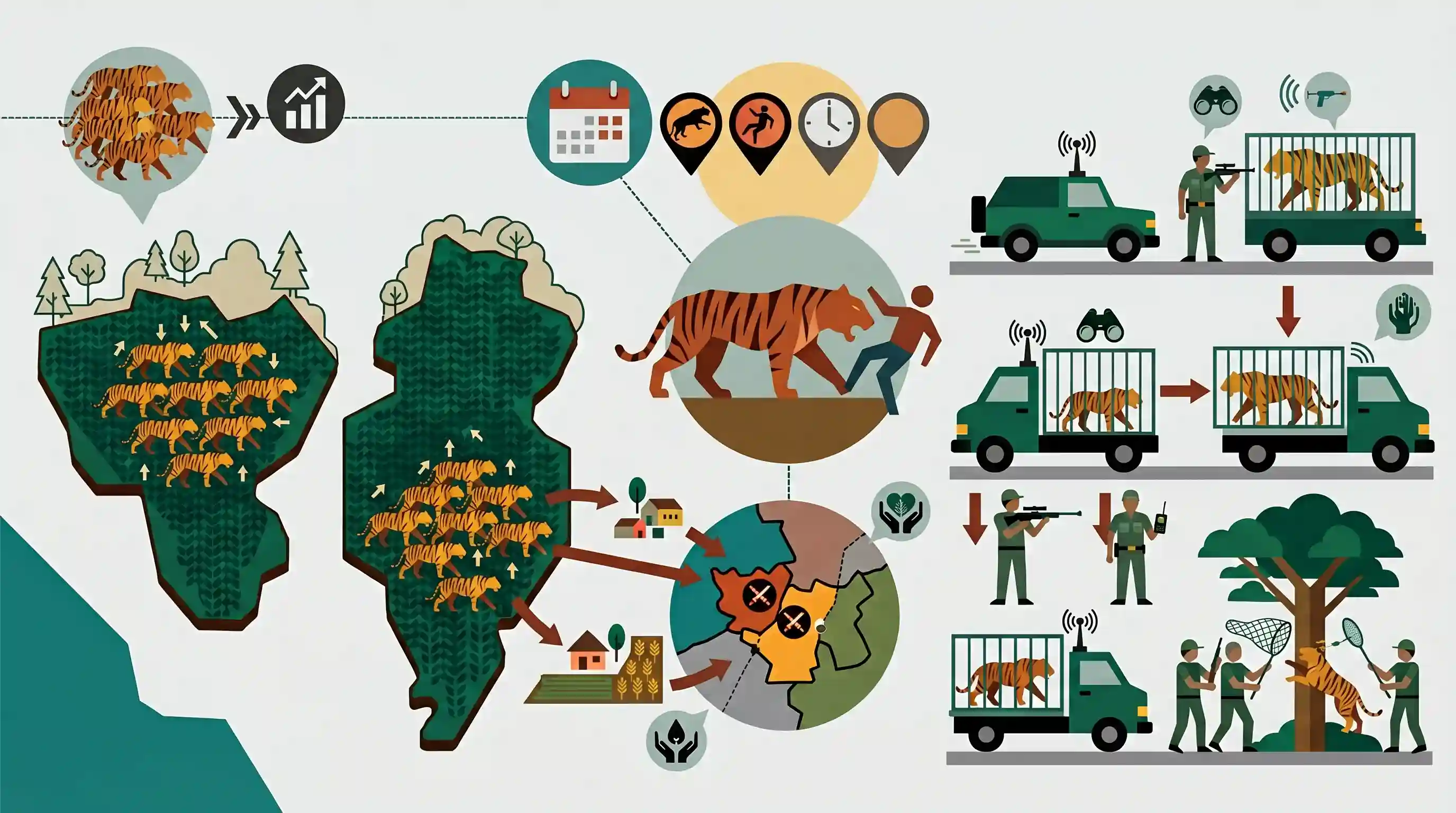
A tragic incident at the Bandipur Tiger Reserve (BTR) in Karnataka saw a forest watcher killed by a tiger, bringing the death toll from tiger attacks in the Bandipur and adjacent Nagarahole regions to four in the past two months. The attacks underscore the growing human-wildlife conflict driven by high tiger population densities—with Bandipur housing an estimated 150-190 tigers and Nagarahole around 149. The Karnataka forest department is conducting operations to capture the man-eating tigers to prevent further casualties.
Key Points
- A forest watcher at an Anti-Poaching Camp in Bandipur Tiger Reserve, Karnataka, was mauled to death by a tiger.
- This marks the fourth fatal tiger attack in the Bandipur and adjacent Nagarahole Tiger Reserve region over the past two months, highlighting escalating human-wildlife conflict.
- Bandipur Tiger Reserve is home to an estimated 150-190 tigers, while Nagarahole hosts around 149 tigers, leading to space constraints and increased encounters with humans.
- The forest department has initiated operations to trace and capture the problem tigers involved in these attacks.
Important Terms
Bandipur Tiger Reserve (BTR)

A premier tiger reserve in Karnataka, established in 1973 under Project Tiger. Part of the Nilgiri Biosphere Reserve, it hosts significant tiger and elephant populations at the Western-Eastern Ghats confluence.
UPSC context
GS Paper 3 (Environment); frequently tested under protected areas, biodiversity hotspots, and conservation history.
Nagarahole Tiger Reserve (NTR)
Also known as Rajiv Gandhi National Park, this Karnataka reserve is part of the Nilgiri Biosphere Reserve. It is contiguous with Bandipur and Wayanad, renowned for high tiger density.
UPSC context
GS Paper 3 (Environment); significant for mapping protected areas and studying wildlife corridor connectivity.
Human-Wildlife Conflict (HWC)
Interactions between humans and wildlife resulting in negative impacts like loss of life, crops, or property. It is driven by habitat fragmentation, high animal densities, and human encroachment into forests.
UPSC context
GS Paper 3 (Environment); a critical Mains topic regarding mitigation strategies, compensation policies, and legal frameworks.
Anti-Poaching Camp (APC)
Strategically located field stations within forest reserves used by frontline guards for 24/7 patrolling, wildlife monitoring, and preventing illegal activities such as poaching and encroachment.
UPSC context
GS Paper 3 (Environment/Security); relates to grassroots conservation infrastructure and the welfare of frontline forest staff.
National Tiger Conservation Authority (NTCA)
A statutory body under the Ministry of Environment, Forest and Climate Change (MoEFCC) responsible for tiger conservation. It issues Standard Operating Procedures (SOPs) for managing man-eaters and tiger reserves.
UPSC context
GS Paper 3 (Institutions); the apex body for implementing Project Tiger and overseeing tiger census operations.
Chief Wildlife Warden (CWLW)
The senior-most wildlife officer in a state, authorized under the Wildlife (Protection) Act, 1972, to grant permission for capturing or eliminating animals declared dangerous to human life.
UPSC context
GS Paper 2 & 3; crucial for understanding administrative authority and the Wildlife (Protection) Act, 1972.
Nilgiri Biosphere Reserve
India's first biosphere reserve (est. 1986), spanning Karnataka, Tamil Nadu, and Kerala. It encompasses several tiger reserves and is recognized by UNESCO for its rich biodiversity and endemic species.
UPSC context
GS Paper 3 (Biodiversity); important for biogeography, international conservation status, and tribal habitats.
Prelims Trap
The NTCA has the statutory power to declare a tiger a 'man-eater' and order its elimination in India.
Under Section 11 of the Wildlife Protection Act, 1972, only the State's Chief Wildlife Warden can permit hunting or eliminating a Schedule I animal dangerous to humans.
Static Concepts Connected
What comprises the contiguous tiger landscape of the Nilgiri Biosphere Reserve?
- Karnataka: Includes Bandipur and Nagarahole Tiger Reserves. They are separated from each other by the Kabini river, a tributary of the Cauvery.
- Tamil Nadu: Includes Mudumalai Tiger Reserve and Mukurthi National Park, directly bordering the Karnataka reserves.
- Kerala: Includes Wayanad Wildlife Sanctuary and Silent Valley National Park, completing the tri-state contiguous forested landscape.
Under what conditions can Schedule I animals be hunted under WPA, 1972?
- Statutory authority: Only the Chief Wildlife Warden (CWLW) of the state can issue a written order to hunt a Schedule I animal.
- Danger to humans: The CWLW must be satisfied that the animal has become a danger to human life or is disabled/diseased beyond recovery.
- Capture as priority: The law mandates prioritizing capture, tranquilization, or translocation. Elimination is the absolute last resort when capture fails.
Cross-Topic Patterns
Conservation success vs Carrying capacity
The 'spill-over effect' occurs when successful conservation pushes tiger populations beyond a reserve's ecological carrying capacity, forcing surplus tigers into human-dominated fringes and triggering conflict.
Relocation from Critical Tiger Habitats
To mitigate conflicts and secure breeding grounds, NTCA mandates voluntary, compensated relocation of human settlements from core 'Critical Tiger Habitats', an ongoing challenge alongside the Forest Rights Act.

Expect a multi-statement question mapping Kabini River to Bandipur/Nagarahole, paired with the CWLW's hunting powers under WPA 1972.
Linked PYQs · 2
Linked PYQs · 2
- 2020PrelimsGS1
Which of the following Protected Areas are located in Cauvery basin ? 1. Nagarhole National Park 2. Papikonda National Park 3. Sathyamangalam Tiger Reserve 4. Wayanad Wildlife Sanctuary Select the correct answer using the code given below:
- 2017PrelimsGS1
From the ecological point of view, which one of the following assumes importance in being a good link between the Eastern Ghats and the Western Ghats?
