Bandhavgarh Tiger Reserve Wildlife Dynamics and Elephant Habitat
Source:freepressjournal ↗
Why It Matters
Questions on National Parks, Tiger Reserves, and specific wildlife species (like tigers, elephants, and gaurs) in Madhya Pradesh are highly frequent in the MPPSC Prelims examination. Recognizing the changing ecological dynamics, such as elephants making Bandhavgarh a permanent habitat, is crucial for environment and geography segments.
Summary
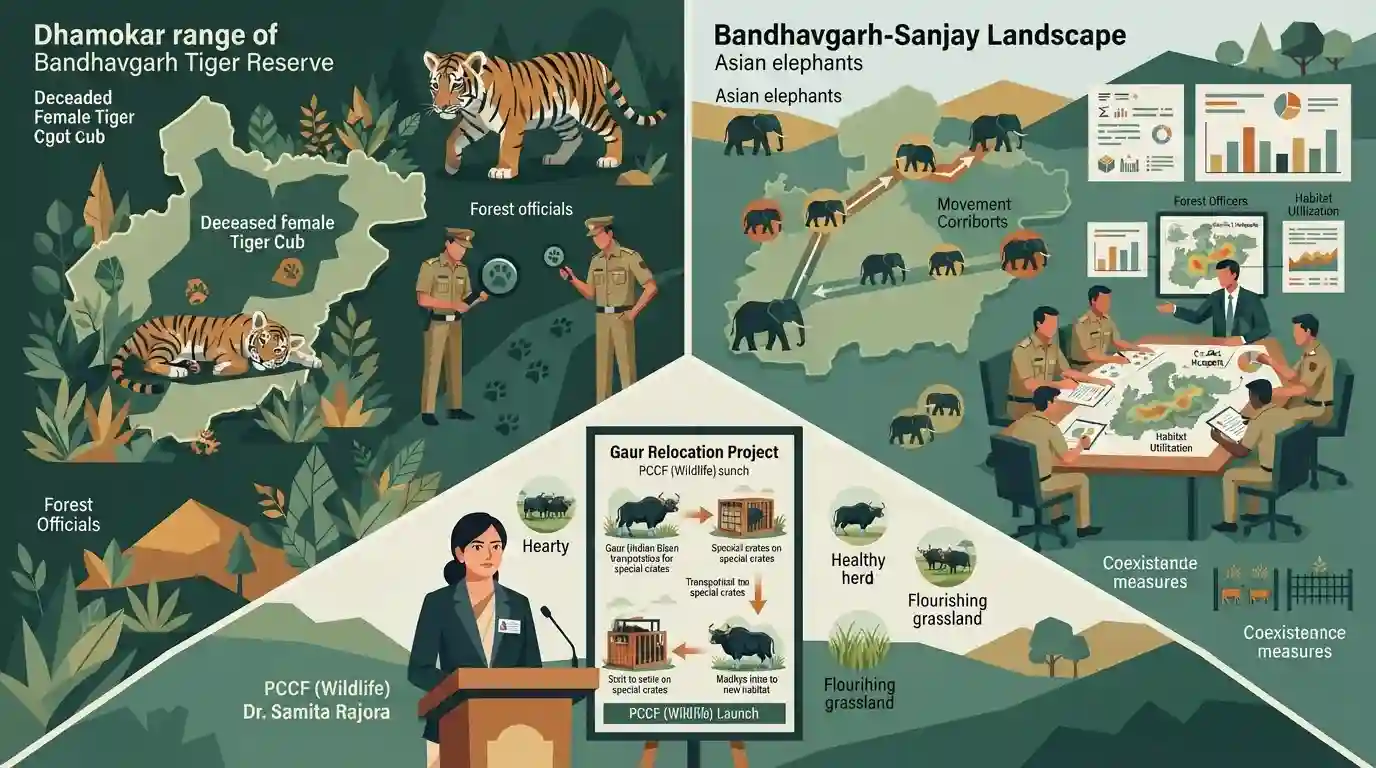
A female tiger cub was found dead in the Dhamokar range of Bandhavgarh Tiger Reserve, Madhya Pradesh. Forest officials suspect the cub was killed by an adult tiger in a territorial dispute. Concurrently, a workshop assessing elephant corridors, habitat utilization, and conflict hotspots was organized for the Bandhavgarh-Sanjay landscape, highlighting that Asian elephants have made the reserve their permanent habitat since 2018. Additionally, a poster on the Gaur relocation project was launched by PCCF (Wildlife) Dr. Samita Rajora, underscoring ongoing wildlife conservation efforts in the state.
Key Points
- A female tiger cub was found dead in the Dhamokar range of Bandhavgarh Tiger Reserve, suspected to be the victim of a territorial attack by an adult tiger.
- Bandhavgarh has increasingly become a permanent habitat for Asian elephants since 2018, leading to new dynamics in the region's wildlife ecology.
- A workshop on assessing elephant corridors and human-wildlife conflict hotspots in the Bandhavgarh-Sanjay landscape was conducted by the forest department.
- A poster detailing the Gaur (Indian Bison) relocation project in Madhya Pradesh was released during the workshop.
Important Terms
Bandhavgarh Tiger Reserve

A prominent tiger reserve in Madhya Pradesh's Vindhya hills, celebrated for its high Bengal tiger density. Since 2018, it has also become a permanent habitat for migrating wild Asian elephants, prompting new conservation and corridor-mapping efforts.
UPSC context
Important for Prelims (Environment) and GS-3; tests knowledge of Central Indian protected areas, wildlife corridors, and human-elephant conflict dynamics.
Gaur Relocation Project
A conservation initiative in Madhya Pradesh aimed at reintroducing the Indian Bison (Gaur) to historical habitats within the state's protected areas. It focuses on restoring herbivore populations, genetic diversity, and ecological balance in central Indian landscapes.
UPSC context
Crucial for GS-3 (Biodiversity); tests knowledge of species reintroduction, the Gaur's IUCN status (Vulnerable), and in-situ conservation efforts in India.
State Forest Department
The nodal state government agency managing forests and protected areas. Its wildlife wing is headed by the Principal Chief Conservator of Forests (Wildlife), who acts as the statutory Chief Wildlife Warden under the Wildlife Protection Act, 1972.
UPSC context
Relevant for GS-3 (Conservation); tests understanding of the administrative and legal frameworks governing India's wildlife, including the Chief Wildlife Warden's role.
Prelims Trap
Asian elephants have historically maintained a permanent, endemic population in the forests of Madhya Pradesh.
Asian elephants historically lacked a permanent population in MP. A herd migrating from Chhattisgarh established permanent residency in Bandhavgarh only recently in 2018.
Static Concepts Connected
What are the core geographical and ecological features of Bandhavgarh Tiger Reserve?
- Location: Situated in the Vindhya mountain range in the Umaria district of Madhya Pradesh.
- Forest Type: Primarily characterized by Tropical Moist Deciduous forests.
- Dominant Flora: Dominated by extensive Sal (Shorea robusta) trees mixed with dense bamboo thickets on the lower slopes.
What is the conservation status of the Indian Gaur and Asian Elephant?
- Asian Elephant: Endangered on the IUCN Red List, protected under WPA Schedule I, and designated as the National Heritage Animal of India.
- Indian Gaur (Bison): Classified as Vulnerable by the IUCN. It was successfully reintroduced to Bandhavgarh from Kanha Tiger Reserve to reverse local extinction.
Cross-Topic Patterns
Active Translocation vs. Climate Migration
While the Indian Gaur was actively translocated to reverse local extinction, Asian elephants naturally migrated and settled in Bandhavgarh, reflecting changing ecological pressures and habitat shifts.
Inter-State Forest Corridors
The Bandhavgarh-Sanjay-Guru Ghasidas-Palamau landscape highlights the necessity of contiguous forest corridors connecting Madhya Pradesh, Chhattisgarh, and Jharkhand for megafauna survival.

Expect a match-the-following question pairing MP tiger reserves (Bandhavgarh, Kuno, Kanha) with their specific relocated/migrated fauna.
Linked PYQs · 2
Linked PYQs · 2
- 2022MPPSC_PRELIMSGS1
Which of the following National Parks is the first in India to officially introduce a mascot named "Bhoorsingh the Barasingha"?
- 2023MPPSC_PRELIMSGS1
Match the following pairs and identify the correct code: Bisophere Reserve Area | State 1. Nokrek | A. Odisha 2. Manas | B. Meghalaya 3. Similipal | C. Andhra Pradesh 4. Seshachalam | D. Assam Code:
