Shimla Tibetans protest Chinese ethnic law via hunger strike
Source:theprint ↗
Why It Matters
For HPAS Prelims, understanding the Tibetan issue is crucial due to the large Tibetan diaspora residing in Himachal Pradesh (Dharamshala, Shimla) and the presence of the Central Tibetan Administration. Furthermore, the deep-rooted historical and cultural ties (e.g., Tabo Monastery) and historic trade routes between Himachal Pradesh and Tibet make the geopolitical dynamics between India, China, and Tibet highly relevant for both GS1 (Himachal Culture) and GS2 (International Relations).
Summary
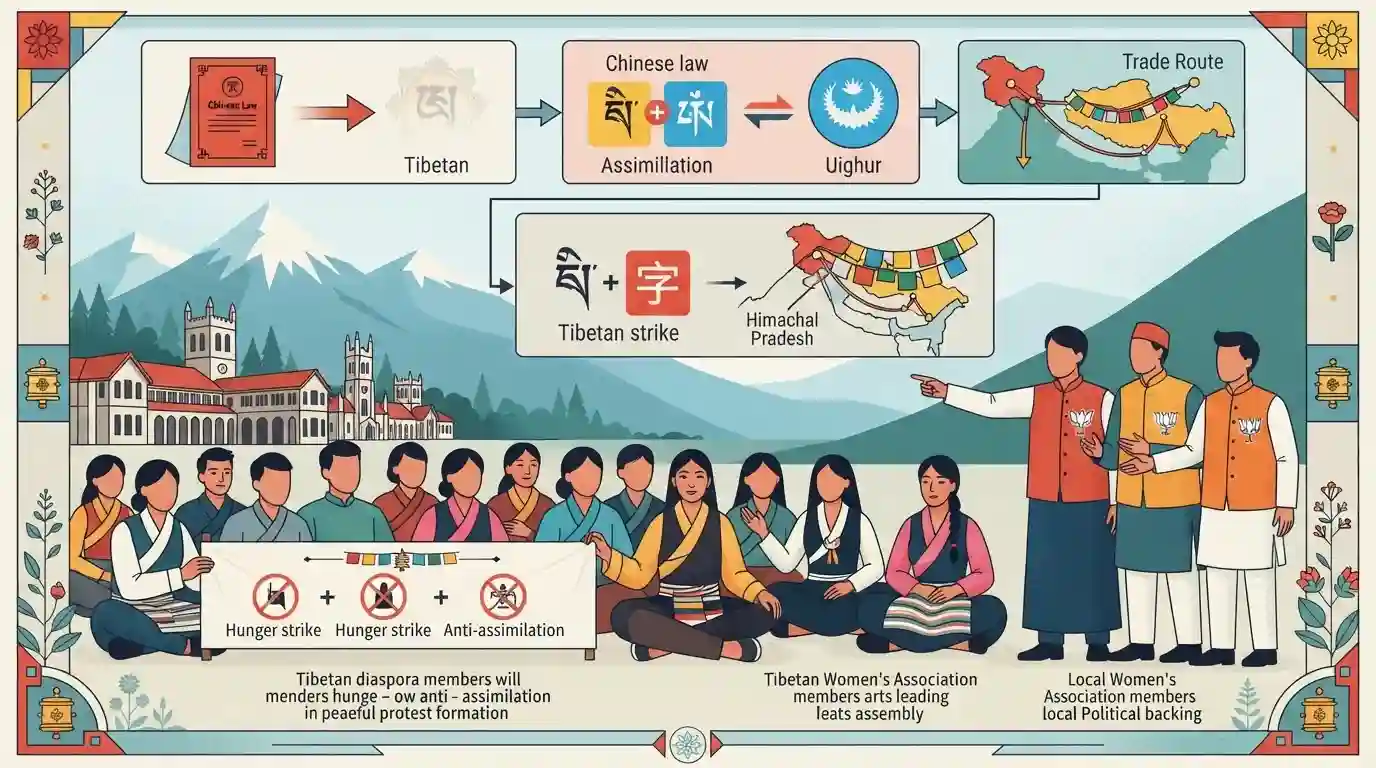
Members of the Tibetan diaspora in Shimla observed a 24-hour hunger strike under the aegis of the Tibetan Women's Association to protest China's newly implemented 'Law on Promoting Ethnic Unity and Progress'. The demonstrators condemned the legislation as an aggressive assimilation strategy intended to eradicate Tibetan culture, language, and ethnic identity, likening it to the suppression faced by Uighurs in Xinjiang. The protest received local political backing from a BJP spokesperson, who highlighted the enduring, centuries-old cultural and trade connections between Himachal Pradesh and Tibet.
Key Points
- Tibetans in Shimla organized a 24-hour hunger strike led by the Tibetan Women's Association to protest China's 'Law on Promoting Ethnic Unity and Progress'.
- The protesters argue the law is a tool for forced assimilation designed to systematically wipe out Tibetan language, culture, and ethnic identity.
- Comparisons were drawn to China's repressive policies in Xinjiang, highlighting a broader pattern of suppressing ethnic minorities.
- Himachal Pradesh BJP spokesperson Karan Nanda supported the protest, emphasizing the deep historical, religious, and trade ties between Himachal Pradesh and Tibet.
Important Terms
Law on Promoting Ethnic Unity and Progress

China's national legislation enacted in 2026, designed to accelerate the cultural assimilation of ethnic minorities by prioritizing Mandarin, tightening state control over religion, and criminalizing actions deemed as promoting ethnic division.
UPSC context
GS Paper II: Bilateral relations and the effect of China's domestic ethnic policies on India's Himalayan borders and neighborhood.
Sinicization
The state-led process of cultural assimilation in China where non-Han ethnic groups, languages, and religions are adapted and restructured to align with Han Chinese culture and Communist Party ideology.
UPSC context
GS Paper II: Effect of foreign state policies on India's neighborhood, border management, and cultural diplomacy.
Tibetan Diaspora
The global community of exiled Tibetans who fled Chinese occupation following the 1959 uprising, predominantly residing in refugee settlements across India, Nepal, Bhutan, and Western countries.
UPSC context
GS Paper II: India's refugee policy, bilateral relations with China, and the political role of the Indian diaspora.
Tibetan Women's Association
An influential non-governmental organization representing Tibetan women in exile, originally founded in Lhasa in 1959 and revived in India in 1984, dedicated to preserving Tibetan culture and human rights advocacy.
UPSC context
GS Paper II: Role of civil society organizations and non-state actors in international human rights advocacy and geopolitics.
Prelims Trap
India officially recognizes the Central Tibetan Administration (CTA) as a sovereign government-in-exile.
India officially views the Tibet Autonomous Region as part of China and does not grant sovereign diplomatic status to the CTA, despite providing it administrative space.
Static Concepts Connected
What is the status of the Central Tibetan Administration (CTA) in India?
- No Official Recognition: India officially views Tibet as part of China and does not formally recognize the CTA as a sovereign government.
- Humanitarian Refuge: Host to the Dalai Lama and CTA in Dharamshala, governed under the Tibetan Rehabilitation Policy of 2014.
- Political Restrictions: Tibetans are permitted cultural and religious freedom but are legally barred from anti-China political activities on Indian soil.
What is the historical significance of the Tabo Monastery?
- Royal Patronage: Founded in 996 AD by King Yeshe-O of the Western Tibetan Kingdom of Guge in Spiti Valley.
- Ajanta of Himalayas: Famous for preserving priceless Indo-Tibetan stucco statues, murals, and manuscripts under the Archaeological Survey of India.
Cross-Topic Patterns
Refugee diplomacy as geopolitical leverage
India's hosting of the Tibetan diaspora balances humanitarian asylum with strategic signaling, serving as an asymmetric diplomatic tool in China-India border negotiations.
Trans-Himalayan trade and passes
Ancient passes like Shipki La link Himalayan cultural geography directly to historical trade routes, merging economic history with modern border security concerns.

Mains 2026 may evaluate how India balances its official 'One China' stance with the geopolitical utility of hosting the Tibetan government-in-exile.
Linked PYQs · 1
Linked PYQs · 1
- 2017HPAS_PRELIMSGS1
Which of the following Monasteries was built by a Western Tibet ruler 'Ye-Sashoad' around the year 996 A.D. ?
