US Tariffs on Indian Imports and Trade Relations
Source:The Hindu ↗
Why It Matters
Highlights the impact of unilateral protectionist policies and secondary sanctions on India's economic stability and geopolitical autonomy. It is highly relevant for GS-2 and GS-3 discussions on India-US bilateral ties, global trade shifts towards protectionism, and the balancing act required in securing energy needs (like Russian oil) amidst geopolitical pressure.
Summary
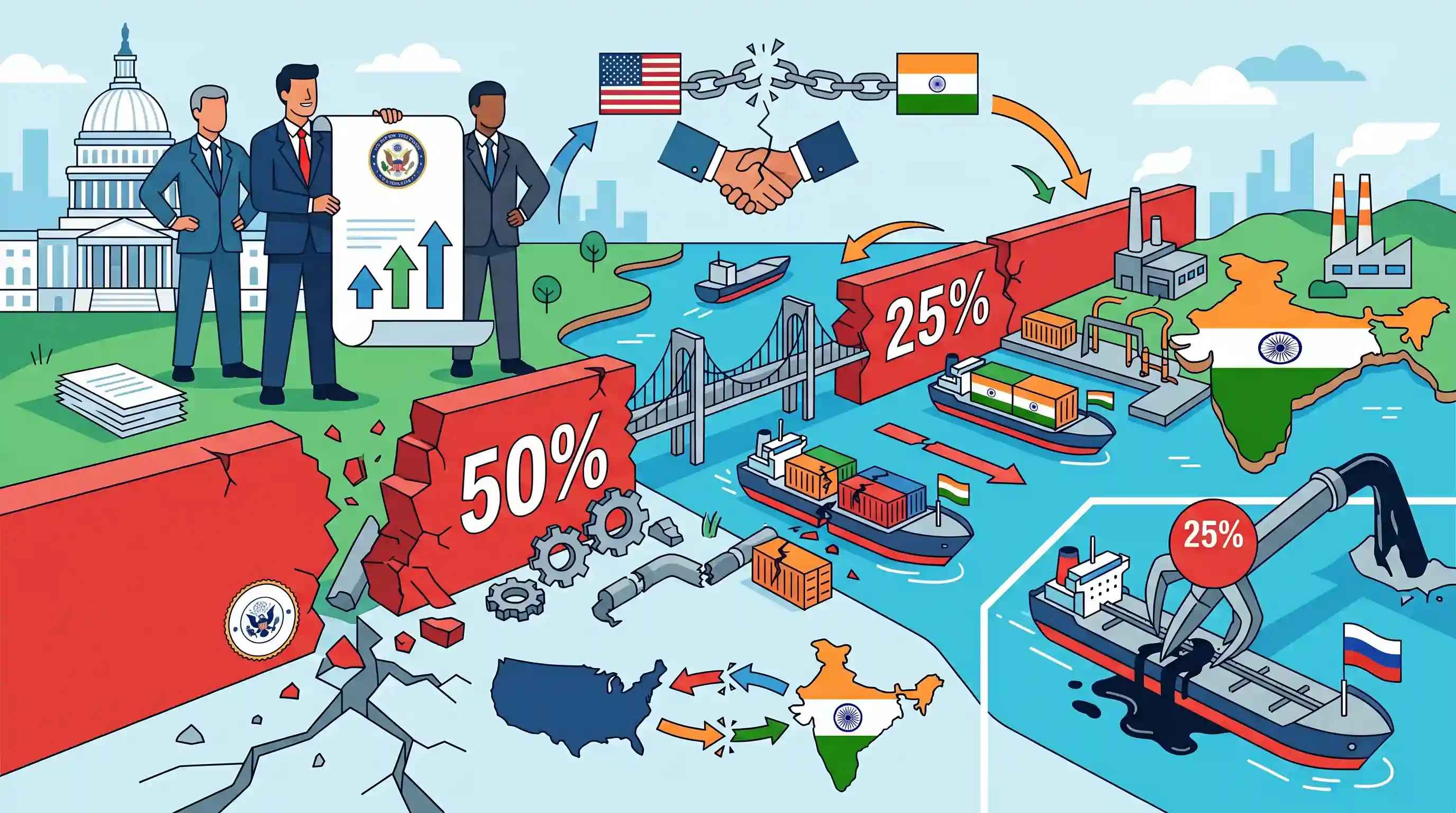
Three U.S. lawmakers have introduced a resolution in the House of Representatives to revoke the sweeping 50% tariffs on Indian imports imposed by President Donald Trump under the International Emergency Economic Powers Act (IEEPA). The tariffs, which include a 25% secondary duty explicitly targeting India's purchases of Russian oil, have drawn significant criticism for destabilizing trade ties, disrupting supply chains, and harming the broader bilateral relationship. The resolution aims to terminate the invoked national emergency and restore the US Congress's constitutional authority over trade policy, reflecting domestic pushback against unilateral protectionism.
Key Points
- Three US lawmakers introduced a resolution in the House of Representatives to end the 50% tariffs on Indian imports imposed by Donald Trump.
- The resolution aims to terminate the national emergency invoked under the International Emergency Economic Powers Act (IEEPA) that authorized the tariffs.
- The tariffs included a 25% secondary duty targeting India's purchases of Russian oil, raising duties on several Indian goods to 50%.
- Lawmakers argued that the protectionist measures disrupt supply chains, harm American workers, and weaken the critical US-India strategic partnership.
- The move intends to restore the US Congress's constitutional authority over trade and curb the executive's use of emergency powers to unilaterally impose trade barriers.
Important Terms
International Emergency Economic Powers Act (IEEPA)

A 1977 U.S. federal law authorizing the President to regulate international commerce and freeze assets after declaring a national emergency to address foreign threats.
UPSC context
GS Paper 2: Effect of policies of developed countries on India; tests understanding of unilateral trade barriers and executive vs. legislative authority.
US Congress
The bicameral federal legislature of the United States, which holds the constitutional authority to regulate foreign commerce, impose duties, and oversee executive trade actions.
UPSC context
GS Paper 2: International Relations; crucial for understanding the 'Separation of Powers' and legislative pushback on bilateral trade agreements.
House of Representatives
The lower chamber of the US Congress where revenue-related legislation must originate; it plays a critical role in checking executive overreach in trade policy.
UPSC context
GS Paper 2: Comparison of the Indian constitutional scheme with other countries; tests knowledge of the U.S. legislative role in foreign trade.
Reciprocal Tariffs
Customs duties applied by a country to match the tariff levels of a trading partner, often used as leverage to force market access concessions.
UPSC context
GS Paper 3: Indian Economy and issues relating to growth; specifically the impact of protectionism on Indian exports.
Secondary Sanctions
Economic penalties or duties imposed on a third-party country (like India) for engaging in trade with a primary sanctioned nation (like Russia).
UPSC context
GS Paper 2: Bilateral and global groupings involving India; tests awareness of how third-party geopolitics affects India-US energy ties.
Prelims Trap
US secondary sanctions on India for Russian oil purchases are enforced under a World Trade Organization (WTO) or United Nations mandate.
Secondary sanctions under domestic acts like IEEPA or CAATSA are purely unilateral, extraterritorial tools used by the US. Neither the UN nor the WTO authorizes them.
Static Concepts Connected
What are secondary sanctions in international trade?
- Primary sanctions: Restrictions prohibiting a country's own citizens and domestic companies from doing business with a targeted nation or entity.
- Secondary sanctions: Extraterritorial measures penalizing third-party countries or foreign corporate entities for continuing to trade with the primary sanctioned target.
- Global legality: Unlike UN Security Council sanctions, these are unilateral tools not broadly recognized under international law, frequently causing diplomatic friction.
What is the GATT Article XXI National Security Exception?
- Security exception: Allows WTO member nations to breach standard trade rules if necessary to protect their "essential security interests" during emergencies.
- Recent weaponization: Increasingly invoked by nations to justify unilateral protectionist tariffs, raising concerns about the circumvention of rules-based multilateral trade systems.
Cross-Topic Patterns
Strategic Autonomy vs Alliance Politics
India's continued purchase of Russian oil despite US tariffs exemplifies its multi-alignment strategy, balancing deep defense ties with Washington against critical energy security needs from Moscow.
Weaponization of Trade and Finance
Punitive secondary tariffs often run parallel to financial sanctions, pushing countries like India to explore Rupee-Ruble trade and non-dollar payment systems to bypass unilateral economic blockades.

Expect a 2026 multi-statement question contrasting unilateral US secondary sanctions (IEEPA/CAATSA) with UN mandates and WTO rules.
Linked PYQs · 3
Linked PYQs · 3
- 2012MainsGS2
Discuss the likely negative impact of the protectionist measures proposed by the US on India's software industry.
- 2025MainsGS3
What are the challenges before the Indian economy when the world is moving away from free trade and multilateralism to protectionism and bilateralism? How can these challenges be met?
- 2018MainsGS3
How would the recent phenomena of protectionism and currency manipulations in world trade affect macroeconomic stability of India?
