Commercial Tankers Attacked in Strait of Hormuz
Source:The Hindu ↗
Why It Matters
This development emphasizes the high vulnerability of global trade chokepoints to regional geopolitical conflicts and asymmetric maritime tactics (such as drone strikes). Given India's deep energy dependence on West Asia for its crude oil and LNG imports, any threat to the Strait of Hormuz directly impacts India's economic stability, inflation levels, and maritime security policy, making it a critical topic for GS Paper 2 (International Relations) and GS Paper 3 (Economy and Security).
Summary
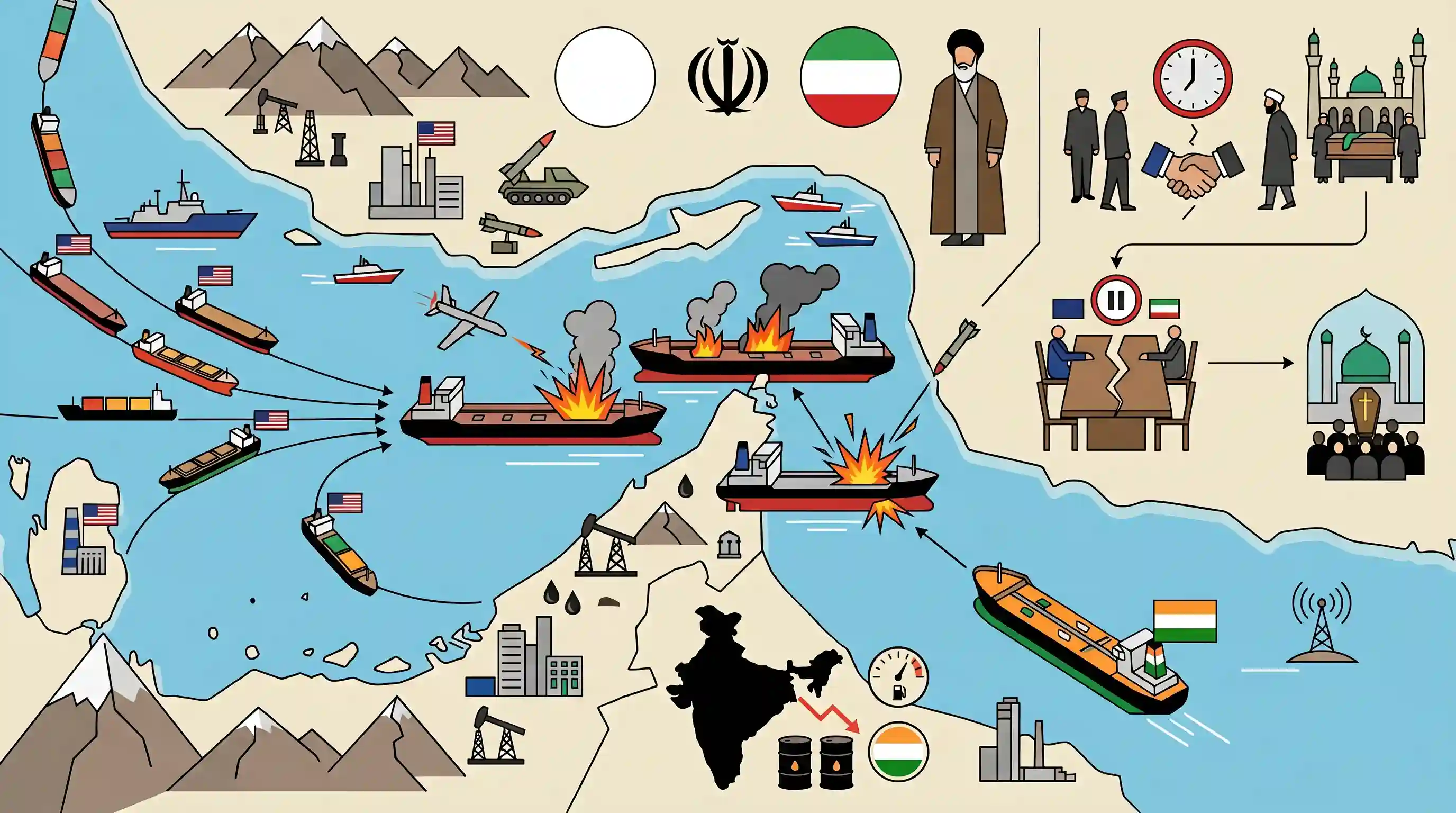
Three commercial tankers were struck by projectiles, including a drone, in the Strait of Hormuz off the coast of Oman. The attacks, reported by the UKMTO, threaten to block the flow of international maritime trade through the Persian Gulf's narrow opening. This escalation takes place amidst the ongoing conflict between the US and Iran, with diplomatic negotiations currently on hold due to the funeral of Iran's Supreme Leader Ayatollah Ali Khamenei.
Key Points
- Three commercial tankers, including an LNG carrier that caught fire, were hit by projectiles and a drone strike in the strategically vital Strait of Hormuz.
- The Strait of Hormuz is a critical maritime choke point connecting the Persian Gulf and the Gulf of Oman, handling approximately 20% of global oil and liquefied natural gas (LNG) maritime trade.
- The attacks occur in the context of an ongoing war between the United States and Iran (commenced on Feb 28, 2026). Diplomatic efforts to fully reopen the strait and roll back Iran's nuclear program are temporarily paused following the death of Iran's Supreme Leader Ayatollah Ali Khamenei.
- Iran is suspected of targeting ships that take alternative trade routes closer to the Omani coast to bypass Iran's designated and monitored shipping lanes.
- Such shipping disruptions threaten global energy security, raise maritime insurance premiums, and introduce major shipping delays, affecting key import-dependent economies like India.
Important Terms
United Kingdom Maritime Trade Operations (UKMTO)

A British Royal Navy-sponsored maritime liaison cell acting as the primary point of contact for commercial vessels to coordinate security, exchange information, and receive threat alerts in the Indian Ocean, Red Sea, and Gulf.
UPSC context
GS Paper 3 (Security/Maritime domain awareness); tests understanding of institutional mechanisms safeguarding international trade routes and commercial shipping.
Strait of Hormuz
A highly strategic, narrow waterway connecting the Persian Gulf with the Gulf of Oman, carrying nearly one-fifth of the world’s global petroleum trade and acting as a critical geopolitical energy flashpoint.
UPSC context
GS Paper 1 (World Geography) and GS Paper 2 (International Relations); tests knowledge of key regional choke points and energy dynamics.
Maritime Chokepoint
Geographically narrow and strategically significant sea passages—such as straits and canals—through which a disproportionately large volume of global shipping, trade, and energy supplies must navigate, creating systemic economic vulnerabilities.
UPSC context
GS Paper 1 (Geography) and GS Paper 3 (Economy/Security); tests understanding of supply chain vulnerabilities, global maritime trade, and naval strategy.
India's Energy Security
The uninterrupted availability of energy sources at an affordable price, crucial for India due to its nearly 90% import dependency on crude oil, requiring diversified sourcing and strategic petroleum reserves.
UPSC context
GS Paper 3 (Energy/Infrastructure); tests critical understanding of resource management, import vulnerabilities, and policy resilience to international economic shocks.
Prelims Trap
The Strait of Hormuz is bordered to the south exclusively by the United Arab Emirates (UAE).
The southern coast is the Musandam Peninsula, an exclave belonging to Oman, although UAE territory is directly adjacent just further south.
Static Concepts Connected
What are the key West Asian maritime chokepoints?
- Strait of Hormuz: Connects the Persian Gulf with the Gulf of Oman and the Arabian Sea; bordered by Iran and Oman's Musandam exclave.
- Bab-el-Mandeb: Connects the Red Sea with the Gulf of Aden, bordered by Yemen on the Arabian Peninsula, and Djibouti and Eritrea in Africa.
What is the status of India's Strategic Petroleum Reserves (SPR) programme?
- Phase-I sites: Operational underground rock cavern storages are located at Visakhapatnam (AP), Mangaluru (Karnataka), and Padur (Karnataka) under Phase-I.
- Emergency duration: Phase-I offers crude oil safety cushion of roughly 9.5 days of India’s import requirements; it currently excludes natural gas/LNG.
- Managing agency: Managed by the Indian Strategic Petroleum Reserves Limited (ISPRL), a Special Purpose Vehicle under the Ministry of Petroleum and Natural Gas.
Cross-Topic Patterns
SAGAR Initiative & western ocean security
Escalating West Asian chokepoint risks test India's net security provider role, forcing a pivot from passive diplomacy to active maritime security operations like Operation Sankalp.
Gas-based economy vs import vulnerability
India's policy target of raising natural gas to 15% of its energy mix by 2030 faces severe supply-chain risks due to the lack of strategic gas reserves.

West Asian chokepoints (Hormuz/Bab-el-Mandeb) paired with India's SPR/gas vulnerability likely to feature in 2026 Prelims geography.
Linked PYQs · 3
Linked PYQs · 3
- 2026PrelimsGS1
Ships from which of the following countries have to cross the Strait of Hormuz to reach out to the Indian Ocean ? 1. Bahrain 2. Syria 3. Qatar 4. Egypt Select the answer using the code given below :
- 2025MainsGS3
Why is maritime security vital to protect India's sea trade? Discuss maritime and coastal security challenges and the way forward.
- 2017MainsGS2
The question of India's Energy Security constitutes the most important part of India's economic progress. Analyze India's energy policy cooperation with West Asian countries.
