Multilateral Summits and US-China-India Geopolitics
Source:Indian Express ↗
Why It Matters
Crucial for understanding how major international forums (EAS, APEC, G20) shape India's foreign policy, strategic autonomy, and great power dynamics between the US and China.
Summary
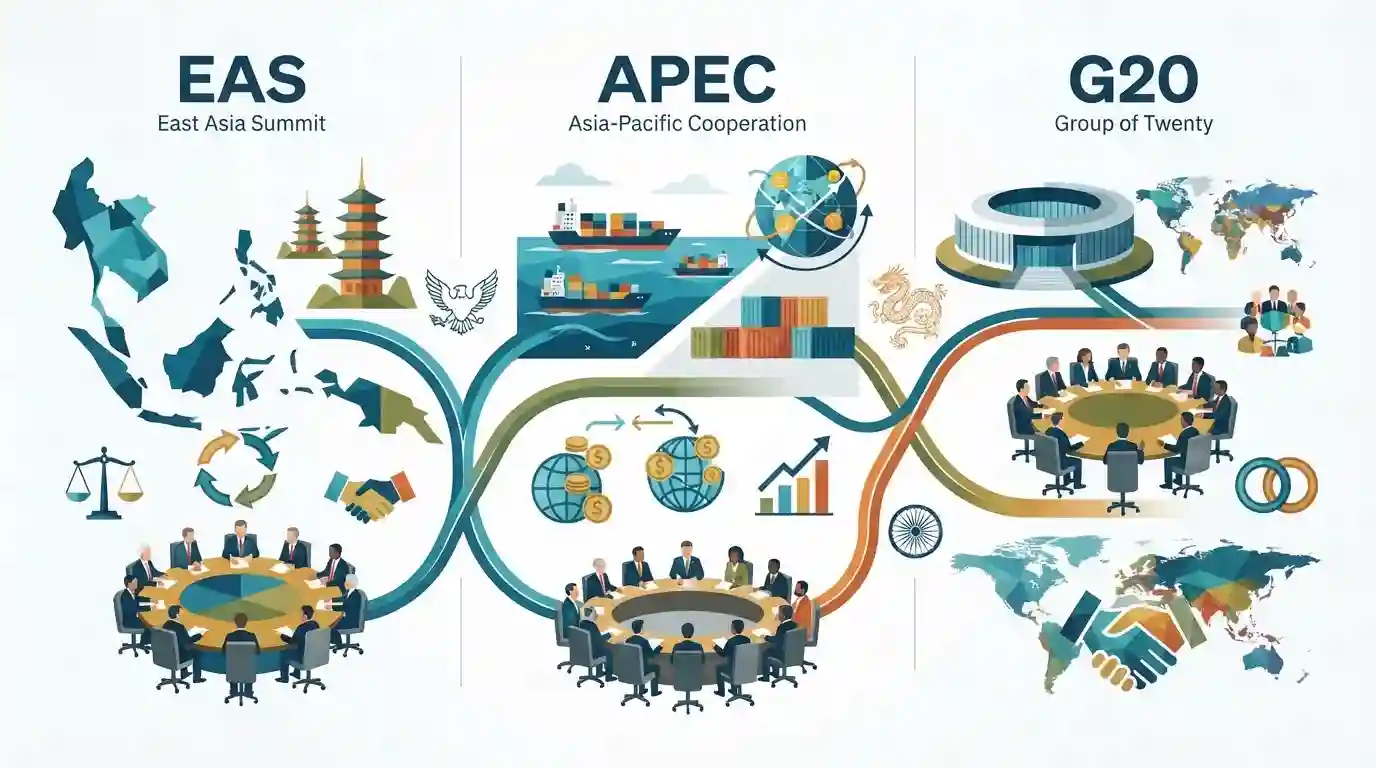
The article explores the geopolitical implications of three consecutive international summits—the East Asia Summit, APEC, and the G20—examining how interactions between major powers like the US, China, and India shape global governance, economic architecture, and strategic stability in an era of intense competition.
Key Points
- A triad of high-stakes multilateral summits—East Asia Summit (EAS), APEC, and G20—serves as critical barometers for great power competition and cooperative governance between the US, China, and India.
- The EAS and APEC formats highlight shifting economic integration, supply chain realignments, and regional security dynamics across the Indo-Pacific.
- The G20 continues to function as a vital platform for addressing global economic governance, climate finance, and north-south divides despite intensifying geopolitical polarization.
- India navigates these multilateral spaces by balancing strategic autonomy, engaging in minilaterals like the Quad, and advocating for the interests of the Global South.
Important Terms
East Asia Summit

A premier leaders-led forum comprising 18 participating countries focusing on strategic, political, and economic security challenges in the Indo-Pacific region, with ASEAN playing a central role.
UPSC context
UPSC GS Paper II: Important International Institutions, groupings, and forums affecting India's strategic and geopolitical interests in the Indo-Pacific.
APEC
A regional economic forum of 21 member economies established to promote free trade, sustainable development, and economic cooperation across the Asia-Pacific region.
UPSC context
UPSC GS Paper II & III: Regional economic groupings, global trade architecture, and multilateral economic diplomacy involving India and major powers.
G20
A premier intergovernmental forum comprising 19 countries, the European Union, and the African Union, focused on global economic governance, financial stability, and sustainable development.
UPSC context
UPSC GS Paper II: Global governance institutions, minilateralism, and India's leadership role in shaping plurilateral consensus on international economic issues.
ASEAN
A geopolitical and economic intergovernmental organization of 10 Southeast Asian member states dedicated to regional integration, economic growth, and socio-cultural cooperation.
UPSC context
UPSC GS Paper II: India's 'Act East' Policy, regional security architecture, and multilateral diplomacy in Southeast Asia.
Static Concepts Connected
What are the structural differences in membership and focus between the East Asia Summit and APEC?
- EAS Scope: EAS membership includes 18 countries (ASEAN + 8 dialogue partners including India, US, China, Russia) focusing on strategic and political dialogue.
- APEC Scope: APEC comprises 21 Pacific Rim economies (member-economies rather than sovereign states) focusing primarily on trade liberalization and economic cooperation.
- India Status: India is a founding/core member of EAS but is not a member of APEC due to geographic and economic integration criteria.
Cross-Topic Patterns
G20 Global South Diplomacy + Climate Finance
India's presidency institutionalized development and climate finance equity for the Global South, linking multilateral economic diplomacy with domestic climate commitments and North-South equity debates.
Indo-Pacific Architecture + Strategic Autonomy
Simultaneous engagement in ASEAN-centric forums (EAS) and minilaterals (Quad) showcases India's multi-alignment strategy across Indo-Pacific security architectures.

Multilateral summit architectures (EAS vs APEC vs G20) and membership overlaps tested via a statement-based pairing question.
Linked PYQs · 3
Linked PYQs · 3
- 2024MainsGS2
Critically analyse India's evolving diplomatic, economic and strategic relations with the Central Asian Republics (CARs) highlighting their increasing significance in regional and global geopolitics.
- 2021MainsGS2
The newly tri-nation partnership AUKUS is aimed at countering China's ambitions in the Indo-Pacific region. Is it going to supersede the existing partnerships in the region? Discuss the strength and impact of AUKUS in the present scenario.
- 2024MainsGS2
‘The West is fostering India as an alternative to reduce dependence on China's supply chain and as a strategic ally to counter China's political and economic dominance.’ Explain this statement with examples.
