Mumbai Building Collapse and Urban Disaster Management Challenges
Source:The Hindu ↗
Why It Matters
Frequent building collapses in Indian metropolises highlight the critical need for robust urban planning, rigorous structural safety audits, and rapid multi-agency emergency response mechanisms as part of urban disaster management.
Summary
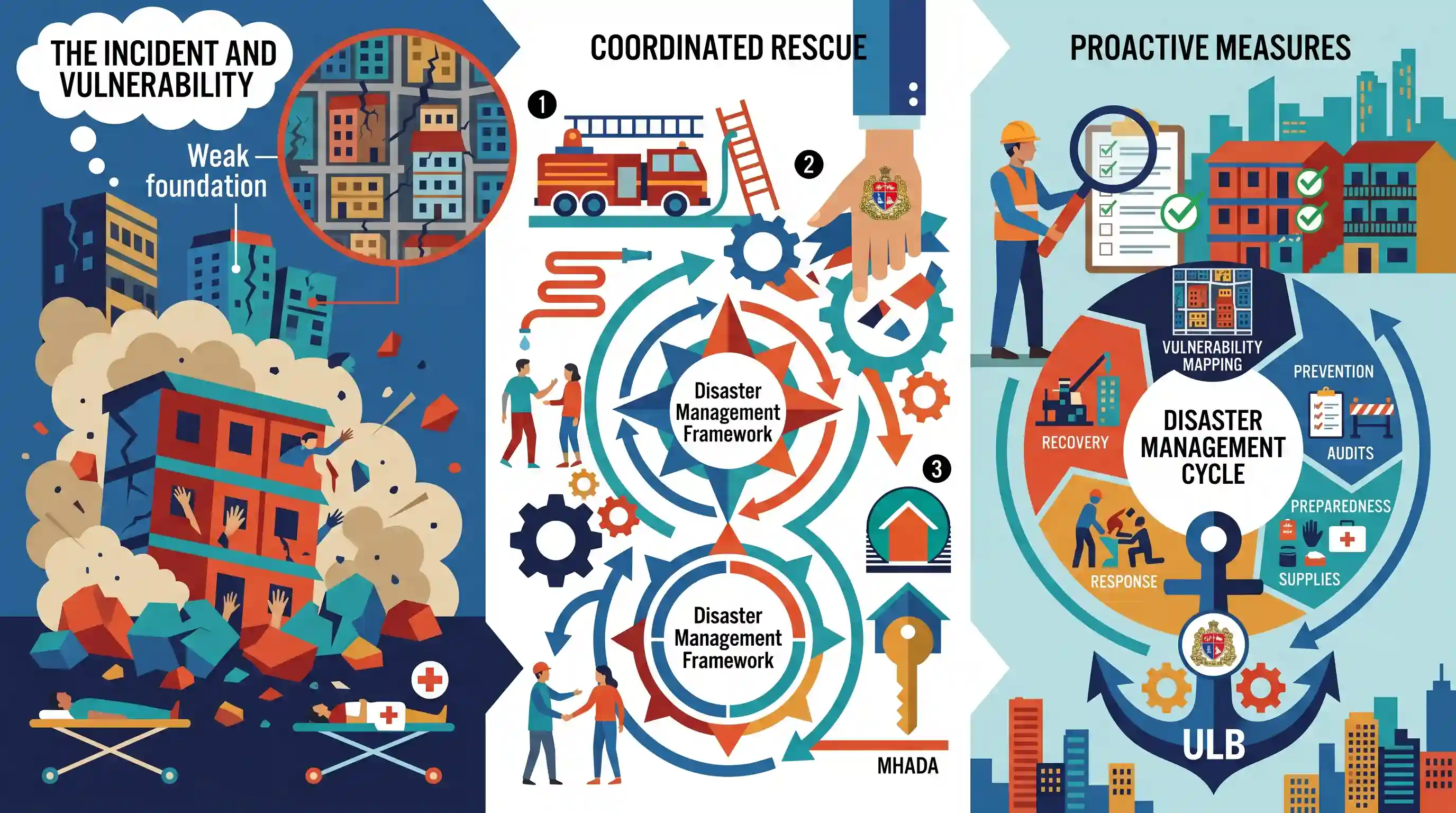
A three-storey chawl in Mumbai's Bandra East collapsed early morning, leaving at least seven people injured and several others feared trapped. A coordinated rescue operation was quickly launched by multiple civic and emergency agencies, including the Mumbai Fire Brigade, BMC, and MHADA. The incident draws attention to the persistent vulnerabilities of urban infrastructure and emphasizes the crucial role of proactive safety audits and disaster management frameworks in densely populated metropolitan areas.
Key Points
- A ground-plus-three chawl structure collapsed early in the morning in Bharat Nagar, BKC, Bandra East, Mumbai.
- At least seven people were injured and admitted to Bandra Bhabha Hospital, while 8-10 individuals were feared trapped in the debris.
- A rapid, multi-agency rescue operation was initiated involving the Mumbai Fire Brigade, BMC, MHADA, PWD, Adani, and local police.
- The incident highlights the recurring issue of structural failures in aging urban infrastructure and the necessity of proactive urban disaster management.
Important Terms
Brihanmumbai Municipal Corporation (BMC)

The governing civic body for Mumbai and India's wealthiest municipal corporation. It manages urban infrastructure, public health, and disaster management through its specialized Disaster Management Unit (DMU).
UPSC context
GS Paper II: Urban Local Bodies (ULBs) and GS Paper III: Disaster Management frameworks for metropolitan areas.
MHADA
A statutory state agency responsible for planning and developing affordable housing in Maharashtra. It also oversees the repair and redevelopment of old or dilapidated 'cessed' buildings in Mumbai.
UPSC context
GS Paper III: Urban infrastructure and housing; GS Paper II: State government agencies and welfare-oriented urban planning.
Mumbai Fire Brigade
The specialized fire and rescue service of the BMC. It is the primary responder for fires, building collapses, and natural disasters within Mumbai's municipal limits.
UPSC context
GS Paper III: Disaster Management—specifically the role of first responders in urban structural failure scenarios.
Public Works Department (PWD)
A state or central government agency tasked with the construction, maintenance, and repair of public infrastructure like roads, bridges, and government buildings.
UPSC context
GS Paper III: Infrastructure development and maintenance standards; GS Paper II: Governance and administrative departments.
Bandra Bhabha Hospital
A major public municipal hospital in Bandra, Mumbai, operated by the BMC. It serves as a vital hub for emergency medical services during local disasters and mass casualty incidents.
UPSC context
GS Paper III: Public health infrastructure and emergency medical response as part of disaster mitigation.
Adani Electricity
The private utility company providing power to Mumbai's suburbs. During disasters, its staff coordinate with civic agencies to manage electrical risks and prevent secondary hazards like short circuits.
UPSC context
GS Paper III: Role of private sector entities and utility providers in coordinated disaster response efforts.
Prelims Trap
"NDMA directly enforces urban building bylaws and mandatory structural audits."
Enforcing building bylaws, conducting structural audits, and regulating urban zoning are state/local subjects managed by Urban Local Bodies (ULBs), not directly enforced by NDMA.
Static Concepts Connected
What is the role of Local Authorities under the Disaster Management Act, 2005?
- Integration: They must ensure disaster management and mitigation plans are integrated into local development projects and schemes.
- First Responders: They serve as the immediate first responders for rescue, relief, and rehabilitation operations at the ground level.
- Capacity Building: Responsible for training local officers, building community resilience, and enforcing localized safety regulations.
What are the key structural mitigation measures for aging urban infrastructure?
- Code Compliance: Strict implementation of the National Building Code (NBC) and BIS standards for new constructions.
- Retrofitting & Audits: Techno-legal regime mandating periodic structural safety audits and seismic retrofitting for old, vulnerable buildings.
- Micro-zonation: Micro-zonation of urban centers to map localized hazards and restrict construction in highly vulnerable pockets.
Cross-Topic Patterns
74th CAA & Disaster Resilience
Poor enforcement of safety audits exposes the lack of financial and technical capacity within Urban Local Bodies (ULBs), linking disaster vulnerability to incomplete devolution under the 74th CAA.
Compounded Urban Hazards
Structural vulnerabilities in legacy megacities exacerbate combined disaster scenarios, such as aging structures collapsing under the compounded stress of extreme urban flooding during monsoons.

Expect 2026 Prelims statements testing the statutory distinction between NDMA's advisory role and ULBs' enforcement of building codes.
Linked PYQs · 4
Linked PYQs · 4
- 2023MainsGS3
Dam failures are always catastrophic, especially on the downstream side, resulting in a colossal loss of life and property. Analyze the various causes of dam failures. Give two examples of large dam failures.
- 2021MainsGS3
Describe the various causes and the effects of landslides. Mention the important components of the National Landslide Risk Management Strategy.
- 2019MainsGS3
Disaster preparedness is the first step in any disaster management process. Explain how hazard zonation mapping will help disaster mitigation in the case of landslides.
- 2017MainsGS1
"The growth of cities as I.T. hubs has opened up new avenues of employment, but has also created new problems." Substantiate this statement with examples.
