Building Collapse in Kota Highlights Urban Construction Safety Lapses
Source:The Hindu ↗
Why It Matters
The incident is a classic case study of man-made urban disasters caused by lapses in enforcing building codes and construction safety norms. It highlights the functional challenges faced by Urban Local Bodies (ULBs) in regulating rapid urbanization and ensuring citizen safety.
Summary
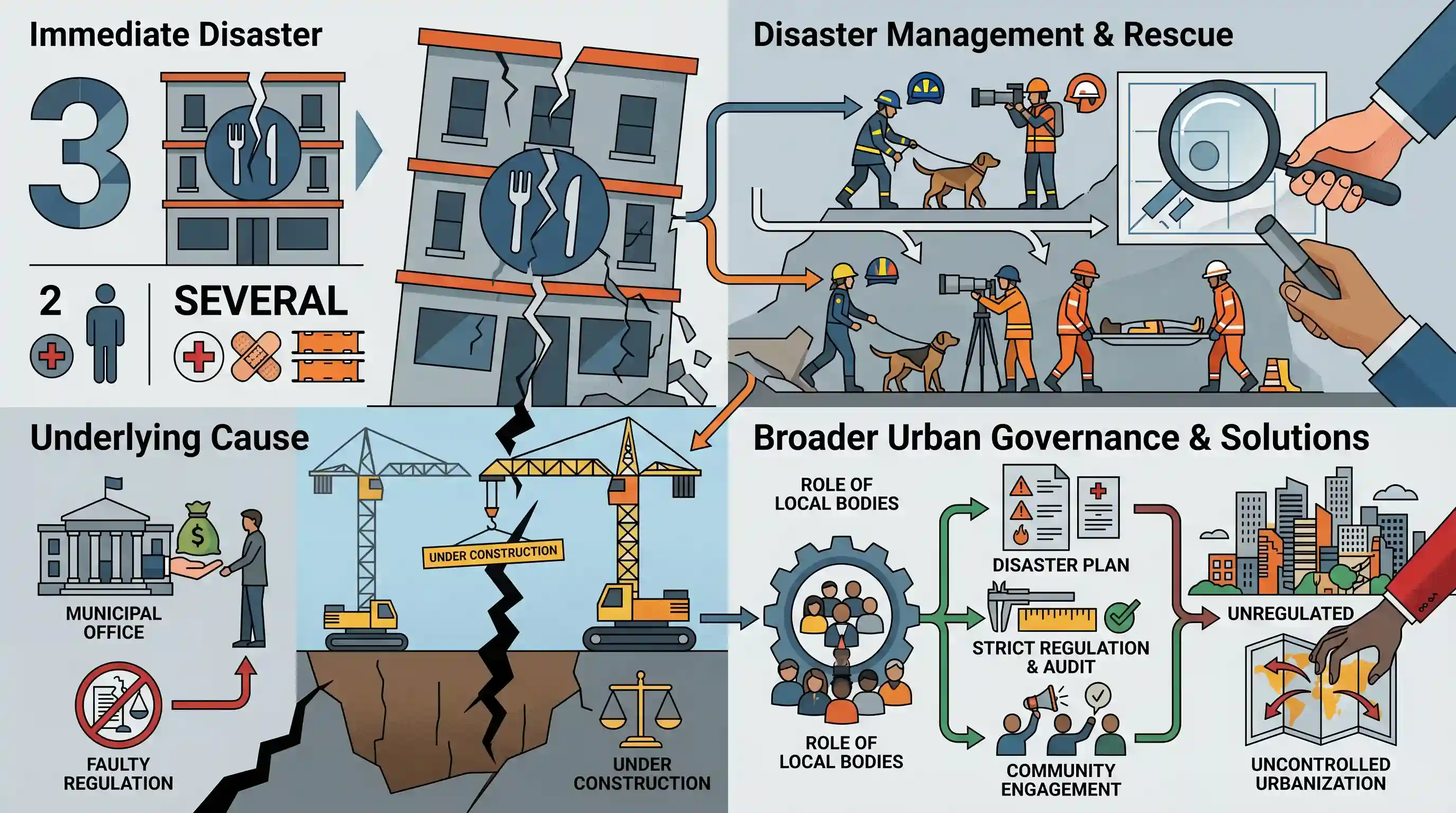
A three-storey building housing a restaurant collapsed in Kota, Rajasthan, killing two people and injuring several others. Rescue operations involved the SDRF and NDRF. Authorities suspect that ongoing construction work in an adjacent plot may have compromised the building's structural integrity, bringing attention to the broader issue of municipal regulation and urban construction safety.
Key Points
- A three-storey building in Kota collapsed, resulting in two fatalities and numerous injuries, prompting emergency response from SDRF and NDRF teams.
- Initial assessments point to adjacent construction work weakening the building's foundation, leading to the structural failure.
- The tragedy highlights the ongoing issues of poor urban planning, inadequate enforcement of building codes, and municipal governance deficits in Indian cities.
Important Terms
National Disaster Response Force (NDRF)

A specialized force established under the Disaster Management Act, 2005, for responding to natural and man-made disasters with specialized search and rescue capabilities.
UPSC context
GS Paper III (Disaster Management); tests knowledge of the institutional framework for specialized emergency response in India.
State Disaster Response Force (SDRF)
The state-level counterpart to the NDRF, acting as the primary responder for notified disasters within a state's jurisdiction under the Disaster Management Act, 2005.
UPSC context
GS Paper III (Disaster Management); highlights the federal structure of disaster response and state-level preparedness.
Disaster Management Act, 2005
The primary legislation in India providing a legal and institutional framework for disaster management, establishing bodies like the NDMA, SDMAs, and the NDRF.
UPSC context
GS Paper III (Internal Security/Disaster Management); essential for understanding the statutory powers during emergencies.
National Building Code (NBC)
A comprehensive set of guidelines issued by the Bureau of Indian Standards for regulating building construction to ensure structural, fire, and health safety.
UPSC context
GS Paper I (Urbanization) and Paper III (Disaster Management); tests knowledge of urban safety regulations and mitigation.
Urban Local Bodies (ULBs)
Constitutional bodies (74th Amendment) like Municipal Corporations responsible for urban planning, land-use regulation, and enforcing building safety norms at the city level.
UPSC context
GS Paper II (Governance); crucial for analysis of urban governance failures and administrative accountability in safety enforcement.
Prelims Trap
"The National Building Code is legally binding across all states under the Disaster Management Act."
The NBC is a recommendatory model code by the BIS. It only becomes legally enforceable once state governments incorporate it into their municipal building bylaws.
Static Concepts Connected
How are the SDRF and NDRF funded under the Disaster Management Act?
- SDRF Funding: It is the primary fund for state-level response. The Centre contributes 75% for general category states and 90% for special category states.
- NDRF Funding: It supplements the SDRF only for severe calamities, funded primarily through the National Calamity Contingent Duty (NCCD) and budgetary allocations.
What is the constitutional mandate for urban planning under the 74th Amendment?
- 12th Schedule: The 12th Schedule lists 18 functions for ULBs, specifically including "Urban planning" and "Regulation of land-use and construction of buildings."
- State Discretion: Devolution of these powers is not automatic; state legislatures must pass laws endowing municipalities with these specific regulatory powers.
Cross-Topic Patterns
Urban disasters & drainage infrastructure
Unregulated urban construction not only causes building collapses but directly links to urban flooding by obstructing natural drainage channels, a frequent theme in GS-3 disaster management mains.
BIS standards in municipal governance
The Bureau of Indian Standards (BIS) formulates the National Building Code, linking central statutory quality-control bodies directly to local municipal governance deficits and urban resilience.

Expect a Prelims statement confusing the statutory backing of the National Building Code with the mandate of the Disaster Management Act.
Linked PYQs · 3
Linked PYQs · 3
- 2024MainsGS2
Analyse the role of local bodies in providing good governance at local level and bring out the pros and cons merging the rural local bodies with the urban local bodies.
- 2023MainsGS2
“The states in India seem reluctant to empower urban local bodies both functionally as well as financially.” Comment.
- 2016MainsGS1
With a brief background of quality of urban life in India, introduce the objectives and strategy of the 'Smart City Programme'.
