Northeast insurgency dynamics and organized crime nexus in Assam
Source:The Hindu ↗
Why It Matters
The incident serves as a practical example for GS-3 (Security) answers regarding the persistent low-intensity conflicts in Northeast India and the crucial, often-overlooked nexus between organized crime (like wildlife poaching in the Kaziranga belt) and armed insurgency/terrorism.
Summary
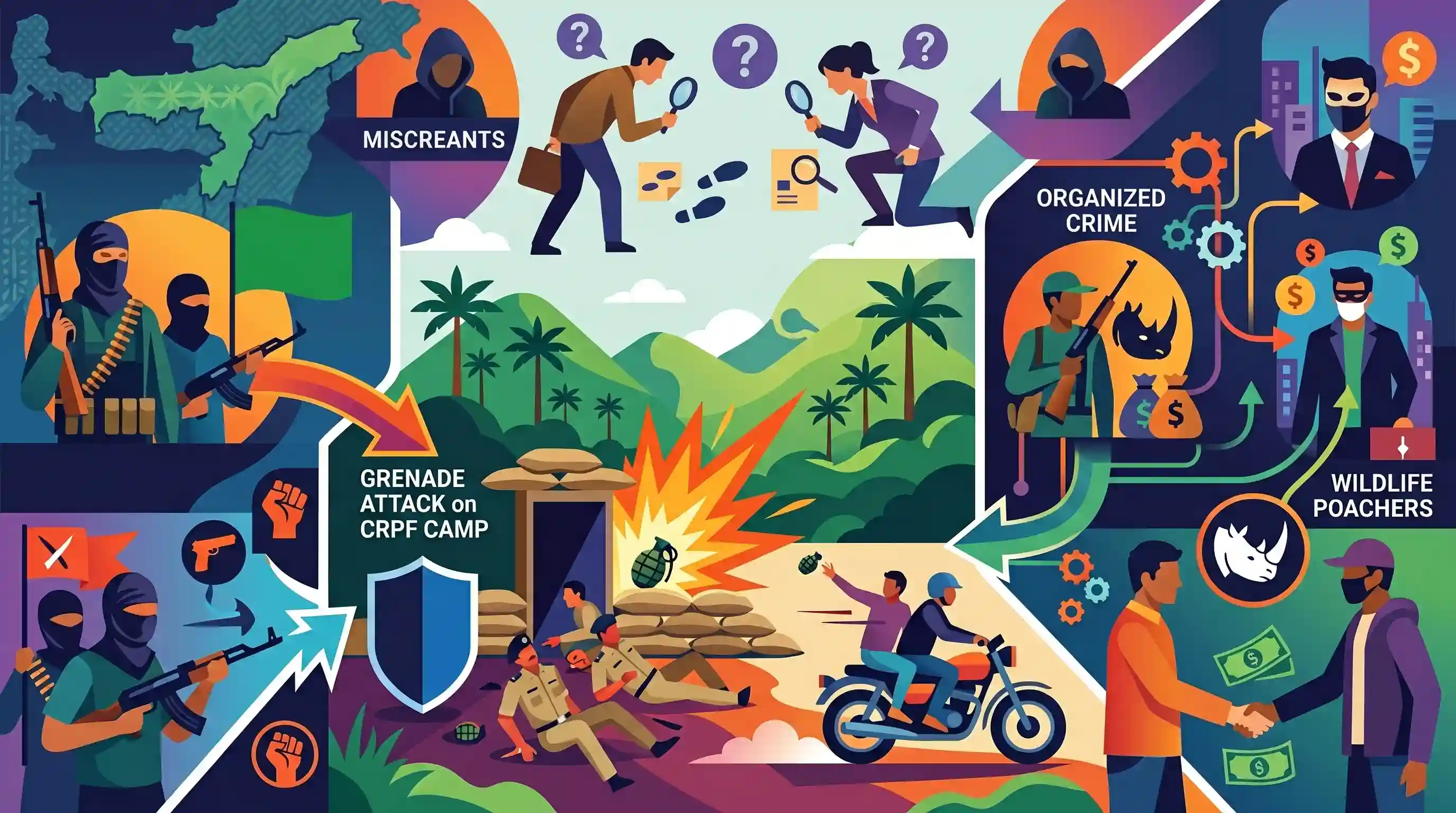
Three Assam Police personnel were injured in a grenade attack targeting a CRPF camp in Bokakhat, Golaghat district, Assam. Unidentified motorcycle-borne assailants lobbed the explosive in the Sapguri area. Authorities are investigating the incident from all angles, including potential involvement by armed extremists, miscreants, or wildlife poachers. The mention of poachers is notable, pointing to the underlying complex security environment in Assam where organized crime syndicates frequently operate alongside or in collusion with insurgent factions.
Key Points
- Three Assam Police personnel sustained injuries after two motorcycle-borne assailants lobbed a grenade at a CRPF camp in Bokakhat, Golaghat district.
- The attack took place in the Sapguri area; the injured personnel are reported to be out of danger.
- Police investigations are exploring multiple angles, including the possible involvement of armed extremists, wildlife poachers, or local miscreants.
- The possibility of poachers being involved highlights the suspected nexus between organized crime (wildlife trafficking/poaching) and armed extremism in the region.
Important Terms
Central Reserve Police Force (CRPF)

India's largest Central Armed Police Force (CAPF) under the Ministry of Home Affairs, primarily mandated with maintaining internal security, counter-insurgency, and riot control across the nation.
UPSC context
GS Paper 3 (Internal Security). Crucial for understanding the role of various security forces and their mandates in conflict zones.
Organized Crime-Terrorism Nexus
A symbiotic relationship where terrorist groups utilize criminal networks (e.g., drug trafficking, poaching) for funding and logistics, while criminals exploit insurgent-driven instability to expand illicit activities.
UPSC context
GS Paper 3 (Internal Security). Tests the ability to analyze complex linkages between crime syndicates and national security threats.
Insurgency in Northeast India
Long-standing armed conflicts involving various ethnic and political groups seeking autonomy or secession, often fueled by historical grievances, economic neglect, and porous international borders.
UPSC context
GS Paper 3. Significant for questions on regional security, peace accords, and the 2029 government target to end regional militancy.
Wildlife Poaching (Security Linkage)
In Northeast India, illegal hunting of protected species (like rhinos) often overlaps with arms trafficking, where animal parts are exchanged for weapons, financing local insurgent factions.
UPSC context
GS Paper 3 (Internal Security/Environment). Illustrates how environmental crimes can escalate into national security threats in sensitive border states.
Assam Police
The state-level law enforcement agency responsible for maintaining order in Assam, frequently engaging in joint counter-insurgency and anti-poaching operations with central forces.
UPSC context
GS Paper 3. Relevant for understanding the cooperation between state and central security agencies in "disturbed areas."
Prelims Trap
"Wildlife poaching offences cannot be investigated under the Prevention of Money Laundering Act (PMLA)."
Major offences under the Wildlife Protection Act (1972) are scheduled offences under PMLA, allowing the ED to probe terror-funding and organized crime links.
Static Concepts Connected
How does organized crime fuel insurgency in India's Northeast?
- Resource Barter: Poachers and smugglers barter illegal wildlife products (like rhino horns) in international black markets to procure sophisticated arms.
- Extortion Networks: Insurgent groups levy illegal taxes on smuggling syndicates operating across porous borders (e.g., Myanmar) to fund their secessionist activities.
- Shared Logistics: Crime syndicates and terror groups share logistical networks, local informants, and border-crossing routes to evade state security forces.
What are the respective roles of CAPFs and State Police in counter-insurgency?
- CRPF Mandate: Forces like CRPF are deployed by the Centre to aid states in maintaining public order and conducting targeted anti-terror operations.
- State Police: Maintains primary jurisdiction over law and order (State List) and conducts local intelligence gathering and crime investigation.
- Inter-agency Coordination: Operations where organized crime overlaps with extremism require combined task forces to leverage local intel and heavy operational capacity.
Cross-Topic Patterns
Wildlife Trade funding Terrorism
The illicit trade of rhino horns and pangolin scales utilizes the same cross-border smuggling routes as drugs and arms, acting as a critical funding source for Northeast insurgent factions.
Kaziranga's Geostrategic Vulnerability
Located near the Karbi Anglong hills and porous transit networks, Kaziranga's geography makes it a dual hotspot for biodiversity conservation and asymmetric counter-insurgency operations.

Expect a GS3 Mains question explicitly linking environmental crimes (like wildlife poaching) to terror financing and Northeast insurgency.
Linked PYQs · 3
Linked PYQs · 3
- 2017MainsGS3
The North-East region of India has been infested with insurgency for a very long time. Analyze the major reasons for the survival of armed insurgency in this region.
- 2022MainsGS3
Discuss the types of organised crimes. Describe the linkages between terrorists and organised crime that exist at the national and transnational levels.
- 2021MainsGS3
Analyse the complexity and intensity of terrorism, its causes, linkages and obnoxious nexus. Also suggest measures required to be taken to eradicate the menace of terrorism.
