Three New Cascade Frog Species Discovered in Northeast India
Source:The Hindu ↗
हे का महत्त्वाचे आहे
It provides a concrete example of how geological events (Himalayan uplift) drive evolutionary speciation, an important concept at the intersection of Geography (GS1) and Environment (GS3). It also adds crucial factual data points on India's amphibian biodiversity for Prelims.
सारांश
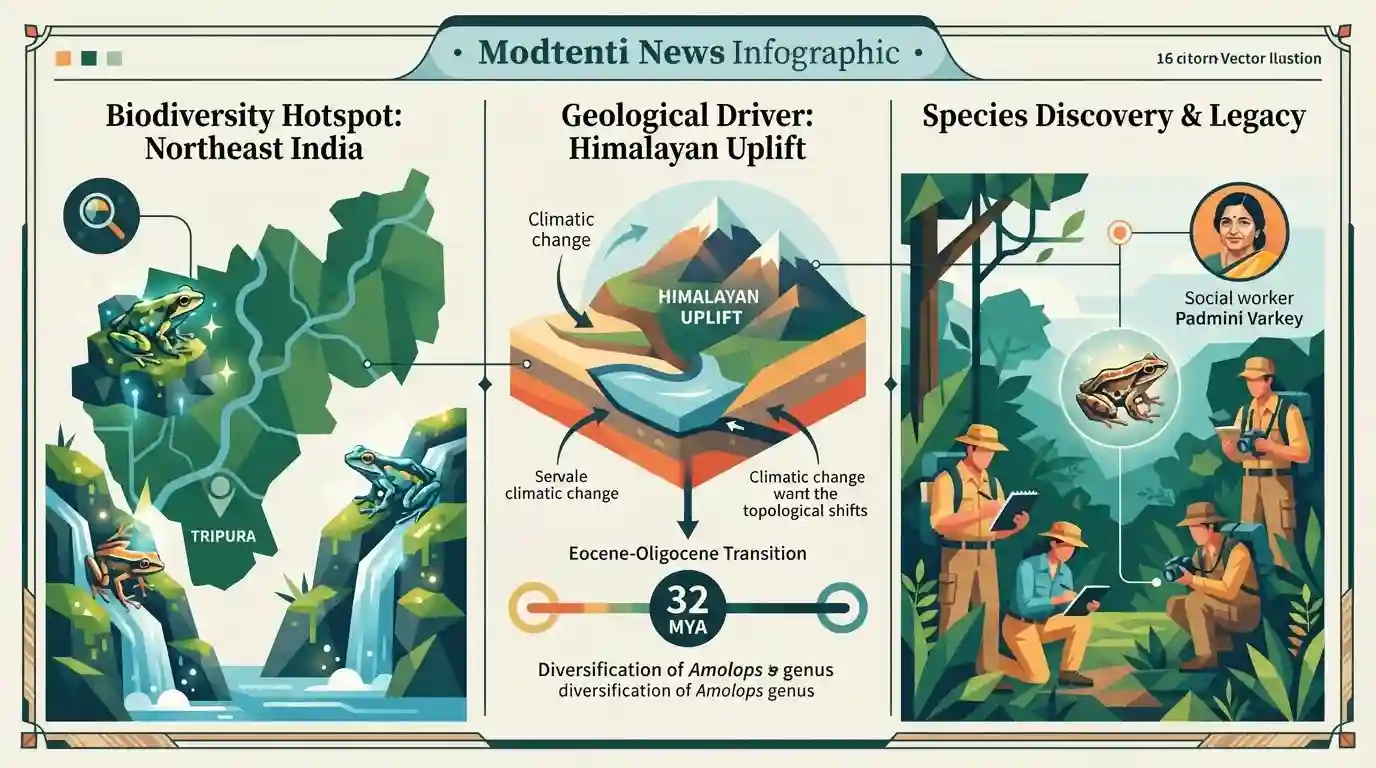
A team led by Delhi University's Prof. S. D. Biju discovered three new cascade frog species in Northeast India, including one in Tripura named after Kerala social worker Padmini Varkey. The research highlights that the rapid diversification of the Amolops genus occurred roughly 32 million years ago, driven by the climatic and topological changes resulting from the Himalayan uplift during the Eocene-Oligocene transition. This underscores the profound impact of geological shifts on regional speciation and the rich, unexplored biodiversity of Northeast India.
मुख्य मुद्दे
- Researchers have discovered three new cascade frog species (genus Amolops) in Northeast India and documented five others in the country for the first time.
- The newly discovered species are Amolops ammachi (Tripura, named after social worker Padmini Varkey), Amolops sendenyu (Nagaland), and Amolops bella (West Bengal).
- The study traces the evolutionary history of cascade frogs, noting their rapid diversification around 32 million years ago.
- This speciation was heavily influenced by the Eocene-Oligocene transition and the upliftment of the Himalayas, which dramatically altered regional topologies and climates.
पूर्वपरीक्षा सापळा
Cascade frogs are primarily adapted to stagnant, lentic wetlands and marshy floodplains of Northeast India.
Cascade frogs (Amolops) are strictly lotic, torrent-dwelling species. They inhabit fast-flowing mountain streams, relying on specialized toe pads to cling to wet rocks, and cannot survive in stagnant wetlands.
संबंधित स्थिर संकल्पना
What is the ecological difference between lotic and lentic freshwater systems?
- Lotic Systems: Flowing water bodies like rivers and rapid hill streams. Organisms require torrent-adapted features like adhesive discs.
- Lentic Systems: Stagnant water bodies such as ponds, lakes, and marshes. Oxygen levels are typically lower and highly variable compared to lotic systems.
- Bio-indicator Role: Lotic specialists like torrent frogs are highly sensitive to siltation and canopy cover loss, making them excellent indicators of stream health.
What was the Eocene-Oligocene Transition (EOT) in Earth's history?
- Climatic Shift: Occurred ~34 million years ago, transitioning Earth from a warm greenhouse state to a cold icehouse state.
- Glaciation: Triggered the rapid formation of the East Antarctic Ice Sheet, driven by dropping atmospheric carbon dioxide levels.
- Tectonic Activity: Coincided with the collision of the Indian and Eurasian plates, initiating significant mountain-building phases in the Himalayas.
आंतर-विषय नमुने
Speciation & Plate Tectonics
Links biological evolution to geological events. Himalayan uplift created physical barriers and microclimates, illustrating how continental drift drives regional biodiversity.
Bio-indicators & River Projects
Integrates wildlife biology with environmental impact assessments. Sensitive species like Amolops act as natural monitors for developmental projects in Himalayan river basins.

Himalayan tectonic uplift epochs (Eocene-Oligocene transition) linked with speciation of indicator taxa will likely feature in 2026.
संबंधित PYQ · 2
संबंधित PYQ · 2
- 2011PrelimsGS1
The Himalayan Range is very rich in species diversity. Which one among the following is the most appropriate reason for this phenomenon?
- 2020PrelimsGS1
With reference to India's biodiversity, Ceylon frogmouth, Coppersmith barbet, Gray-chinned minivet and White-throated redstart are
