NCPI MPs political alignment and assembly developments
Source:The Hindu ↗
কেন এটি গুরুত্বপূর্ণ
The political dynamics of party defections, resignations, and mergers tie directly into the Anti-Defection Law (Tenth Schedule) and the functioning of the Parliament. Additionally, the role and nature of central agencies (ED and CBI) are key topics in Indian Polity.
সারসংক্ষেপ
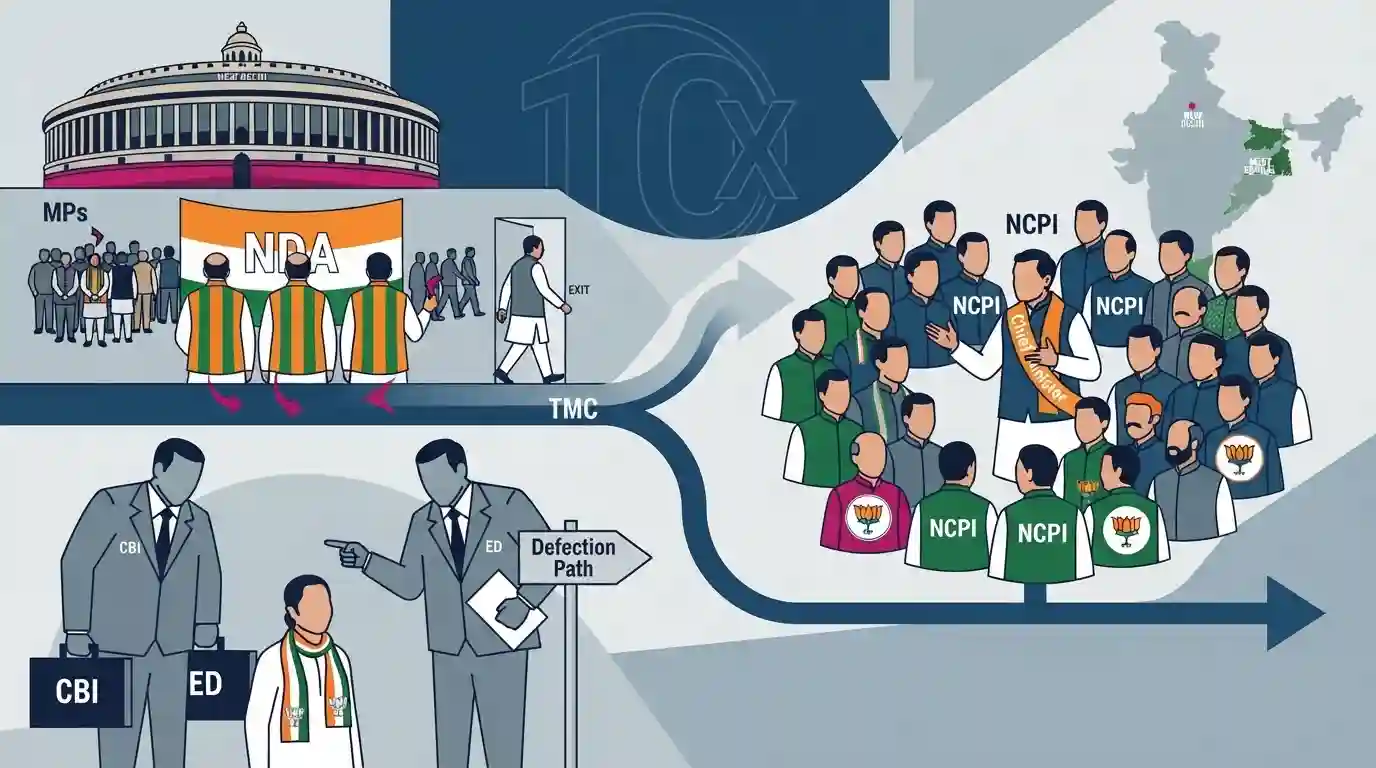
Three MPs of the Nationalist Citizens Party of India (NCPI) from West Bengal, previously belonging to the Trinamool Congress (TMC), abstained from an NDA meeting and refused to ally with the BJP. Meanwhile, West Bengal Chief Minister Suvendu Adhikari held talks with 22 MPs, which included 19 NCPI MPs and three BJP Rajya Sabha MPs who recently resigned from the TMC and were re-elected to the Upper House. TMC chief Mamata Banerjee has accused central investigative agencies, such as the Enforcement Directorate (ED) and Central Bureau of Investigation (CBI), of coercing party leaders into defecting. The situation highlights ongoing political realignment, the role of central agencies, and dynamics of the Anti-Defection Law in parliamentary democracy.
মূল বিষয়
- Three NCPI MPs (Abu Taher Khan, Khalilur Rahaman, and Yusuf Pathan), former TMC members, skipped an NDA meeting and refused to join the BJP alliance.
- West Bengal CM Suvendu Adhikari met with 22 MPs, including 19 NCPI MPs and 3 BJP Rajya Sabha MPs who recently resigned from the TMC and were re-elected with BJP support.
- TMC leader Mamata Banerjee alleged that deserting MPs and MLAs were pressured by central investigative agencies such as the ED and CBI.
- Earlier, 20 out of 28 rebel Lok Sabha MPs merged with the NCPI to align with the BJP-led NDA, raising issues relevant to the Anti-Defection Law.
গুরুত্বপূর্ণ শব্দ
Enforcement Directorate (ED)

A non-statutory economic intelligence and law enforcement agency under the Ministry of Finance. It investigates financial crimes and enforces laws like the Prevention of Money Laundering Act (PMLA) and Foreign Exchange Management Act (FEMA).
UPSC context
GS Paper 2 & 3. Highly relevant for topics on non-statutory bodies, money laundering, and central-state administrative relations.
Central Bureau of Investigation (CBI)
India's premier investigative agency functioning under the Ministry of Personnel, Public Grievances and Pensions. Deriving power from the DSPE Act, 1946, it probes cases of corruption, economic offenses, and serious crimes.
UPSC context
GS Paper 2. Essential for studying anti-corruption bodies, governance, and federal frictions regarding state consent for investigations.
National Democratic Alliance (NDA)
A center-right political alliance in India led by the Bharatiya Janata Party (BJP). First formed in 1998, it exemplifies the significant role of multi-party coalitions and regional partnerships within India's parliamentary democracy.
UPSC context
GS Paper 2. Important for understanding the evolution of coalition politics, the party system, and federal dynamics in India.
প্রিলিমস ফাঁদ
"A split by one-third of the members of a legislative party protects them from disqualification under the Tenth Schedule."
The 91st Amendment Act (2003) deleted the protection for a 'split' by one-third members. Currently, only a 'merger' agreed upon by at least two-thirds of the legislative members is protected from disqualification.
সংযুক্ত স্থির ধারণা
What are the exceptions to disqualification under the Anti-Defection Law?
- Merger Exception: Disqualification does not apply if a political party merges with another, provided at least two-thirds of its legislative members agree to the merger.
- 91st Amendment: The 91st Constitutional Amendment Act, 2003, removed the earlier exception that protected a 'split' by one-third of the party's members.
- Nominated Members: A nominated member can join a party within six months of taking their seat; joining after this period results in disqualification.
What are the foundational differences between the CBI and the ED?
- CBI Status: CBI is an attached office under the DoPT. It is not a statutory body but derives investigative powers from the DSPE Act, 1946.
- ED Status: ED functions under the Department of Revenue (Ministry of Finance) and is primarily mandated to enforce PMLA, 2002, and FEMA, 1999.
- Mandate Differences: CBI handles corruption, economic offences, and special crimes, whereas ED strictly focuses on money laundering and foreign exchange violations.
আন্তঃবিষয় প্যাটার্ন
Federalism & CBI General Consent
Allegations of coercive agency action frequently trigger questions on federalism, specifically Section 6 of the DSPE Act regarding states withdrawing 'general consent' for CBI probes.
Speaker's Role & Judicial Review
Mass defection scenarios always revive the debate around the Speaker's adjudicatory powers under the Tenth Schedule and the scope of judicial review established in the Kihoto Hollohan case (1992).

Expect a multi-statement Prelims question testing exact Tenth Schedule 'merger' conditions intertwined with the statutory status of CBI/ED.
সংযুক্ত PYQ · 4
সংযুক্ত PYQ · 4
- 2024WBCS_PRELIMSGS1
Consider the following statements: (I) Finance Commission is a Constitutional Body. (II) National Commission for Women is a Statutory Body. Which option is correct?
- 2020WBCS_PRELIMSGS1
The Supreme Court of India upheld that RTI was applicable to the
- 2020WBCS_PRELIMSGS1
The Chairperson of Rajya Sabha is
- 2022WBCS_PRELIMSGS1
The ex-officio Chairman of the Rajya Sabha is
