Sambhal Violence Judicial Inquiry Report and Communal Harmony
Source:The Hindu ↗
Why It Matters
The Sambhal incident and the subsequent report highlight contemporary challenges to communal harmony, the weaponization of demographic data for political polarization, and the sensitive role of judicial commissions in probing public order crises.
Summary
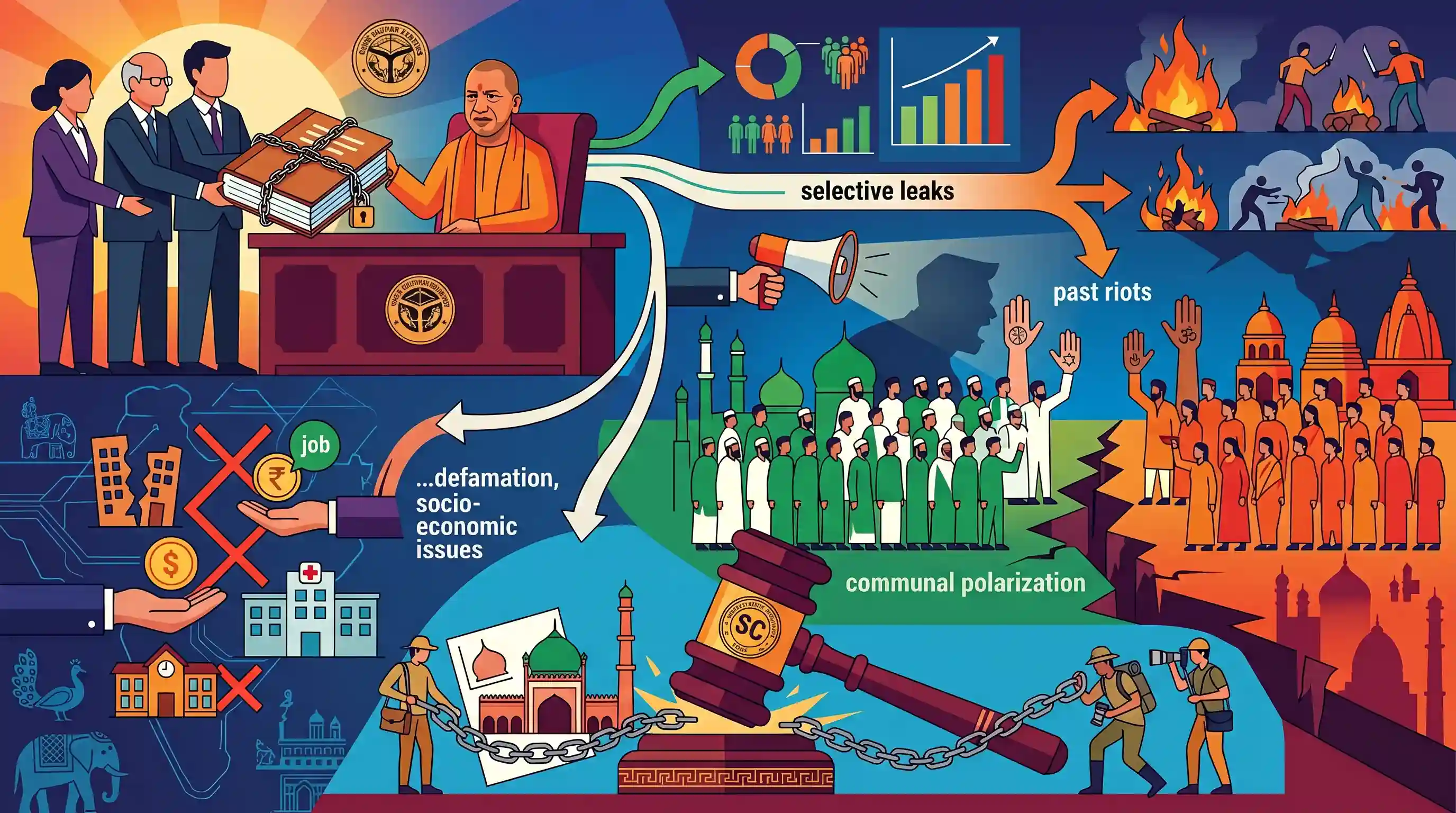
A three-member judicial commission has submitted its report to Uttar Pradesh Chief Minister Yogi Adityanath regarding the violence that erupted in Sambhal in November 2024 during an ASI survey of the Shahi Jama Masjid. Although the report remains confidential, Opposition leaders allege that its contents are being selectively leaked to emphasize demographic shifts and past riots. They accuse the government of using these leaks to stoke communal polarization, defame the minority community, and distract from core socio-economic issues. The Supreme Court has currently stayed the survey and related proceedings.
Key Points
- A three-member judicial commission submitted its report on the November 2024 Sambhal violence to UP Chief Minister Yogi Adityanath.
- The violence was triggered during an ASI-monitored survey of the Shahi Jama Masjid, resulting in casualties and tensions.
- Opposition leaders claim the confidential report is being selectively leaked to highlight demographic shifts (decline in Hindu population) and a history of riots to polarize voters.
- The Supreme Court has stayed all proceedings and the ASI survey in the dispute.
- Critics argue that focusing on demographic changes and communal narratives distracts from pressing issues like unemployment and farmer distress.
Important Terms
Judicial Commission

An ad-hoc body appointed by the executive to investigate specific incidents of public importance, such as communal violence or administrative lapses, under the Commissions of Inquiry Act, 1952.
UPSC context
GS II: Governance and Executive/Judiciary interface. Tests knowledge of the mechanism for impartial inquiries into administrative or social failures.
Archaeological Survey of India (ASI)
The premier organization under the Ministry of Culture for archaeological research, excavation, and protection of India\'s cultural heritage, administering over 3,600 ancient monuments.
UPSC context
GS I: Art & Culture and GS II: Statutory Bodies. Tests understanding of agencies protecting heritage and their role in historical disputes.
Places of Worship (Special Provisions) Act, 1991
A 1991 law that freezes the religious character of any place of worship as it existed on August 15, 1947, prohibiting its conversion to another denomination.
UPSC context
GS II: Polity and Constitution. Crucial for topics like Secularism, Communalism, and the balancing of religious rights with the Rule of Law.
Supreme Court
The apex judicial authority in India, possessing original, appellate, and advisory jurisdiction, and acting as the final interpreter of the Constitution.
UPSC context
GS II: Judiciary. Tests knowledge of judicial review, its role in maintaining social harmony, and staying lower court orders.
Communalism
An ideology prioritizing religious identity over national identity, often leading to social tension or violence between different religious communities in India.
UPSC context
GS I: Indian Society. Tests the ability to analyze social challenges, polarization, and the impact of demographic politics on internal security.
Prelims Trap
"Judicial commissions appointed under the 1952 Act have binding authority and their findings automatically mandate criminal prosecution."
Under the Commissions of Inquiry Act, 1952, findings are strictly recommendatory. The government is only obligated to table the report and an Action Taken Report (ATR) within six months, not to act on it.
Static Concepts Connected
What are the key provisions and exceptions of the Places of Worship Act, 1991?
- Status quo: Freezes the religious character of any place of worship exactly as it existed on August 15, 1947.
- Legal bar: Prevents courts from entertaining any legal proceedings aiming to alter this frozen religious character.
- AMASR exception: Specifically exempts ancient and historical monuments governed by the Ancient Monuments and Archaeological Sites and Remains (AMASR) Act, 1958.
- Ayodhya exception: The Ram Janmabhoomi-Babri Masjid dispute was explicitly excluded from the purview of this legislation.
What are the powers of a Commission of Inquiry under the 1952 Act?
- Civil court powers: They hold powers similar to a civil court for summoning witnesses, requiring public records, and recording evidence under oath.
- Tabling requirement: The appropriate government must lay the report along with an Action Taken Report before the respective legislature within six months.
- Non-binding nature: The commission's findings are legally non-binding; it is a fact-finding body, not a court of law capable of pronouncing judgments.
Cross-Topic Patterns
1991 Act vs. AMASR Act exemptions
ASI surveys at contested sites often rely on the exemption granted to historical monuments under the Places of Worship Act, creating a clash between archaeological exploration and statutory freezes.
Demographic narratives and internal security
Electoral politics frequently weaponize perceived demographic shifts, directly linking population geography (GS-1) and sociology to communalism, social polarization, and internal security challenges (GS-3).

Expect a multi-statement Prelims question testing the exact statutory exceptions to the Places of Worship Act, 1991.
Linked PYQs · 3
Linked PYQs · 3
- 2017MainsGS1
Distinguish between religiousness/religiosity and communalism giving one example of how the former has got transformed into the latter in independent India.
- 2022MainsGS1
Are tolerance, assimilation and pluralism the key elements in the making of an Indian form of secularism? Justify your answer.
- 2023MainsGS1
Discuss the impact of post-liberal economy on ethnic identity and communalism.
