Maharashtra Beaches Win First International Blue Flag Certification
Source:The Hindu ↗
Why It Matters
Blue Flag certification highlights the intersection of sustainable tourism, coastal ecosystem management, and international environmental standards, making it an important topic for Prelims and GS3 environment questions.
Summary
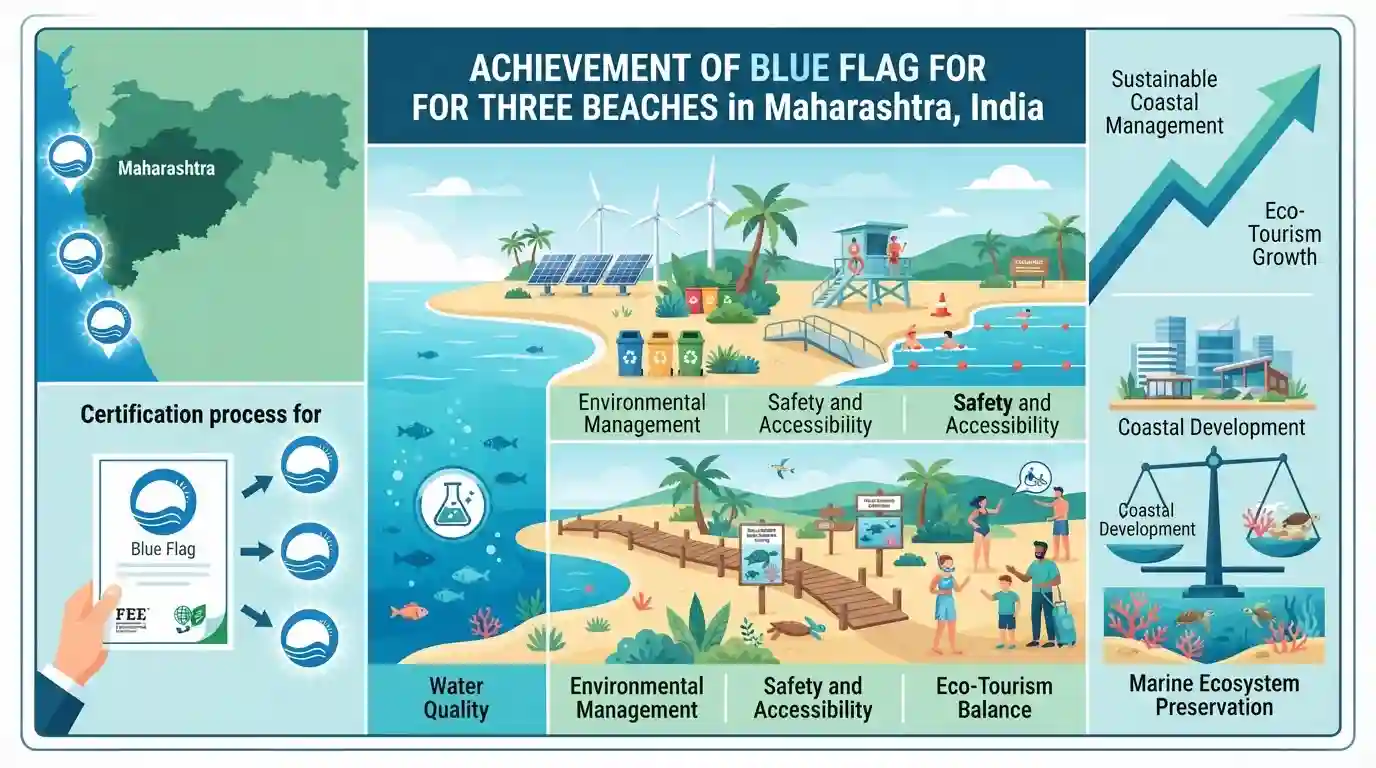
Three beaches in Maharashtra have achieved the international Blue Flag certification for the first time, marking a significant milestone in sustainable coastal management and eco-tourism. Awarded by the Foundation for Environmental Education (FEE), Denmark, the certification requires adherence to stringent environmental, water quality, safety, and accessibility criteria, balancing coastal development with marine ecosystem preservation.
Key Points
- Three beaches in Maharashtra received the international Blue Flag certification for the first time.
- Blue Flag certification is an internationally recognized eco-label awarded by the Foundation for Environmental Education (FEE), Denmark.
- To qualify for a Blue Flag, beaches must meet strict environmental, educational, safety, and accessibility criteria, including water quality standards.
- The certification boosts sustainable coastal tourism, local economic development, and marine conservation efforts in the region.
Important Terms
Blue Flag Certification

An international eco-label awarded to beaches, marinas, and boating tourism operators meeting strict environmental, educational, safety, and water quality criteria set by the Foundation for Environmental Education (FEE).
UPSC context
UPSC Paper III (Environment and Ecology): Tests awareness of international eco-labels, sustainable coastal management, and marine pollution mitigation.
Foundation for Environmental Education (FEE)
A non-governmental organization headquartered in Denmark that promotes sustainable development through environmental education, operating global programs including the Blue Flag eco-label.
UPSC context
UPSC Paper III (Environment and Conservation): Important for international environmental organizations and global eco-certification frameworks.
Prelims Trap
Blue Flag certification is a legally binding environmental treaty administered directly by the United Nations Environment Programme (UNEP).
Aspirants often assume Blue Flag is a statutory UN or UNESCO convention, whereas it is administered by a private non-governmental organization (FEE, Denmark).
Static Concepts Connected
What are the key pillars and implementing agencies of the Blue Flag certification in India?
- FEE Denmark: Global Body: Awarded annually by the Foundation for Environmental Education (FEE), Denmark, a non-profit organization.
- BEAMS Program: Domestic Scheme: Implemented in India via the BEAMS (Beach Environment & Aesthetics Management Services) program under MoEFCC.
- 33 Criteria: Core Pillars: Compliance across 33 strict criteria spanning water quality, environmental management, safety, and eco-education.
Cross-Topic Patterns
Blue Flag & ICZM Coastal Governance
Coastal eco-labels tie tourism development directly to MoEFCC's ICZM (Integrated Coastal Zone Management) project and CRZ notification rules.
Eco-Tourism & Marine Pollution Control
FEE certification criteria bridge local panchayat solid waste management duties with international marine pollution treaties like MARPOL.

Expect a matching or statement-based question linking Blue Flag certification criteria with India's domestic BEAMS program and MoEFCC mandate.
Linked PYQs · 2
Linked PYQs · 2
- 2026PrelimsGS1
Which one of the following is the first Plan Vivo certified Reducing Emissions from Deforestation and Forest Degradation (REDD+) project in India ?
- 2026PrelimsGS1
At the United Nations Ocean Conference (UNOC) held in June, 2025 in France, the Food and Agricultural Organization (FAO) of the United Nations demonstrated its leading voice on marine and ocean issues, especially on sustainable fisheries and aquaculture for resilient livelihood and "Blue Transformation". Which of the following combinations about the "Four Betters" proposed by FAO for "Blue Transformation" is correct ?
