Maharashtra extends deadline for three language policy panel
Source:Indian Express ↗
Why It Matters
The controversy over mandating Hindi as a third language in non-Hindi speaking states touches upon sensitive issues of linguistic identity, cultural diversity, and educational autonomy. It is highly relevant for GS Paper 2 under issues related to education, federalism, and the practical implementation challenges of the National Education Policy (NEP) 2020.
Summary
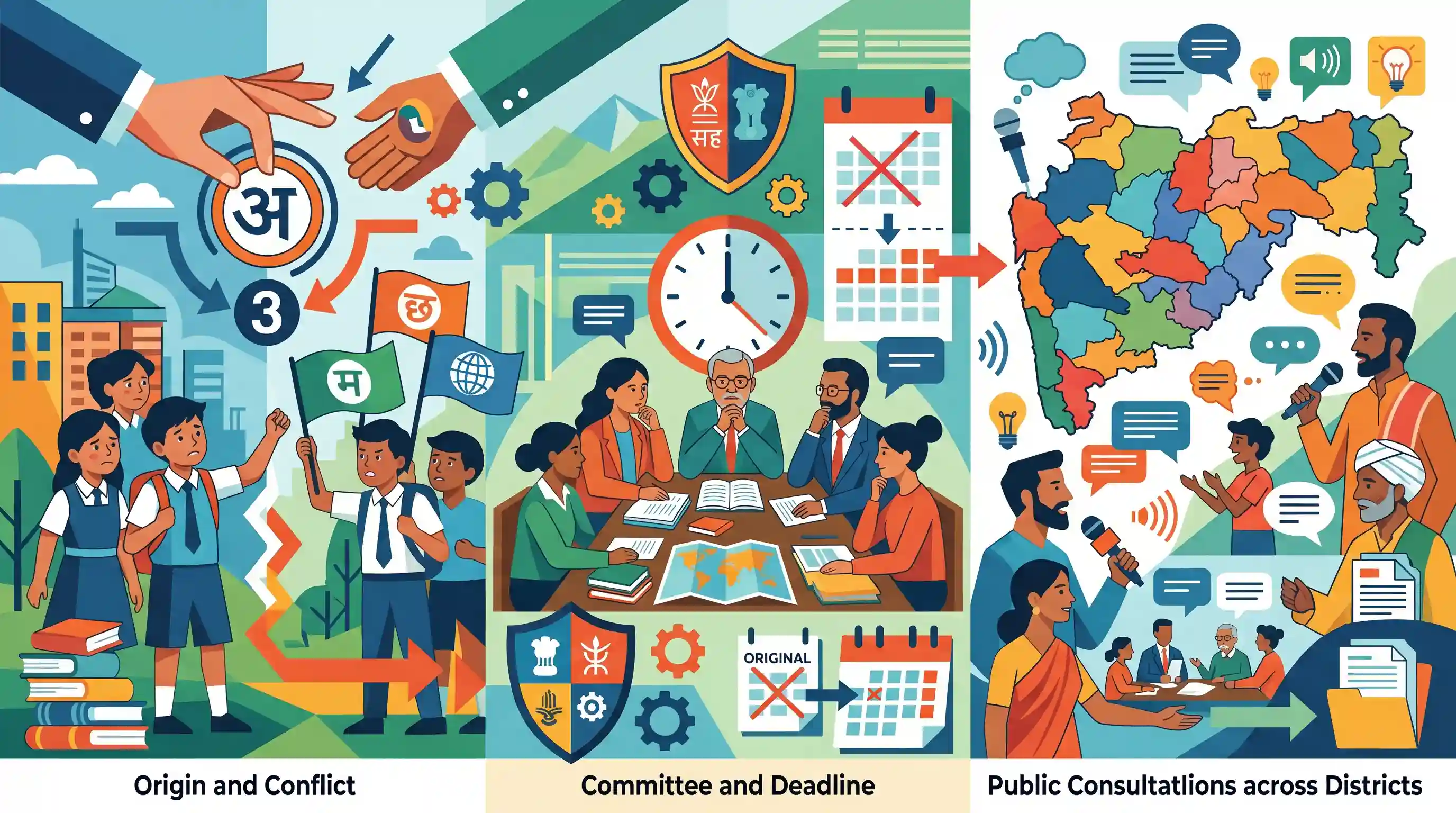
The Maharashtra government has extended the deadline for the Dr. Narendra Jadhav committee by a month to submit its report on the state's three-language policy for schools. The committee was formed in response to severe criticism over a proposed mandate that would have made Hindi the compulsory third language in English and Marathi medium schools. Currently, the committee is conducting public consultations across various districts to gather input from diverse stakeholders before finalizing its recommendations.
Key Points
- The Maharashtra government has granted a one-month extension to the Dr. Narendra Jadhav-led committee tasked with drafting a report on the state's three-language policy in school education.
- The committee was established following widespread public and political backlash against a proposal to mandate Hindi as the third language in Marathi and English medium schools.
- The panel is conducting extensive state-wide consultations with stakeholders, including parents, teachers, institutions, language activists, and politicians, to gather diverse perspectives.
- The issue underscores ongoing debates surrounding linguistic autonomy, regional identity, and the implementation of language recommendations under the National Education Policy (NEP).
Important Terms
Three-Language Formula

A 1968 framework reaffirmed in NEP 2020, mandating schools teach three languages—typically a mother tongue, English, and another modern Indian language—to foster multilingualism and national unity.
UPSC context
GS Paper 2 (Social Justice/Governance) — tests linguistic policy history, federalism challenges, and educational equity across diverse states.
National Education Policy (NEP) 2020
India's comprehensive 21st-century educational reform framework emphasizing flexible language choice, instruction in mother tongue till Grade 5, and the promotion of Indian classical languages.
UPSC context
GS Paper 2 (Governance/Social Justice) — essential for understanding state vs center policy alignment and transformative educational reforms.
Concurrent List (Education)
Found in the Seventh Schedule (List III), it includes subjects like Education (moved by the 42nd Amendment, 1976) where both Parliament and State Legislatures can legislate.
UPSC context
GS Paper 2 (Polity/Federalism) — critical for discussing the division of powers and cooperative federalism in social sector implementation.
Article 350A
A constitutional provision directing states to ensure that children from linguistic minority groups receive primary education in their mother tongue.
UPSC context
GS Paper 2 (Polity) — relates to fundamental rights and constitutional safeguards for protecting India’s linguistic diversity.
Dr. Narendra Jadhav Committee
An expert body formed by the Maharashtra government to review the implementation of the Three-Language Formula and address regional concerns over mandatory Hindi instruction.
UPSC context
Current Affairs — illustrates state-level responses to central policy frameworks and the role of expert committees in public consultation.
Prelims Trap
"NEP 2020 mandates Hindi as the compulsory third language in non-Hindi speaking states."
NEP 2020 explicitly states that no language will be imposed on any state. It only requires that two of the three chosen languages be native to India.
Static Concepts Connected
What are the key Constitutional safeguards for state languages and linguistic minorities?
- Article 345: Allows State legislatures to adopt any language(s) in use in the State, or Hindi, as their official language.
- Article 350A: Mandates states and local authorities to provide adequate facilities for instruction in the mother tongue at the primary stage of education.
- Article 350B: Provides for a Special Officer for linguistic minorities, appointed by the President, to investigate matters relating to constitutional safeguards.
How did the Three-Language Formula evolve in India's education policies?
- Kothari Commission (1964-66): First proposed this formula to balance the promotion of Hindi, the utility of English, and the preservation of regional languages.
- NPE 1968: Formally adopted the formula, promoting Hindi, English, and a modern Indian language in non-Hindi speaking states.
- NEP 2020: Retains the formula but emphasizes strict linguistic flexibility, stipulating that no language will be imposed on any state.
Cross-Topic Patterns
Linguistic Federalism + Eighth Schedule
State-level language friction often intersects with demands to include regional dialects in the 8th Schedule to secure central patronage, funding, and Sahitya Akademi recognition.
NEP Implementation + Concurrent List
Education's status on the Concurrent List means state-appointed panels evaluating NEP guidelines frequently highlight the federal tension in executing national frameworks at the regional level.

Expect a multi-statement question testing the nuances between Article 350A (primary instruction) and NEP 2020's language flexibility.
Linked PYQs · 3
Linked PYQs · 3
- 2020MainsGS2
National Education Policy 2020 is in conformity with the Sustainable Development Goal-4 (2030). It intends to restructure and reorient education system in India. Critically examine the statement.
- 2022MainsGS2
“While the national political parties in India favour centralisation, the regional parties are in favour of State autonomy.” Comment.
- 2016MainsGS1
What is the basis of regionalism? Is it that unequal distribution of benefits of development on regional basis eventually promotes regionalism? Substantiate your answer.
