Judicial Officers Appointed to Delhi High Court
Source:The Hindu ↗
Why It Matters
The article highlights the ongoing process of judicial appointments and the persistent gap between the sanctioned and working strength of High Court judges in India, which is a major factor contributing to judicial pendency.
Summary
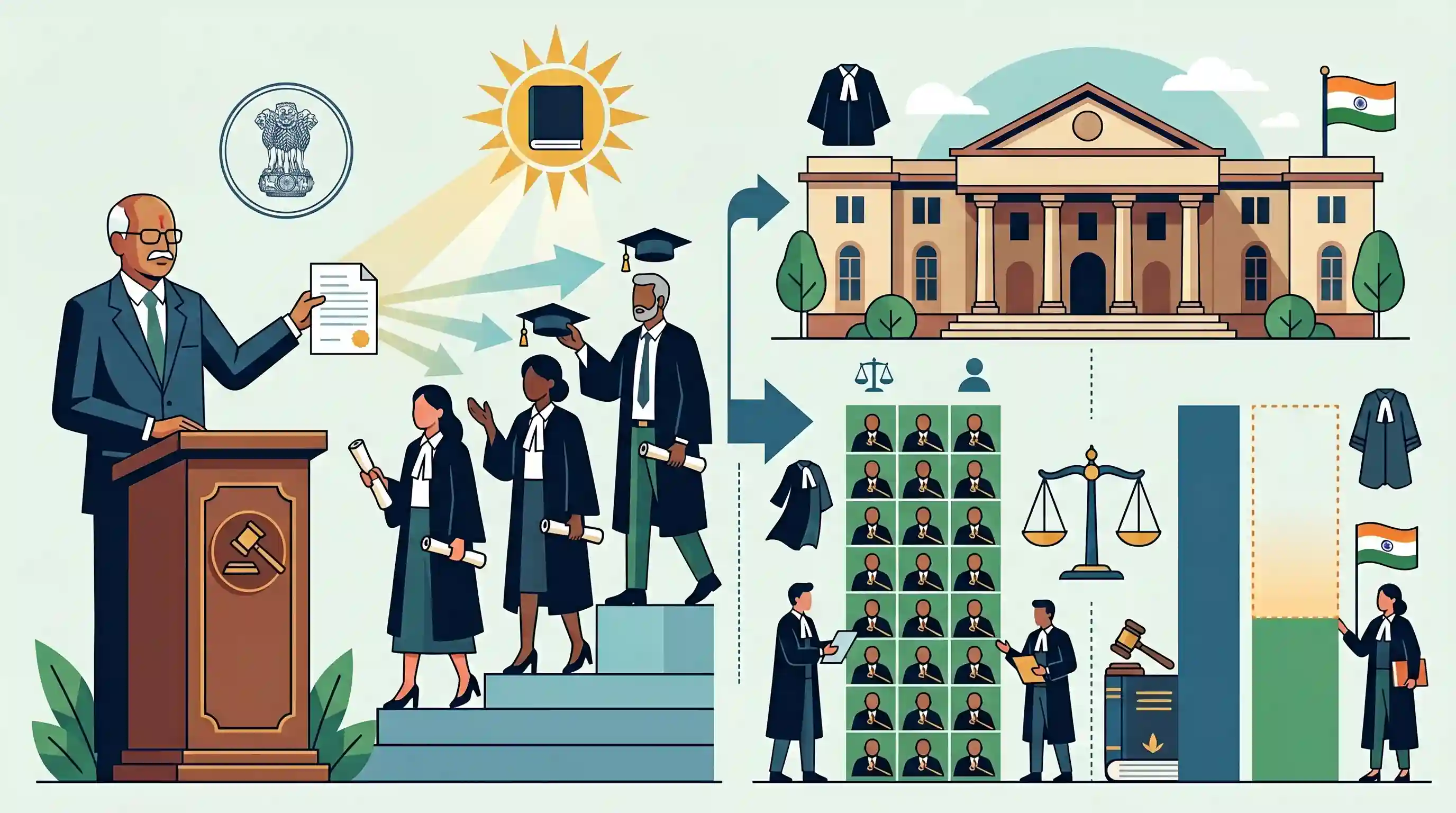
Three judicial officers—Vinod Kumar, Shail Jain, and Madhu Jain—have been appointed as judges of the Delhi High Court, as announced by Union Law Minister Arjun Ram Meghwal. These appointments, along with six others made earlier in the week, raise the court's working strength to 43 judges. The sanctioned strength of the Delhi High Court is 60, highlighting the ongoing issue of judicial vacancies.
Key Points
- Three judicial officers, Vinod Kumar, Shail Jain, and Madhu Jain, were appointed as judges of the Delhi High Court.
- Union Law Minister Arjun Ram Meghwal announced these appointments.
- Six other judges were appointed to the Delhi High Court earlier in the week.
- The working strength of the Delhi High Court has now risen to 43 judges, against a sanctioned strength of 60.
Important Terms
Article 217

Constitutional provision governing the appointment, tenure, and conditions of service for High Court judges, mandating the President appoint judges after consulting the Chief Justice of India and the State Governor.
UPSC context
GS-II (Indian Constitution). Essential for understanding the formal legal procedure for judicial appointments and independence.
Collegium System
A non-constitutional mechanism evolved through Supreme Court judgments (Three Judges Cases) where senior judges recommend appointments to the higher judiciary, making their advice largely binding on the Executive.
UPSC context
GS-II (Structure & Functioning of Judiciary). A recurring topic regarding transparency and separation of powers.
Judicial Officers
In the context of High Court elevations, these are judges from the subordinate judiciary (District Judges/Additional District Judges) promoted to the High Court, usually following a specific 'service quota' convention.
UPSC context
GS-II (Structure of Judiciary). Distinguishes between 'Bar' (advocates) and 'Bench' (service) sources of judicial recruitment.
Sanctioned Strength
The total number of judge positions authorized by the President for a specific court based on its workload, serving as the benchmark for measuring judicial capacity.
UPSC context
GS-II (Governance/Judiciary). Critical for analyzing the gap between judicial demand and resources.
Judicial Vacancies
The difference between a court's sanctioned strength and its actual working strength, often cited as a primary reason for high case pendency in the Indian legal system.
UPSC context
GS-II (Issues in Justice Delivery). Frequently tested as a challenge to the 'Ease of Doing Business' and fundamental rights.
Delhi High Court
Established in 1966, it is the premier constitutional court for the National Capital Territory of Delhi, unique for having its own dedicated High Court despite being a Union Territory.
UPSC context
GS-II (Jurisdiction). Important for understanding the special status of Delhi's administrative and judicial setup.
Prelims Trap
The Constitution fixes the sanctioned maximum strength of judges for each High Court.
Under Article 216, the Constitution does not fix a maximum strength for High Courts. It empowers the President to determine the number of judges based on workload.
Static Concepts Connected
How does the Collegium system work for High Court appointments?
- Initiation: The HC Collegium (Chief Justice of the respective HC + its two senior-most judges) initiates the proposal.
- SC Approval: The Supreme Court Collegium that approves HC appointments/transfers comprises the CJI and only two senior-most SC judges (unlike four for SC judges).
- Final Appointment: The President of India ultimately appoints them under Article 217, not the Governor.
What are the constitutional qualifications to become a High Court judge?
- Citizenship: Must be a citizen of India.
- Experience: Must have held a judicial office in India for 10 years, OR been an advocate of a High Court for 10 years.
- No Minimum Age: Unlike the President or Governor, the Constitution prescribes no minimum age requirement to be appointed as a High Court judge.
Cross-Topic Patterns
Judicial vacancies & NJAC debate
Persistent HC vacancies routinely trigger debates on executive delays, pendency of cases, and the structural void left by the Supreme Court striking down the National Judicial Appointments Commission (NJAC).
Executive-Judiciary friction over MoP
The ongoing friction between the Union Law Ministry and the Judiciary often hinges on the unresolved Memorandum of Procedure (MoP) guiding these very appointments.

Expect a prelims question contrasting the SC Collegium composition for Supreme Court (CJI+4) vs High Court (CJI+2) appointments in 2026.
Linked PYQs · 3
Linked PYQs · 3
- 2025MainsGS2
Discuss the evolution of collegium system in India. Critically examine the advantages and disadvantages of the system of appointment of the Judges of the Supreme Court of India and that of the USA.
- 2017MainsGS2
Critically examine the Supreme Court's judgement on 'National Judicial Appointments Commission Act, 2014' with reference to appointment of judges of higher judiciary in India.
- 2013PrelimsGS1
Which one of the following statements is correct?
