Jaisalmer Facility Places Bustard Chicks in Rewilding Tunnel
Source:The Hindu ↗
Why It Matters
The Great Indian Bustard (Godawan) is the state bird of Rajasthan. Its critical conservation status and ongoing breeding programs in the Desert National Park region are staple topics in RPSC RAS Prelims, especially in sections dealing with Rajasthan's biodiversity, wildlife sanctuaries, and state symbols.
Summary
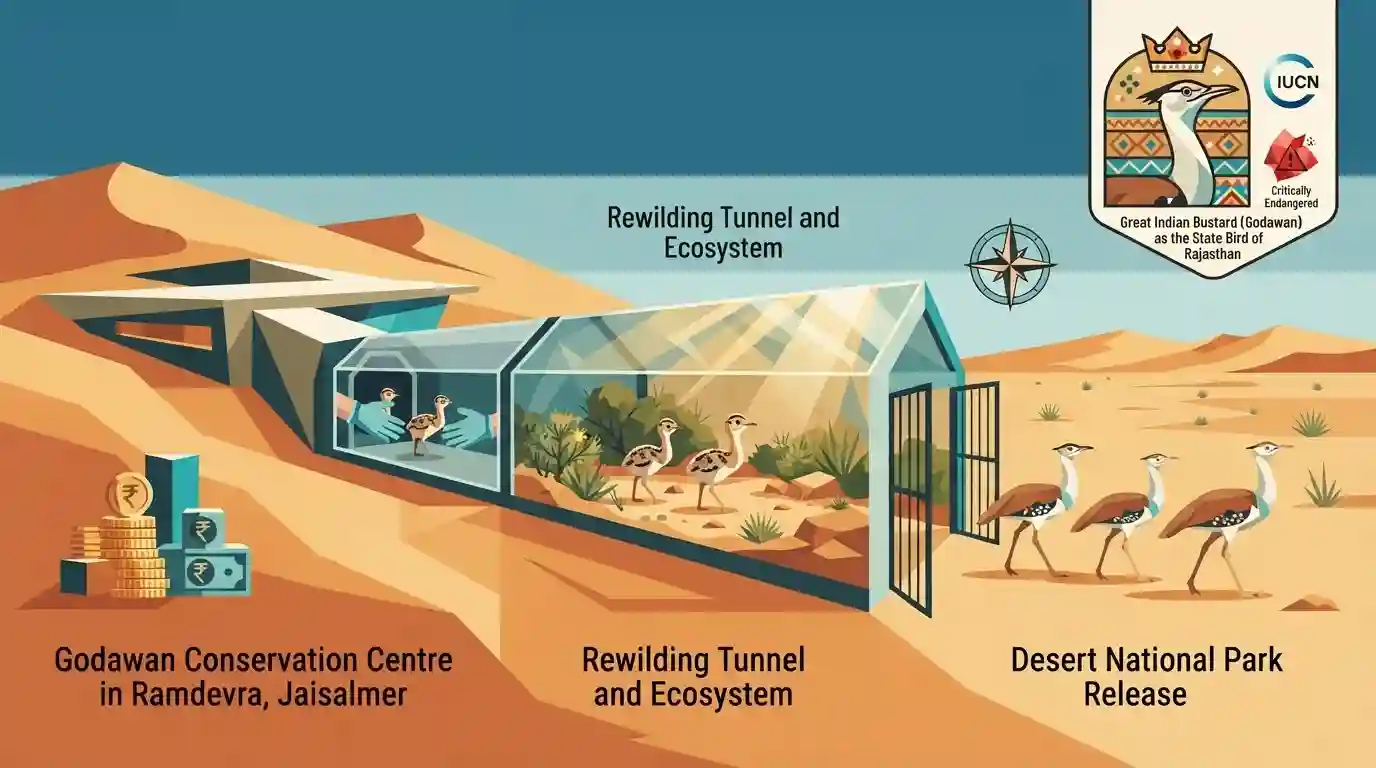
In a significant step for wildlife conservation, three Great Indian Bustard (GIB) chicks have been moved to a new rewilding tunnel at the Godawan Conservation Centre in Ramdevra, Jaisalmer. Built at a cost of ₹9.25 crore, the facility is designed to prepare these captive-bred chicks for life in the wild by minimising human contact and mimicking the natural desert ecosystem. The chicks will be monitored for about four months before being released into the Desert National Park. The GIB, or Godawan, is the state bird of Rajasthan and is currently listed as critically endangered.
Key Points
- Three Great Indian Bustard (GIB) chicks were introduced into a newly built rewilding tunnel at the Godawan Conservation Centre in Ramdevra, Jaisalmer.
- The ₹9.25 crore facility aims to train captive-bred chicks for survival in the wild by drastically minimising human contact and replicating their natural desert habitat.
- Food is supplied mechanically without human visibility, ensuring the chicks develop vital foraging and survival instincts before they are set free.
- After a four-month period of observation via CCTV, the chicks will be released into their natural habitat at the Desert National Park (DNP).
- The Great Indian Bustard (locally known as Godawan) is critically endangered and is the state bird of Rajasthan, making this conservation effort highly significant.
Important Terms
Great Indian Bustard (Godawan)

A critically endangered, large ground-dwelling bird endemic to the Indian subcontinent, representing the flagship species of dry grassland ecosystems, primarily found in Rajasthan's deserts.
UPSC context
GS Paper III (Environment & Ecology); tests knowledge of critically endangered Indian species, their conservation status (IUCN, WPA), and habitat threats.
Godawan Conservation Centre
A dedicated breeding and conservation facility in Ramdevra and Sam, Jaisalmer, designed to secure, artificially inseminate, and rear the critically endangered Great Indian Bustard in a controlled environment.
UPSC context
GS Paper III (Environment & Ecology); tests ex-situ wildlife conservation methods, species recovery programmes, and state-level initiatives.
Rewilding Tunnel
A state-of-the-art, large outdoor enclosure mimicking natural habitats, used to train and acclimate captive-bred animals to forage, survive, and adapt without human contact before full release into the wild.
UPSC context
GS Paper III (Biodiversity & Conservation); tests soft-release methodologies and innovative tools in species reintroduction programs.
Desert National Park
A major protected area in Rajasthan (spanning Jaisalmer and Barmer) representing the Thar Desert ecosystem, containing Jurassic-era fossils and serving as a critical natural habitat for the Great Indian Bustard.
UPSC context
GS Paper III (Environment & Ecology) & Prelims; tests protected areas in India, their geography, biodiversity, and local human habitations.
Captive Breeding
The process of breeding and raising rare or endangered wild species in controlled environments, like zoos or conservation centers, to increase their population size and eventually reintroduce them into natural habitats.
UPSC context
GS Paper III (Biodiversity & Conservation); tests ex-situ conservation strategies, regulatory guidelines, and measures preventing species extinction.
Prelims Trap
"The Great Indian Bustard is endemic only to the Desert National Park in Rajasthan."
While DNP holds the largest remaining population, the GIB is not strictly endemic to Rajasthan. Small, isolated populations still exist in Gujarat, Maharashtra, Karnataka, and Andhra Pradesh.
Static Concepts Connected
What are the key ecological and geographical features of the Desert National Park (DNP)?
- Geography: It spans across Jaisalmer and Barmer districts, representing the unique arid ecosystem of the Thar Desert.
- Flora & Fauna: Characterized by sand dunes, craggy rocks, and sewan grass. It hosts flagship species like the GIB, chinkara, and desert fox.
- Geological history: The park includes the Akal Wood Fossil Park, containing 180-million-year-old tree fossils from the Jurassic period.
What is the official conservation and legal status of the Great Indian Bustard?
- IUCN & WPA: Listed as Critically Endangered (CR) on the IUCN Red List and protected under Schedule I of the Wildlife (Protection) Act, 1972.
- Global Treaties: Listed in Appendix I of both CITES and the Convention on Migratory Species (CMS). The GIB was the mascot ('Gibi') for CMS COP13.
- Project GIB: Rajasthan launched this initiative to enclose and protect breeding grounds within the Desert National Park from anthropogenic pressures.
Cross-Topic Patterns
Green Energy vs. Avian Conservation
Rajasthan's booming solar and wind energy sectors require overhead transmission lines, creating fatal collision hazards for the heavy, poor-vision GIB, which led to Supreme Court interventions.
Ex-situ to In-situ conservation continuum
Rewilding tunnels bridge ex-situ (captive breeding) and in-situ (wild release) conservation. This mirrors acclimatization strategies used in Project Cheetah to prevent human imprinting before wild release.

Expect a 2026 multi-statement question mixing GIB's IUCN status, DNP geography (Jaisalmer/Barmer), and the solar power-line conflict.
Linked PYQs · 2
Linked PYQs · 2
- 2021RPSC_PRELIMSGS1
The state flower of Rajasthan is
- 2023RPSC_PRELIMSGS1
The National Tiger Conservation Authority has conferred the status of the fifth tiger sanctuary in Rajasthan, to which of the following sanctuaries?
