Cyclogenesis and Rapid Intensification in Bay of Bengal
Source:The Hindu ↗
Why It Matters
Understanding the mechanisms behind frequent and intense cyclones in the Bay of Bengal is crucial for geography and disaster management, aligning with UPSC syllabus requirements on climatology and extreme weather events.
Summary
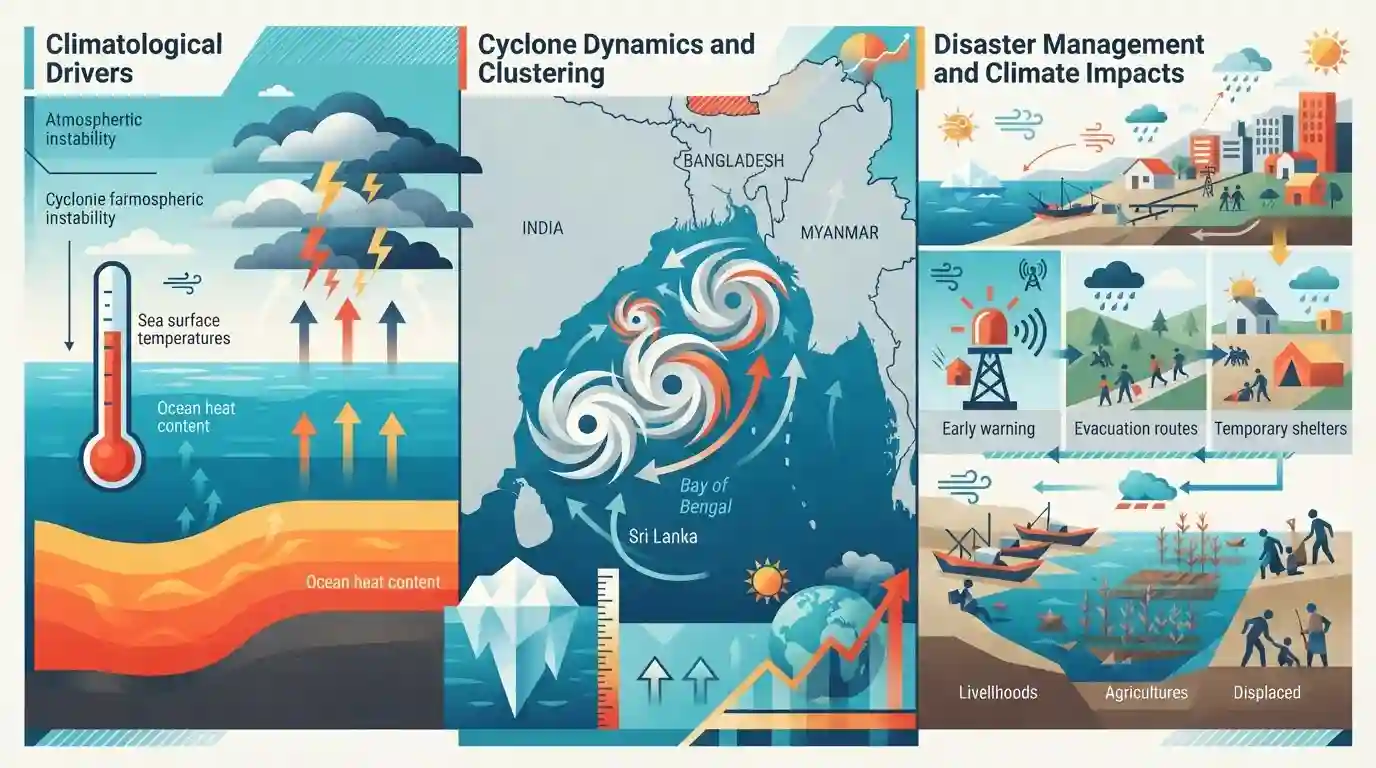
The occurrence of multiple cyclones in rapid succession over the Bay of Bengal is driven by rising sea surface temperatures, ocean heat content, and favorable atmospheric conditions. Climate change has altered regional weather dynamics, leading to rapid intensification and clustering of extreme cyclonic events, posing severe challenges to coastal safety, disaster management, and livelihoods in South Asia.
Key Points
- Frequent cyclogenesis in the Bay of Bengal highlights shifting regional weather patterns and rapid intensification.
- Ocean warming, high sea surface temperatures (SST), and deep warm water layers act as major fuel sources for successive tropical cyclones.
- Atmospheric oscillations like the Madden-Julian Oscillation (MJO) and altered wind shear patterns play critical roles in clustering cyclone events.
- Enhanced disaster preparedness and resilient coastal infrastructure are vital for mitigating recurring extreme weather events in South Asia.
Important Terms
India Meteorological Department

The national meteorological service in India, functioning under the Ministry of Earth Sciences, responsible for weather forecasting, meteorological observations, and seismological recordings, including tracking and issuing cyclone warnings.
UPSC context
UPSC Paper III (Disaster Management) and Paper I (Geography). Tests institutional frameworks for early warning systems and disaster response coordination.
Rapid intensification
The phenomenon where a tropical cyclone experiences a sharp, sudden increase in maximum sustained winds over a short timeframe, commonly defined as an increase of 30 knots within 24 hours.
UPSC context
UPSC Paper I (Climatology) and Paper III (Climate Change). Tests understanding of ocean-atmosphere interactions, warming seas, and challenges in disaster forecasting.
Static Concepts Connected
What are the primary meteorological and oceanographic conditions necessary for tropical cyclogenesis in the North Indian Ocean?
- High SSTs:: Sea surface temperatures exceeding 28°C to a depth of at least 60 meters, providing sustained latent heat energy.
- Low Wind Shear:: Low vertical wind shear, which prevents the upper-level vortex from being sheared away from the low-level circulation.
- Coriolis Force:: Presence of Coriolis force (sufficient distance from the equator) to initiate rotational cyclonic spin.
- Atmospheric Moisture:: Pre-existing low-level cyclonic vorticity and high relative humidity in the lower and middle troposphere.
Cross-Topic Patterns
Cyclone Clustering & Disaster Resilience Governance
Successive cyclogenesis over the BoB directly tests coastal vulnerability mapping and the efficacy of the National Cyclone Risk Mitigation Project (NCRMP) in disaster governance.
Marine Heatwaves & Indian Ocean Climatology
Marine heatwaves and elevated ocean heat content connect climate change science directly with Indian Ocean geopolitics and fisheries livelihoods.

BoB cyclone clustering fueled by OHC and MJO likely to feature in prelims statements on rapid intensification and tropical cyclogenesis.
Linked PYQs · 4
Linked PYQs · 4
- 2025PrelimsGS1
The World Bank warned that India could become one of the first places where wet-bulb temperatures routinely exceed 35 °C. Which of the following statements best reflect(s) the implication of the above-said report? I. Peninsular India will most likely suffer from flooding, tropical cyclones and droughts. II. The survival of animals including humans will be affected as shedding of their body heat through perspiration becomes difficult. Select the correct answer using the code given below.
- 2026PrelimsGS1
Which of the following statements with regard to India's indigenous new high resolution weather model, the 'Bharat Forecast System,' is/are correct? 1. Its objective is to generate forecasts at the Panchayats cluster level. 2. It was developed by IIT Delhi. Select the answer using the code given below :
- 2026PrelimsGS1
Which of the following best explain(s) the rationale for protecting mangrove ecosystems in the context of climate resilience? 1. Mangroves reduce tidal energy and store freshwater, making them ideal sites for paddy cultivation in saline estuarine belts. 2. Their salt-sensitive roots filter seawater, making mangroves key to converting coastal land into freshwater aquaculture zones. 3. By withstanding tidal surges and offering biomass resources, mangroves function both as natural bio-shields and livelihood bases for rural communities. Select the answer using the code given below :
- 2023MainsGS3
The Intergovernmental Panel on Climate Change (IPCC) has predicted a global sea level rise of about one metre by AD 2100. What would be its impact in India and the other countries in the Indian Ocean region?
