Nepal Political Transition and Gen Z Anti Corruption Protests
Source:The Hindu ↗
Why It Matters
The political upheaval in Nepal offers a vital case study on democratic transitions, the rising influence of youth (Gen Z) and civil society in demanding governance accountability, and the severe socio-economic costs of political instability. As an immediate neighbor, Nepal's domestic stability directly impacts India's strategic and diplomatic interests, making it highly relevant for GS Paper 2 (International Relations) and GS Paper 3 (Internal Security & Economy).
Summary
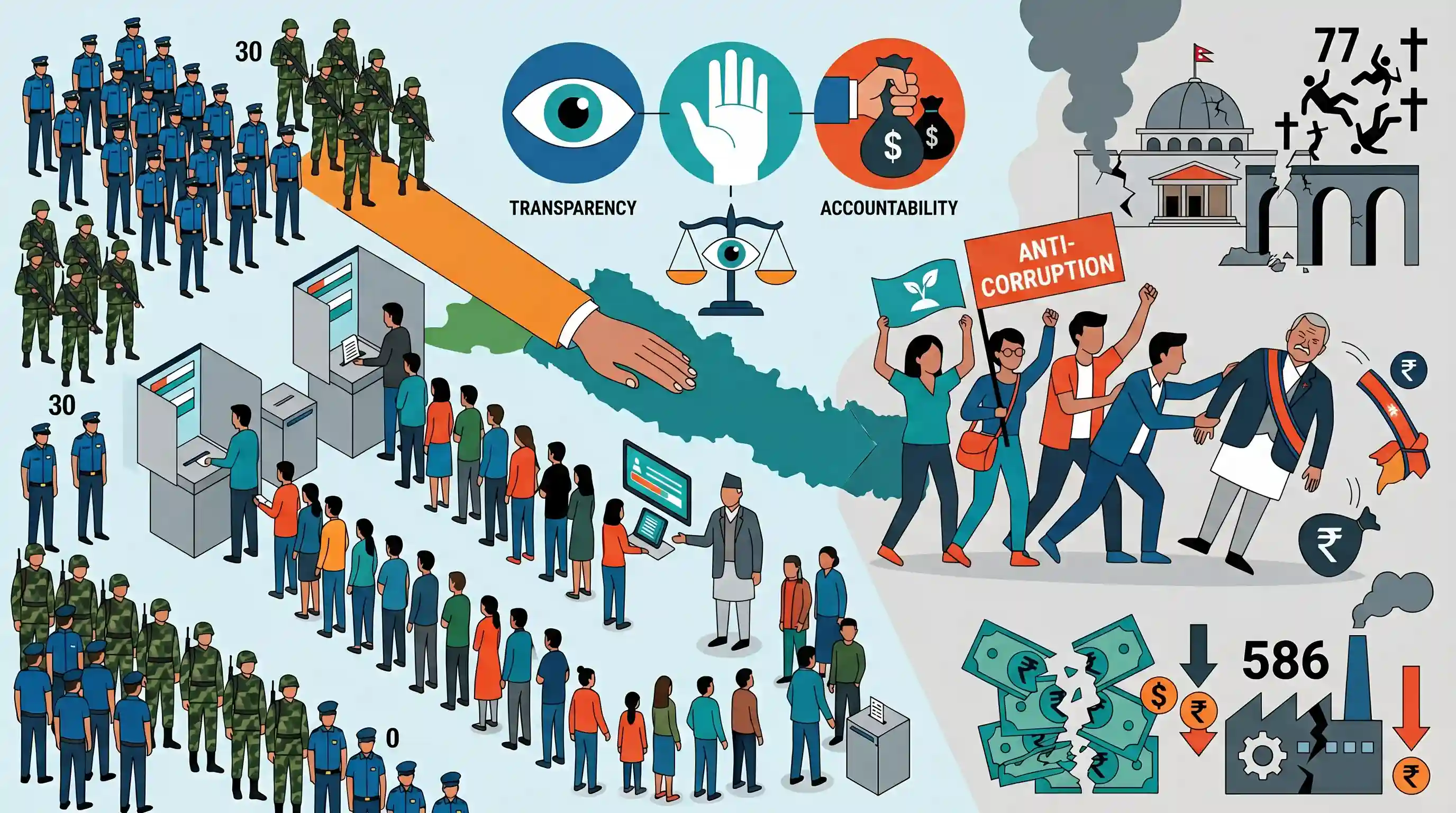
Nepal is preparing for crucial parliamentary elections on March 5, 2026, deploying nearly 300,000 security personnel—including 80,000 Army troops—to maintain peace. The country is currently under an interim government following deadly 'Gen Z' anti-corruption protests in September 2025 that successfully ousted Prime Minister K.P. Sharma Oli. The widespread civil unrest resulted in 77 fatalities, structural damage to key institutions like the Parliament and courts, and inflicted an estimated economic blow of $586 million. Despite the turmoil, nearly two-thirds of the country's 30 million citizens are eligible to participate in the upcoming democratic exercise.
Key Points
- Nepal is deploying approximately 300,000 security personnel, including 80,000 Army troops, to ensure safety during the March 5 parliamentary elections.
- The elections are taking place under an interim government following the ouster of Prime Minister K.P. Sharma Oli.
- Oli's government was toppled in September 2025 by massive 'Gen Z' led anti-corruption protests.
- The civil unrest resulted in 77 deaths, significant damage to institutions like the Parliament and courts, and caused an economic loss of $586 million.
- Nearly two-thirds of Nepal's 30 million population are eligible to vote in this crucial democratic transition.
Important Terms
Federal Parliament of Nepal

The bicameral supreme legislature of Nepal, consisting of the House of Representatives (Lower House) and the National Assembly (Upper House), established under the 2015 Constitution.
UPSC context
GS Paper II: Comparative study of constitutions and the functioning of legislatures in India's neighborhood.
House of Representatives (Pratinidhi Sabha)
The 275-member lower house of Nepal’s parliament, elected through a mixed system (FPTP and Proportional Representation) to a five-year term, responsible for lawmaking and electing the Prime Minister.
UPSC context
GS Paper II: Governance and electoral systems; vital for understanding democratic transitions in South Asia.
Nepali Army
The primary military force of Nepal, which remains apolitical and currently assists in domestic election security under the 'Integrated Election Security Plan' while protecting national sovereignty.
UPSC context
GS Paper II/III: Role of institutional actors in regional stability and internal security challenges.
Neighborhood First Policy
India’s foreign policy framework prioritizing consultative, non-reciprocal engagement with immediate neighbors like Nepal to foster regional stability, connectivity, and development cooperation.
UPSC context
GS Paper II: India and its neighborhood relations; critical for mains analysis of regional diplomacy.
Interim Government
A temporary administrative body established to manage essential government functions and maintain order during periods of political vacuum, specifically between the ousting of a leader and new elections.
UPSC context
GS Paper II: Government policies and interventions for development; tests understanding of transitional justice and constitutional law.
Federal Democratic Republic
The political system of Nepal since 2008, where power is divided between central and provincial levels, and the country is headed by a President rather than a monarch.
UPSC context
GS Paper II: Political systems and structures; relevant for comparing India’s federalism with regional neighbors.
Prelims Trap
Nepal's 2025 democratic transition resulted in the military taking executive control.
The Army is deployed strictly for election security; executive power resides with an interim civilian government following the protests, not a military junta.
Static Concepts Connected
How do modern youth-led movements differ from traditional political mobilization?
- Leaderless structure: Driven by decentralized social media networks and digital coordination rather than hierarchical political parties or charismatic leaders.
- Issue-based focus: Centered on tangible, immediate grievances like corruption, inflation, and employment, rather than rigid ideological fault lines.
- Rapid escalation: Digital connectivity allows for swift mass mobilization, frequently catching state intelligence and traditional security apparatuses off guard.
How does political instability in Nepal specifically impact India?
- Border vulnerability: The porous, open border managed by the SSB becomes highly vulnerable to smuggling, arms transit, and unregulated influxes of people during crises.
- Project delays: Domestic turmoil and interim governments often stall critical bilateral infrastructure, cross-border rail, and strategic hydropower connectivity projects.
- Geopolitical vacuum: Frequent constitutional logjams and anti-incumbency vacuums provide strategic space for extra-regional powers (like China) to expand their influence.
Cross-Topic Patterns
South Asian Youth Protests
The 2025 Nepal protests mirror the 2024 Bangladesh student movement, indicating a regional trend of leaderless, digital-first youth mobilizations toppling entrenched regimes over governance issues.
Military in Election Security
Heavy military deployment for civilian polls in Nepal highlights state fragility during democratic transitions, contrasting with India's reliance on CAPFs (like CRPF) for routine election security.

Expect a GS-2 Mains question comparing youth-led regime changes in South Asia (Nepal, Bangladesh) and impacts on India's border security.
Linked PYQs · 3
Linked PYQs · 3
- 2012MainsGS2
Discuss the contentious issues that have caused the prolonged constitutional logjam in Nepal.
- 2025MainsGS2
Civil Society Organizations are often perceived as being anti-State actors than non-State actors. Do you agree? Justify.
- 2017MainsGS3
Mob violence is emerging as a serious law and order problem in India. By giving suitable examples, analyze the causes and consequences of such violence.
