Greenland Protests Against US Coercion and Territorial Claims
Source:Indian Express ↗
Why It Matters
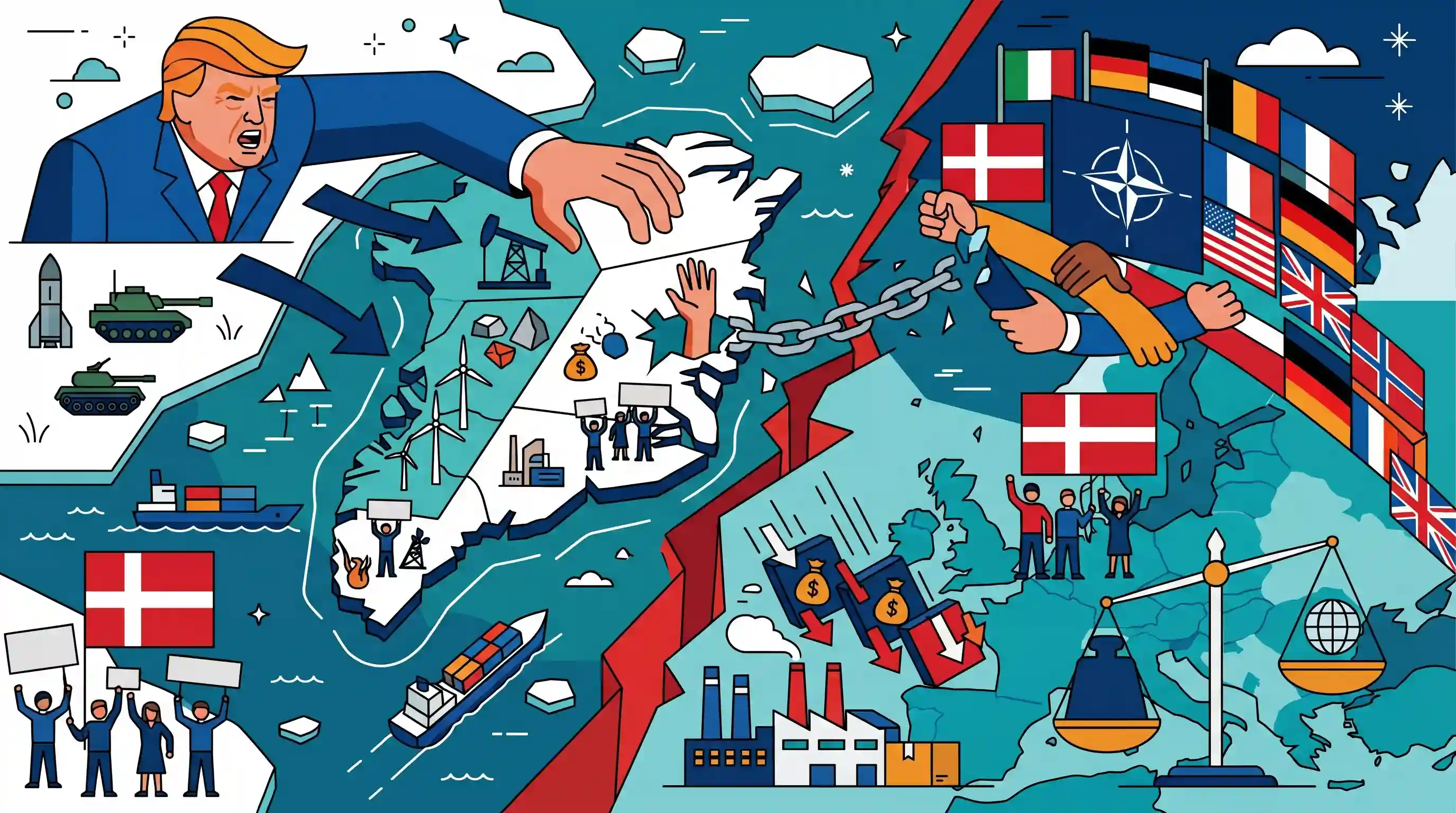
The Arctic region is becoming a major theater for global strategic competition due to climate change opening up shipping routes and resources. The US attempting to coercively acquire territory using trade tariffs highlights the weaponization of economic policy, the resurgence of sovereign nationalism, and shifting security dynamics within global alliances like NATO.
Summary
Thousands of protesters in Greenland and Denmark rallied against US President Donald Trump’s aggressive efforts to acquire Greenland, a resource-rich autonomous territory under Danish rule. Citing the island's strategic importance for Arctic security, shipping routes, and natural resources, Trump has threatened to use force and imposed coercive tariffs on several European countries to force a deal. In response, European nations have backed Denmark and emphasized self-determination for Greenland, asserting that regional security should be handled jointly through NATO. The incident highlights rising tensions in trans-Atlantic relations, the weaponization of trade tariffs for geopolitical goals, and the escalating great power competition in the Arctic region.
Key Points
- Thousands of people in Greenland and Denmark protested US President Donald Trump's attempt to coercively purchase Greenland.
- The US views Greenland as strategically critical for monitoring Arctic shipping routes, missile threats, and accessing natural resources.
- Trump has imposed tariffs (initially 10%, rising to 25%) on several European nations to pressure them into facilitating the US acquisition of the territory.
- European countries have rallied behind Denmark, sending troops for reconnaissance and emphasizing that Arctic security should be managed cooperatively through NATO.
- Greenlandic leaders and protest groups have strongly asserted their right to self-determination, insisting that the island is 'not for sale'.
Important Terms
NATO (North Atlantic Treaty Organization)

A 32-member intergovernmental military alliance established in 1949 for collective defense. It secures Greenland via Denmark’s membership and manages regional security through new initiatives like the 2026 'Arctic Sentry' framework.
UPSC context
GS-II (International Relations): Essential for understanding collective security, the trans-Atlantic alliance, and emerging military architecture in the High North.
Arctic Council
The primary intergovernmental forum for Arctic cooperation, established by the 1996 Ottawa Declaration. It excludes military matters, focusing instead on environmental protection, sustainable development, and Indigenous rights.
UPSC context
GS-II (International Relations): Key for Arctic governance; India’s 'Observer' status makes this a frequent topic for multilateralism and climate diplomacy.
Inuit
The Indigenous people inhabiting Arctic regions of Greenland, Canada, Alaska, and Russia. Constituting 90% of Greenland's population, they possess legally recognized rights to self-governance and territorial sovereignty.
UPSC context
GS-I (Geography/Social Issues): Relevant for human geography and the rights of Indigenous peoples in global resource-rich territories.
Self-determination
The international law principle asserting a people's right to freely choose their political status and sovereignty. It is enshrined in the UN Charter and the 2009 Greenland Self-Government Act.
UPSC context
GS-II (Polity/International Relations): Core concept for decolonization, state sovereignty, and legal disputes over territorial integrity.
GIUK Gap
A strategic naval chokepoint between Greenland, Iceland, and the United Kingdom. It is a critical corridor for monitoring Russian maritime movements between the Arctic and the Atlantic Oceans.
UPSC context
GS-I (Geography) & GS-II (International Relations): Essential for strategic geography and maritime security chokepoints in global power competition.
Economic Coercion
The practice of using economic tools—such as trade tariffs or investment blocks—to pressure a sovereign state into geopolitical concessions. This includes the 'weaponization of trade' for territory acquisition.
UPSC context
GS-II (International Relations) & GS-III (Economy): Tests understanding of non-military warfare and the impact of protectionist trade policies on global stability.
Pituffik Space Base
The northernmost U.S. military installation (formerly Thule Air Base). It serves as a vital node for ballistic missile early warning, space surveillance, and NATO's Arctic defense architecture.
UPSC context
GS-III (Security/Science & Tech): Strategic asset relevant to missile defense and the militarization of the Arctic.
Prelims Trap
Greenland is an independent sovereign state located in North America.
While geographically part of the North American continent, Greenland is an autonomous territory within the Kingdom of Denmark, not a sovereign nation.
Static Concepts Connected
What is the Arctic Council and what is India's status in it?
- Core Mandate: It is a high-level intergovernmental forum addressing issues faced by Arctic governments and indigenous people (excludes military security).
- Arctic States: Eight states hold sovereignty over the lands: Canada, Denmark, Finland, Iceland, Norway, Russia, Sweden, and the US.
- India's Status: India holds Observer status (since 2013), focusing on scientific research, climate studies, and operating the Himadri research station in Svalbard.
Why are Rare Earth Elements (REEs) central to the geopolitical rush for Greenland?
- REE Definition: A set of 17 metallic elements (15 lanthanides plus scandium and yttrium) essential for modern manufacturing.
- Strategic Application: They are irreplaceable in green technology (EV motors, wind turbines) and advanced military hardware (missile guidance systems).
- Supply Chain De-risking: Global powers are rushing to Greenland's newly exposed, ice-free mining zones to break China's near-monopoly on REE processing and supply.
Cross-Topic Patterns
Climate Change & New Maritime Routes
Retreating Arctic ice is opening the Northern Sea Route and Northwest Passage, drastically cutting shipping times but escalating great power rivalry over choke points and territorial claims.
Tariffs as Geopolitical Coercion
Shifting from WTO-based economic remedies to using tariffs for explicit territorial leverage blurs the lines between trade policy and militarized diplomacy, threatening the rules-based global order.

Expect a multi-statement Prelims question linking Arctic Council membership, Greenland's political status, and critical mineral chains.
Linked PYQs · 5
Linked PYQs · 5
- 2011MainsGS2
As regards the increasing rates of melting of Arctic Sea ice, the interests of the Arctic Council nations may not coincide with those of the wider world." Explain.
- 2023MainsGS2
‘The expansion and strengthening of NATO and a stronger US-Europe strategic partnership works well for India.’ What is your opinion about this statement ? Give reasons and examples to support your answer.
- 2025MainsGS2
"With the waning of globalization, post-Cold War world is becoming a site of sovereign nationalism.” Elucidate.
- 2025MainsGS3
What are the challenges before the Indian economy when the world is moving away from free trade and multilateralism to protectionism and bilateralism? How can these challenges be met?
- 2018MainsGS3
How would the recent phenomena of protectionism and currency manipulations in world trade affect macroeconomic stability of India?
