Legal Profession Regulation and Fake Degree Scrutiny
Source:The Hindu ↗
Why It Matters
The article sheds light on critical governance issues regarding the regulation of professional education and practice in India. It specifically highlights systemic flaws within the Bar Council of India and the need for institutional reform to maintain the sanctity of the legal profession. It also touches upon the contemporary challenges of judicial independence in the age of social media and the procedures concerning the designation of Senior Advocates under the Advocates Act.
Summary
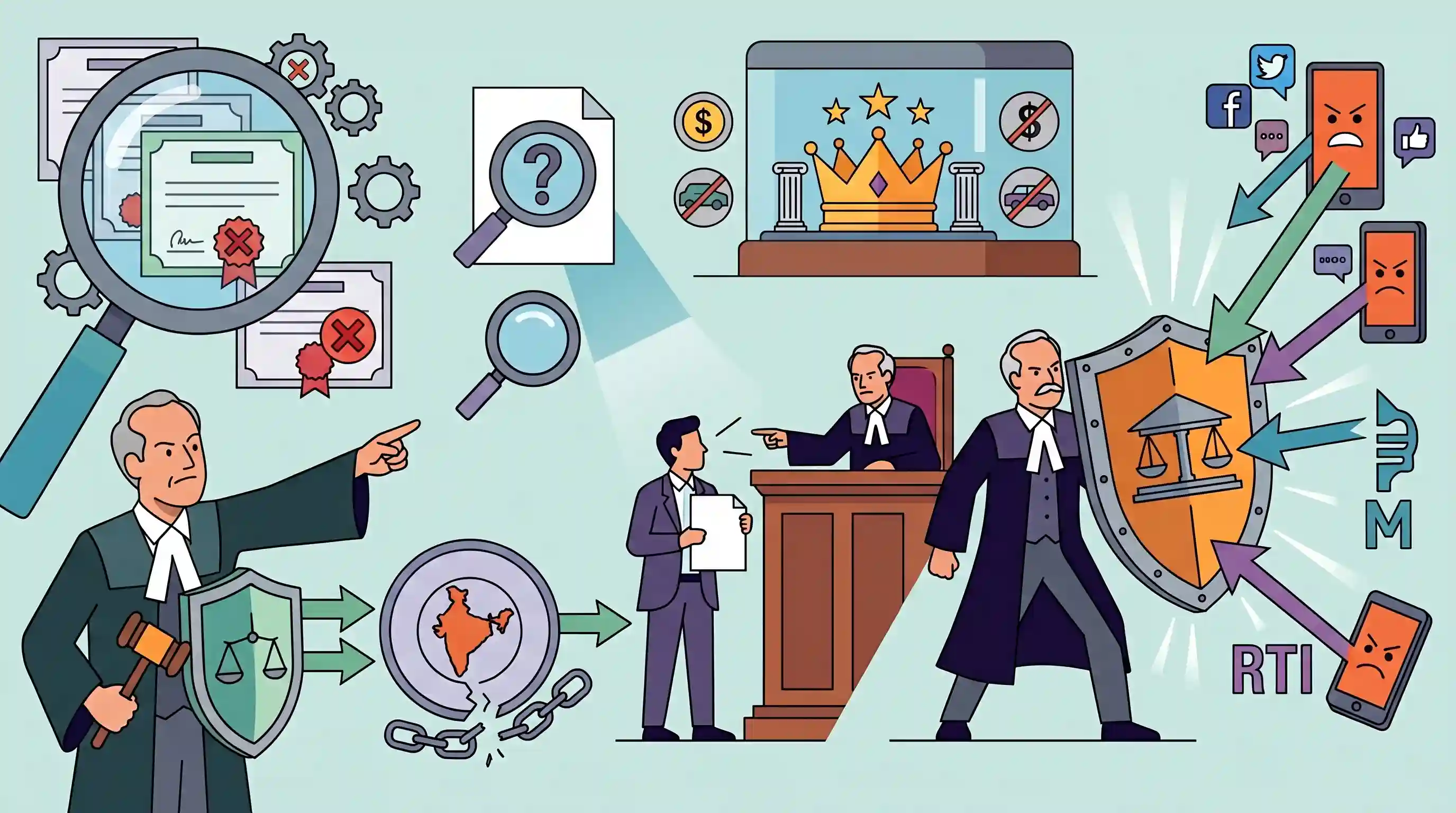
Chief Justice of India Surya Kant expressed serious concerns regarding the proliferation of individuals in the legal profession holding fake or doubtful degrees, suggesting an independent probe by the Central Bureau of Investigation (CBI) rather than relying on the Bar Council of India. The remarks came during the dismissal of a lawyer's plea seeking contempt action for delays in implementing Supreme Court guidelines on the designation of senior advocates. The Bench stressed that the 'senior advocate' designation is a distinguished honor, not a mere status symbol. Additionally, the CJI condemned recent "unwarranted attacks on the judiciary" by individuals on social media and certain RTI activists, labeling such behavior as detrimental to institutional integrity.
Key Points
- Chief Justice of India Surya Kant raised an alarm over thousands of individuals practicing law with fake or dubious educational degrees.
- The Supreme Court suggested that an independent agency like the CBI should investigate the issue, expressing little faith in the Bar Council of India due to alleged collusion.
- The observations were made while dismissing a lawyer's plea seeking contempt proceedings against the Delhi High Court over delays in senior advocate designations.
- The Bench emphasized that the designation of 'senior advocate' is an honor conferred by the court, not a status symbol to be demanded as a right.
- The Court also criticized the increasing trend of unwarranted attacks on the judiciary by social media users and certain RTI activists.
Important Terms
Bar Council of India

A statutory body established under the Advocates Act, 1961, that regulates the legal profession and legal education standards in India.
UPSC context
GS Paper 2: Statutory bodies and regulation of the legal profession. Tests knowledge of professional ethics and regulatory oversight.
Advocates Act, 1961
The primary legislation governing legal practitioners in India, which unified the bar and established the regulatory framework for advocates and senior designations.
UPSC context
GS Paper 2: Judiciary/Legislation. Important for understanding the legal framework and professional standards of the Indian bar.
Central Bureau of Investigation (CBI)
India's premier central investigative agency, governed by the DSPE Act, 1946, often tasked with probing high-stakes corruption and complex criminal cases.
UPSC context
GS Paper 2: Governance/Institutional oversight. Tests knowledge of investigative powers, federalism, and judicial-led probes.
Senior Advocate
A merit-based title conferred by the Supreme Court or High Courts on advocates of exceptional ability, standing, or specialized legal knowledge.
UPSC context
GS Paper 2: Judiciary. Relates to judicial reforms and criteria for professional distinction within the legal system.
Right to Information (RTI) Act
Legislation empowering citizens to seek information from public authorities, increasingly relevant in debates over judicial accountability and institutional transparency.
UPSC context
GS Paper 2: Governance/Transparency. Tests understanding of citizen rights versus judicial independence and potential misuse of activism.
Supreme Court of India
The highest judicial forum and final court of appeal under the Constitution of India, serving as the ultimate interpreter of laws.
UPSC context
GS Paper 2: Judiciary. Central to the Indian constitutional framework and its role in supervising professional standards and institutional integrity.
Prelims Trap
"The Bar Council of India officially designates lawyers as 'Senior Advocates' based on their seniority."
Under Section 16 of the Advocates Act, 1961, the Supreme Court or High Courts confer the 'Senior Advocate' designation, not the Bar Council of India.
Static Concepts Connected
What is the statutory role of the Bar Council of India (BCI)?
- Statutory Origin: Established under the Advocates Act, 1961, it regulates legal practice, professional etiquette, and legal education across India.
- Disciplinary Authority: Holds appellate disciplinary jurisdiction over lawyers and possesses the statutory authority to strike advocates off the rolls for fraud or misconduct.
- Dual Structure: Operates alongside State Bar Councils, which handle the primary enrollment of advocates in their respective jurisdictions.
How is the 'Senior Advocate' designation regulated in India?
- Section 16 Authority: Only the Supreme Court or a High Court can confer this status based on an advocate's exceptional legal ability, standing, or specialized knowledge.
- Objective Guidelines: Regulated by a 'Permanent Committee' formed after the landmark 2017 Indira Jaising case to ensure transparency in the designation process.
- Status as Honor: The Supreme Court views it as a distinguished honor and privilege granted by the judiciary, not a statutory right that can be demanded.
Cross-Topic Patterns
Regulatory capture in professions
The CJI's lack of faith in BCI to self-regulate fake degrees echoes past systemic failures in the Medical Council of India, which ultimately led to its replacement by the NMC.
Social media, RTI & Contempt of Court
The CJI's remarks on unwarranted online attacks link directly to ongoing debates balancing the Contempt of Courts Act, 1971, with citizens' fundamental right to free speech under Article 19(1)(a).

Expect a Prelims statement testing the exact authority (SC/HCs vs BCI) that designates Senior Advocates under the Advocates Act, 1961.
Linked PYQs · 2
Linked PYQs · 2
- 2022PrelimsGS1
With reference to India, consider the following statements: 1. Government law officers and legal firms are recognised as advocates, but corporate lawyers and patent attorneys are excluded from recognition as advocates. 2. Bar Councils have the power to lay down the rules relating to legal education and recognition of law colleges. Which of the statements given above is/are correct?
- 2023MainsGS2
“Constitutionally guaranteed judicial independence is a prerequisite of democracy.” Comment.
