Southern Europe wildfires and climate change induced disasters
Source:The Hindu ↗
Why It Matters
This article highlights the escalating threat of climate-induced disasters (forest fires and heatwaves) that are shifting seasonal baselines globally. Understanding the science behind 'virtually impossible' extreme weather, heatwave dynamics, and transition from reactive fire fighting to proactive risk mapping is crucial for both GS1 (Climatology) and GS3 (Disaster Management & Environment) domains.
Summary
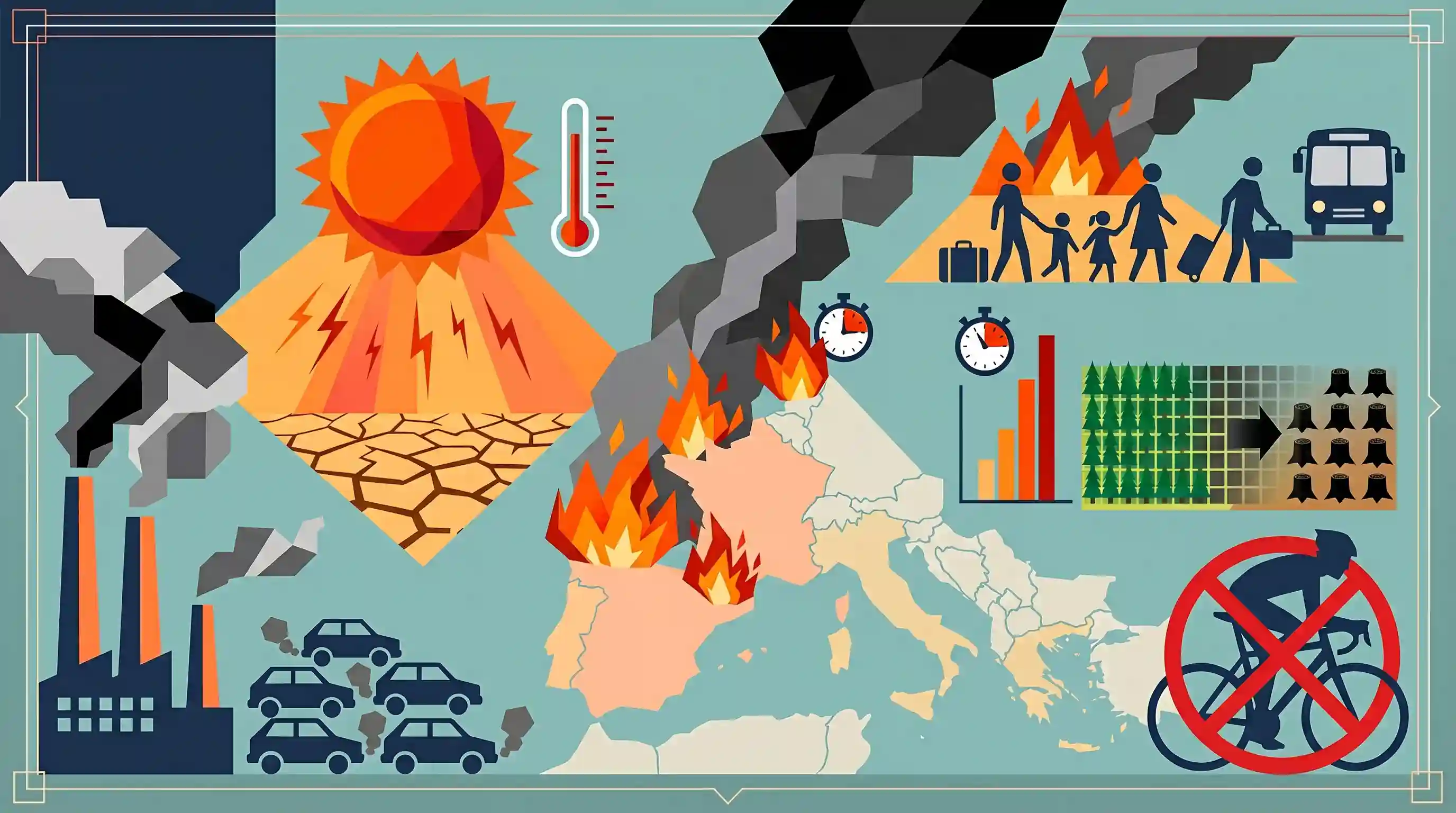
In July 2026, intense wildfires aggravated by record-breaking heatwaves and dry conditions ravaged Southern Europe, decimating over 19,000 hectares across Portugal, Spain, France, and Greece. The annual summer wildfire season began a month earlier than usual, triggering mass evacuations (such as 10,000 residents in Perpignan, France) and forcing authorities to bar spectators from Stage 3 of the Tour de France. The fires followed a catastrophic June heatwave, which scientists from the World Weather Attribution group concluded would have been 'virtually impossible' without anthropogenic climate change, raising serious concerns over accelerating climate-induced disaster patterns.
Key Points
- Early-Onset Wildfire Season: The annual summer wildfire season in southern Europe started a month earlier than usual, driven by intense heatwaves, dry air, and strong winds.
- Widespread Environmental Devastation: More than 19,000 hectares (42,000 acres) of land have been decimated across Portugal, Spain, France, and Greece, including high ecological loss in northern Portugal (13,000 hectares) and northeastern Spain (2,200 hectares).
- Socio-Economic & Event Disruptions: The extreme fire threat forced the evacuation of over 10,000 residents near Perpignan, France, and led authorities to completely ban spectators from Stage 3 of the Tour de France through the Pyrenees to keep emergency routes clear.
- Anthropogenic Climate Change Link: The World Weather Attribution (WWA) scientific group noted that the preceding June heatwave, which led to thousands of excess deaths, would have been 'virtually impossible' without global warming.
- Escalating Heat Alerts: With temperatures pushing past 40°C, multiple regions in Southern Europe have heightened heat alerts, signaling a prolonged and taxing fire-fighting season.
Important Terms
World Weather Attribution

An international scientific collaboration that conducts rapid attribution studies to analyze and quantify how human-induced climate change influences the intensity and likelihood of specific extreme weather events.
UPSC context
GS-III: Environment & Disaster Management; tests scientific evidence linking anthropogenic climate change to rising frequencies of extreme weather hazards.
Anthropogenic Climate Change
Long-term alterations in Earth's climate patterns caused by human activities, primarily the emission of greenhouse gases through fossil fuel combustion, industrial processes, and deforestation.
UPSC context
GS-I: Geography and GS-III: Environment; tests human drivers of global warming, global climate treaties, and domestic mitigation policy.
Disaster Management
The systematic organization and management of resources and responsibilities for addressing all aspects of emergencies, specifically preparedness, response, mitigation, and recovery.
UPSC context
GS-III: Disaster Management; tests institutional mechanisms, policy frameworks, and mitigation strategies for managing natural and man-made disasters.
Extreme Weather Events
Meteorological phenomena that are highly unusual, severe, or unseasonal, such as record-breaking heatwaves, prolonged droughts, catastrophic wildfires, or extreme precipitation events.
UPSC context
GS-I: Geography and GS-III: Environment; tests climate change impacts, ecological vulnerability, and adaptation mechanisms for vulnerable regions.
Prelims Trap
The Mediterranean region receives its rain in summer due to moisture-laden trade winds blowing from the sea.
In summer, the Mediterranean region is under the influence of off-shore trade winds blowing from land to sea, causing dry conditions. Rain occurs only in winter due to on-shore Westerlies.
Static Concepts Connected
What causes the unique dry-summer, wet-winter pattern of the Mediterranean climate?
- Belt Migration: The apparent movement of the sun shifts planetary wind belts northward in summer and southward in winter.
- Offshore Winds: In summer, dry, offshore trade winds blow from land to sea, leaving the region arid and highly fire-prone.
- Onshore Westerlies: In winter, the equatorward shift brings moist, onshore Westerlies, causing characteristic winter rainfall.
What is the fire suppression paradox under NDMA forest fire guidelines?
- Fuel Accumulation: Complete suppression of minor, natural forest fires counterproductively increases the forest's dry fuel load (biomass).
- Severe Outbreaks: This accumulated fuel converts subsequent accidental ignitions into uncontrollable, high-intensity canopy fires.
- Proactive Firelines: NDMA recommends utilizing physical fuel-breaks, including Kachha (retained trees, cleared undergrowth) and Pucca (fully cleared) fire lines.
Cross-Topic Patterns
Viticulture and shifting climate zones
Aridification of Southern Europe threatens historic Mediterranean crop patterns, forcing viticulture and olive cultivation northward and restructuring global GI agricultural trade.
Attribution science and climate litigation
Quantifying anthropogenic contributions to specific weather events provides a scientific basis for Global South legal claims under the UNFCCC Loss and Damage fund.

NDMA's fire line classifications (Kachha/Pucca) and the fuel accumulation paradox will likely feature in GS3 Disaster Management.
Linked PYQs · 3
Linked PYQs · 3
- 2020MainsGS3
Discuss the recent measures initiated in disaster management by the Government of India departing from the earlier reactive approach.
- 2025PrelimsGS1
The World Bank warned that India could become one of the first places where wet-bulb temperatures routinely exceed 35 °C. Which of the following statements best reflect(s) the implication of the above-said report? I. Peninsular India will most likely suffer from flooding, tropical cyclones and droughts. II. The survival of animals including humans will be affected as shedding of their body heat through perspiration becomes difficult. Select the correct answer using the code given below.
- 2013MainsGS1
Bring out the causes for the formation of heat islands in the urban habitat of the world.
