Home Minister Stresses Promotion of Indian Languages Over English
Source:The Hindu ↗
Why It Matters
Ongoing federal frictions over the three-language formula and allegations of Hindi imposition are recurrent issues in India's polity. Understanding the Centre's decolonial narrative versus the regional states' defense of linguistic pluralism is crucial for analyzing India's federal structure, unity in diversity, and the implementation challenges of the National Education Policy 2020.
Summary
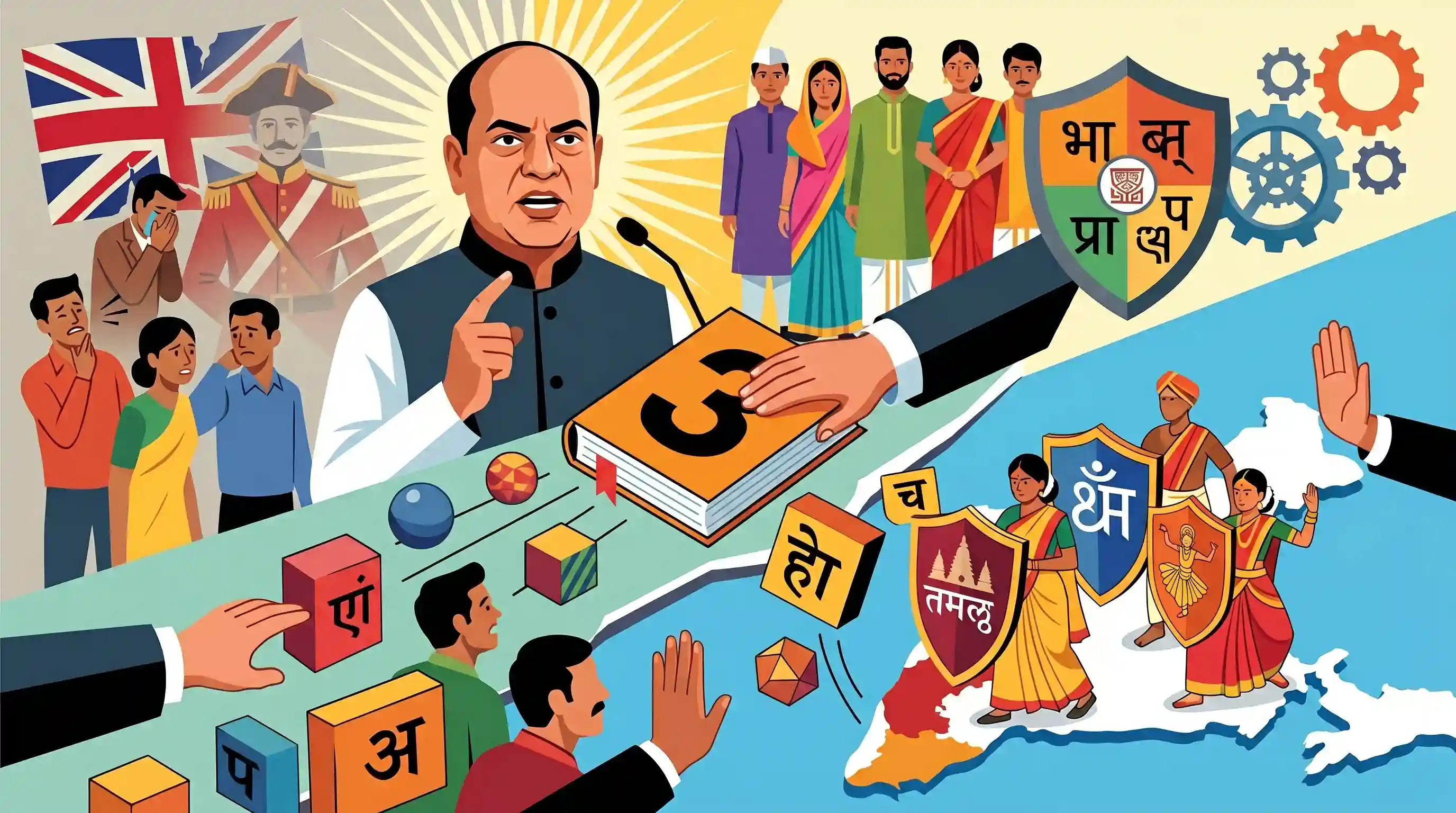
Union Home Minister Amit Shah emphasized the necessity of using Indian languages to truly embody the Indian identity, warning that speaking English will soon become a source of shame as India sheds its colonial mindset. Citing the 'Panch Pran' resolutions for 'Amrit Kaal', the Centre has established the Bharatiya Bhasha Anubhag to promote regional languages in administration. However, this initiative has reignited debates over linguistic federalism, with states like Tamil Nadu and Karnataka continuing to oppose the National Education Policy's three-language formula, citing concerns of Hindi imposition.
Key Points
- Union Home Minister Amit Shah stated that the continued use of English represents a colonial mindset and predicted its speakers will soon feel ashamed.
- The push to replace foreign languages with Bharatiya Bhashas (Indian languages) in governance aligns with PM Modi's 'Panch Pran' resolution for the Amrit Kaal.
- A new official body, the Bharatiya Bhasha Anubhag (BBA), has been established to facilitate the use of Indian languages in central administration.
- The Centre's language policies, particularly the three-language formula under the National Education Policy 2020, continue to face strong opposition from non-Hindi speaking states like Tamil Nadu and Karnataka over fears of Hindi imposition.
Important Terms
National Education Policy (NEP) 2020

A comprehensive 2020 framework overhauling India's education system. It replaces the 1986 policy, emphasizing a 5+3+3+4 structure, multidisciplinary learning, and instruction in mother tongues up to Grade 5.
UPSC context
GS Paper II (Education/Social Justice); tests knowledge of transformative reforms and federal implementation challenges.
Panch Pran
Five resolves introduced for "Amrit Kaal" (2047): building a developed India, removing colonial mindsets, taking pride in heritage, ensuring national unity, and fulfilling the duties of citizens.
UPSC context
GS Paper IV (Ethics) and Paper II (Governance); relevant for India's long-term vision and national values.
Bharatiya Bhasha Anubhag (BBA)
A section under the Ministry of Home Affairs created to promote Indian languages in administration and governance through digital translation tools, aiming to reduce dependence on English.
UPSC context
GS Paper II (Governance); relates to administrative reforms, linguistic inclusivity, and e-governance technology.
Eighth Schedule
A constitutional schedule (Articles 344(1) and 351) recognizing 22 languages for official protection, development, and representation in government recruitment and competitive examinations like the UPSC.
UPSC context
GS Paper II (Polity); tests constitutional provisions on linguistic diversity and minority rights.
Three-Language Formula
A policy framework requiring students to learn their mother tongue, English, and a third language—usually Hindi in non-Hindi states or another Indian language in Hindi-speaking states.
UPSC context
GS Paper II (Polity/Social Justice); central to debates on national integration versus "Hindi imposition."
Linguistic Federalism
A federal structure where state boundaries and administrative autonomy are based on linguistic identity, balancing regional cultural aspirations with national unity.
UPSC context
GS Paper II (Polity/Federalism); tests the history of state reorganization and contemporary center-state identity tensions.
Prelims Trap
"The National Education Policy (NEP) 2020 mandates Hindi as one of the compulsory languages across all states."
NEP 2020 retains the three-language formula but introduces complete flexibility, explicitly stating that no language will be imposed on any State.
Static Concepts Connected
What are the key Constitutional provisions regarding Official Languages?
- Article 343: Hindi in Devanagari script is the official language of the Union, though English was permitted to continue initially.
- Article 344: Provides for the constitution of a Parliamentary Committee and an Official Language Commission to recommend the progressive use of Hindi.
- Article 351: Directs the Union government to promote the spread of the Hindi language to serve as a medium of expression for India's composite culture.
What is the evolution of the Three-Language Formula in India?
- Origin: Proposed by the Kothari Commission (1964-66) to promote national integration, recommending Hindi, English, and a regional language.
- Original Objective: Adopted to balance language learning: Hindi-speaking states were meant to learn a southern language, while non-Hindi states learned Hindi.
- NEP 2020 Shift: Continues the formula but adds flexibility. It mandates that at least two of the three languages must be native to India, without imposing any specific language.
Cross-Topic Patterns
Linguistic federalism and Article 350A/B
The push for Hindi often reignites debates on protecting linguistic minorities. The Special Officer for Linguistic Minorities (Art 350B) monitors safeguards, while Art 350A encourages instruction in the mother tongue at primary stages.
Decolonization of laws and administration
Eradicating the colonial mindset (Panch Pran) connects this language policy to recent overhauls in criminal justice (BNS replacing the colonial IPC) and the renaming of Raj-era institutions and public spaces.

Expect a 2026 Prelims question pairing Article 351 (promoting Hindi) with constitutional safeguards for linguistic minorities (Art 350A/B).
Linked PYQs · 4
Linked PYQs · 4
- 2020MainsGS2
National Education Policy 2020 is in conformity with the Sustainable Development Goal-4 (2030). It intends to restructure and reorient education system in India. Critically examine the statement.
- 2016MainsGS1
Has the formation of linguistic States strengthened the cause of Indian Unity?
- 2024PrelimsGS1
The Constitution (71st Amendment) Act, 1992 amends the Eighth Schedule to the Constitution to include which of the following languages? 1. Konkani 2. Manipuri 3. Nepali 4. Maithili Select the correct answer using the code given below:
- 2008PrelimsGS1
Under which one of the following Constitution Amendment Acts, four languages were added to the languages under the Eighth Schedule of the Constitution of India, thereby raising their number to 22?
