Global Tariff Dynamics and Multilateral Trading System Disruptions
Source:Indian Express ↗
Why It Matters
Tariffs are at the heart of current global economic shifts and trade wars. A clear conceptual understanding of tariffs is essential for aspirants to critically analyze issues related to protectionism, WTO reforms, and the impact of import duties on India's economic growth and inflation.
Summary
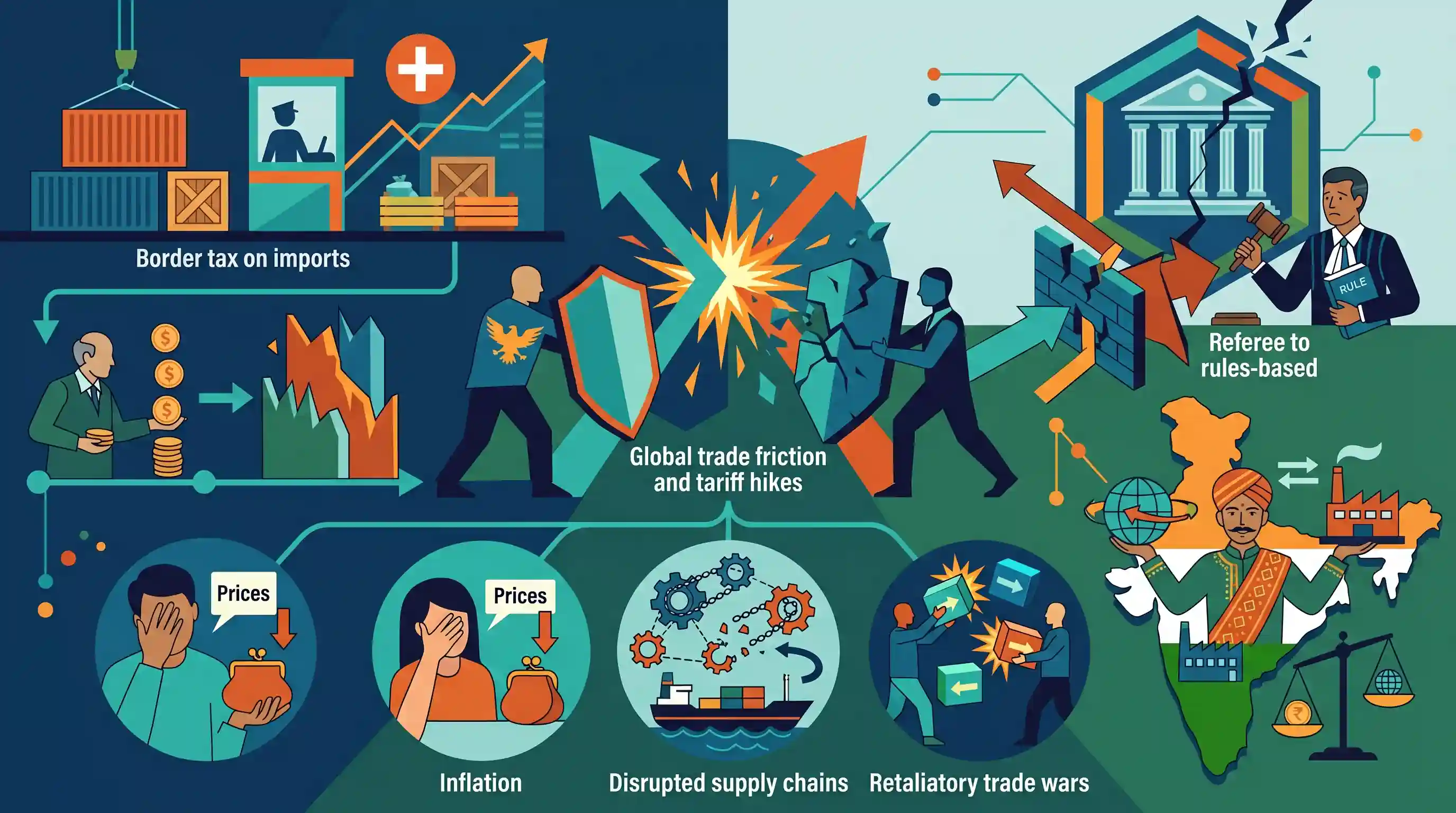
The article explains the fundamental economic concept of a 'tariff,' detailing it as a border tax levied on imported goods. It traces the evolution of tariffs from simple revenue-generating tools to modern instruments of geopolitical leverage and protectionism. Highlighting recent trends, such as the US-led tariff hikes and global trade friction, the piece explores the macroeconomic consequences of tariffs, including imported inflation, disrupted global supply chains, and the risk of retaliatory trade wars. The article also provides context on how this shift challenges the multilateral, rules-based trading system overseen by the World Trade Organization (WTO) and impacts India's contemporary trade posture.
Key Points
- A tariff is a tax or customs duty imposed on imported goods, designed to make foreign products more expensive and artificially boost the competitiveness of domestic goods.
- While historically used as a primary source of government revenue, modern tariffs are largely deployed as tools of protectionism to shield domestic industries and employment from international competition.
- The aggressive use of tariffs often results in retaliatory measures, sparking 'Trade Wars' that disrupt global supply chains, increase consumer inflation, and slow down global economic growth.
- The contemporary resurgence of tariffs—often bypassing World Trade Organization (WTO) norms—signals a broader geopolitical shift away from multilateral free trade towards economic nationalism and bilateralism.
- For India, calibrating tariffs remains a delicate balancing act between protecting domestic manufacturing under initiatives like 'Aatmanirbhar Bharat' and integrating effectively into Global Value Chains (GVCs).
Important Terms
Tariff

A tax imposed by a government on imported goods, designed to protect domestic producers from foreign competition or to generate national revenue.
UPSC context
GS Paper 3 (Economy); essential for topics on trade policy, import substitution, and impacts on domestic manufacturing.
World Trade Organization (WTO)
A 164-member international body established in 1995 to oversee global trade rules, manage trade agreements, and resolve disputes between member nations.
UPSC context
GS Paper 2 & 3; crucial for global governance, dispute settlement mechanisms, and Agreement on Agriculture (AoA).
Protectionism
Economic policy of restricting imports through tariffs, quotas, or subsidies to shield domestic industries and workers from foreign competition.
UPSC context
GS Paper 3; tests understanding of globalization vs. inward-looking policies and their impact on India’s 'Make in India' initiative.
Free Trade Agreements (FTAs)
Pacts between countries to reduce or eliminate trade barriers like tariffs, facilitating easier movement of goods and services between member nations.
UPSC context
GS Paper 2 & 3; key to India’s recent bilateral trade strategy (e.g., India-UAE CEPA, India-Australia ECTA).
General Agreement on Tariffs and Trade (GATT)
A 1947 multilateral treaty aimed at reducing trade barriers; it served as the global trade framework until its replacement by the WTO.
UPSC context
GS Paper 3; important for the historical evolution of international trade and the shift to the Uruguay Round.
Trade War
An economic conflict where nations retaliate against each other’s trade barriers, frequently leading to disrupted supply chains and higher global inflation.
UPSC context
GS Paper 2 & 3; focuses on geopolitical friction (US-China) and its consequences for Indian exports and global stability.
Prelims Trap
Granting MFN status allows a country to offer exclusive, preferential tariff reductions to a specific allied trading partner.
MFN actually mandates non-discrimination. Under core WTO rules, a trade advantage (like a lower tariff) given to one nation must immediately be extended to all other WTO members.
Static Concepts Connected
What are the three major WTO-compliant trade remedy measures against imports?
- Anti-Dumping Duty: Levied when foreign companies export goods at prices below their fair market value or domestic cost of production.
- Countervailing Duty: Imposed to neutralize the price advantage foreign exporters gain from unfair subsidies provided by their home governments.
- Safeguard Measures: Temporary tariffs applied when a sudden, massive surge in perfectly fair imports threatens to cause serious injury to the domestic industry.
How do tariffs contribute to macroeconomic cost-push inflation?
- Input Cost Escalation: Tariffs raise the landed cost of essential imported raw materials and intermediate goods (like electronic components or specialized steel).
- Cascading Price Effect: Domestic manufacturers pass these increased input costs onto consumers through higher retail prices, driving inflation irrespective of domestic demand levels.
Cross-Topic Patterns
Tariff evasion & Rules of Origin (CAROTAR)
As global tariff wars escalate, countries bypass duties by routing goods through FTA nations (e.g., China via ASEAN). This makes strict 'Rules of Origin' (CAROTAR) a critical regulatory tool for India.
Import Substitution via PLI & Tariffs
India pairs strategic tariff walls on finished goods with Production-Linked Incentives (PLI) to compel global manufacturers to localize supply chains, echoing historical import substitution strategies.

Expect a multi-statement question in 2026 combining WTO's MFN principle, tariff-induced imported inflation, and India's CAROTAR rules.
Linked PYQs · 4
Linked PYQs · 4
- 2025MainsGS3
What are the challenges before the Indian economy when the world is moving away from free trade and multilateralism to protectionism and bilateralism? How can these challenges be met?
- 2018MainsGS2
What are the key areas of reform if the WTO has to survive in the present context of "Trade War', especially keeping in mind the interest of India?
- 2016MainsGS2
The broader aims and objectives of WTO are to manage and promote international trade in the era of globalization. But the Doha round of negotiations seem doomed due to differences between the developed and the developing countries." Discuss in the Indian perspective.
- 2020PrelimsGS1
With reference to Trade-Related Investment Measures (TRIMS), which of the following statements is/are correct? 1. Quantitative restrictions on imports by foreign investors are prohibited. 2. They apply to investment measures related to trade in both goods and services. 3. They are not concerned with the regulation of foreign investment. Select the correct answer using the code given below:
