Maoism origins ideology and Left Wing Extremism in India
Source:Indian Express ↗
Why It Matters
UPSC frequently asks about Left Wing Extremism, its spread, and strategies to counter it. Grasping the foundational ideology of Maoism helps aspirants write nuanced answers connecting the socio-economic marginalization of tribals and peasants to the internal security threat.
Summary
The article unpacks the term 'Maoist', tracing its origins to Mao Zedong's adaptation of Marxist-Leninist ideology for an agrarian context. It explains how Maoism diverges from traditional communism by relying on the rural peasantry rather than the industrial proletariat to lead an armed revolution. In India, this ideology forms the bedrock of Left Wing Extremism (LWE) or Naxalism, which originated in the late 1960s. Understanding this ideological root is vital for comprehending the motivations of LWE groups and the socio-economic drivers that fuel one of India's major internal security challenges.
Key Points
- Maoism is a political ideology derived from the teachings of Chinese leader Mao Zedong, adapting Marxism-Leninism to agrarian societies.
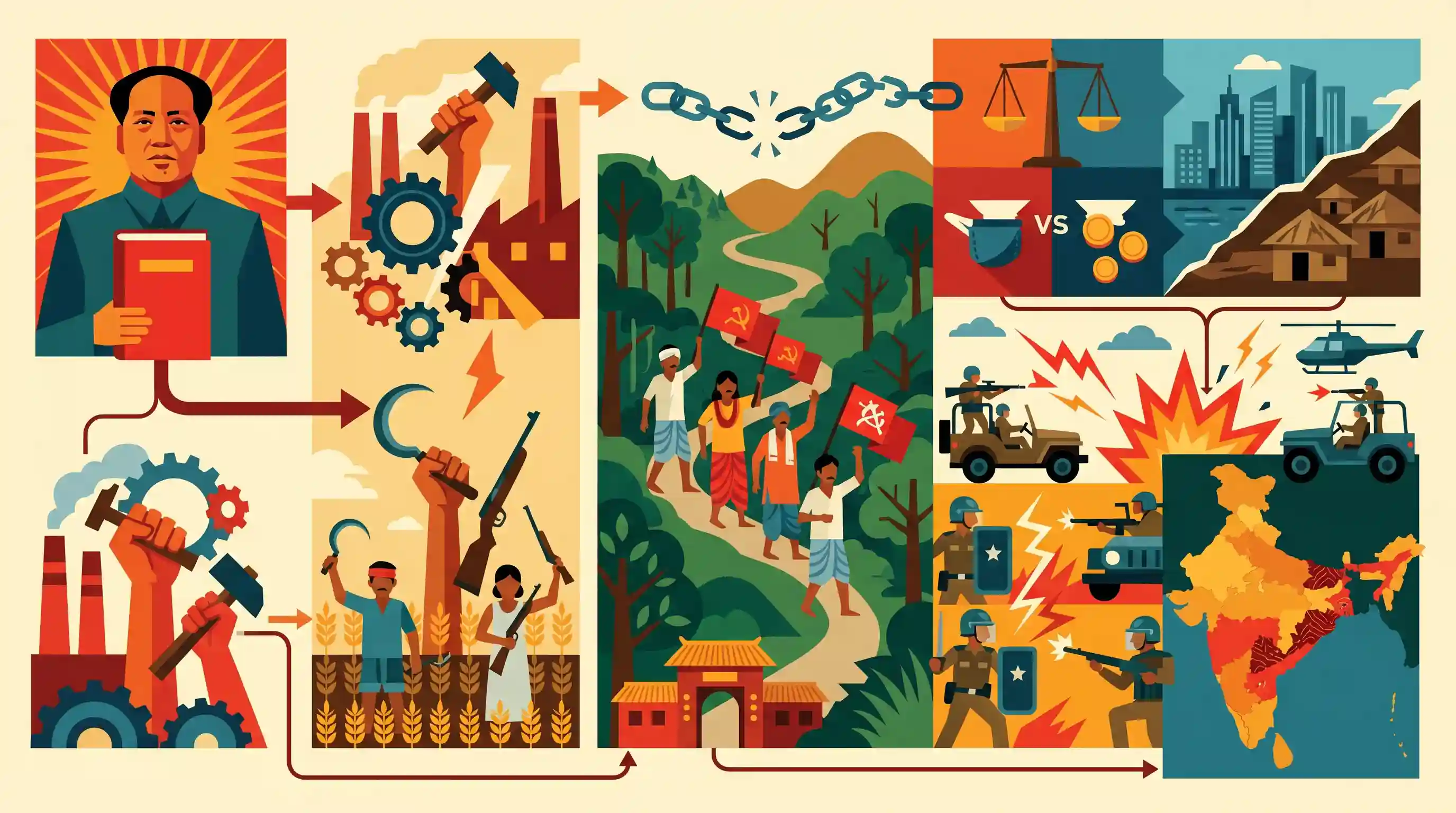
- Unlike orthodox Marxism, which identifies the industrial working class (proletariat) as the vanguard of revolution, Maoism places the rural peasantry at the center of armed struggle.
- In the Indian context, Maoism gave ideological fuel to the Naxalbari uprising of 1967, evolving into the broader Left Wing Extremism (LWE) or Naxalite movement.
- Maoist insurgency remains a persistent internal security challenge in India, exploiting socio-economic marginalization, though state interventions have steadily reduced its geographical footprint.
Important Terms
SAMADHAN doctrine

A 2017 multi-pronged counter-insurgency strategy. SAMADHAN stands for Smart leadership, Aggressive strategy, Motivation, Actionable intelligence, Dashboard-based KPIs, Harnessing technology, Action plans, and No access to financing.
UPSC context
GS Paper III: Internal Security. Tests knowledge of the government's strategic framework to eradicate Left Wing Extremism.
Communist Party of India (Maoist)
A banned militant organization formed in 2004 via the merger of the People’s War Group and Maoist Communist Centre. It seeks to overthrow the Indian state through 'Protracted People's War'.
UPSC context
GS Paper III: Internal Security. Key for identifying major insurgent groups and their ideological motivations in India.
People's Liberation Guerrilla Army (PLGA)
The military wing of the CPI (Maoist), responsible for executing guerrilla warfare, ambushes, and sabotage. It is primarily composed of platoons, guerrilla squads, and people's militias.
UPSC context
GS Paper III: Internal Security. Tests understanding of the tactical and organizational structure of Maoist insurgents.
Left Wing Extremism (LWE)
Violent insurgencies driven by Maoist ideology, predominantly in tribal and underdeveloped regions, aiming to replace the democratic state with a communist system through armed revolution.
UPSC context
GS Paper III: Internal Security. A core syllabus topic covering extremism-development linkages and state security challenges.
Naxalism
A term derived from the 1967 peasant uprising in Naxalbari, West Bengal. It refers to Indian Maoist movements focusing on land reforms and tribal rights via armed struggle.
UPSC context
GS Paper I & III: Post-independence history and Internal Security. Essential for tracing the socio-political roots of domestic insurgency.
Red Corridor
The contiguous forest and tribal belt across central and eastern India (e.g., Chhattisgarh, Jharkhand, Odisha) where Maoist activities and influence have historically been most concentrated.
UPSC context
GS Paper III: Internal Security. Refers to the specific geography of internal conflict and regional development gaps.
Prelims Trap
"Like orthodox Marxism, Maoism identifies the urban industrial working class as the vanguard of the armed revolution."
Maoism explicitly departs from orthodox Marxism by making the rural peasantry—not the urban industrial workers—the central vanguard of the armed revolution.
Static Concepts Connected
What are the key ideological differences between Marxism, Leninism, and Maoism?
- Marxism: Focuses on the inevitable collapse of capitalism through an uprising led by the urban industrial working class (the proletariat).
- Leninism: Argues that a disciplined, elite 'vanguard party' is required to lead the proletariat to revolution, rather than relying on spontaneous organic uprisings.
- Maoism: Adapts communist revolution for agrarian societies by mobilizing the rural peasantry to wage continuous guerrilla warfare, surrounding cities from the countryside.
What are the core pillars of India's anti-LWE strategy?
- SAMADHAN doctrine: The overarching framework for anti-Naxal operations, focusing on Smart leadership, Aggressive strategy, Motivation, Actionable intelligence, Dashboard KPIs, Harnessing tech, Action plans, and No access to financing.
- Development interventions: Focuses on the Aspirational Districts Programme, expanding telecom connectivity (Mobile Towers Project), and road building (Road Requirement Plan) in affected areas.
- Rights recognition: Ensuring tribal integration and reducing perceived state exploitation through the implementation of the Forest Rights Act (FRA) and the PESA Act.
Cross-Topic Patterns
LWE and Tribal Land Rights (PESA/FRA)
The persistence of Maoism in central India directly correlates with gaps in implementing the Forest Rights Act (FRA) 2006 and PESA 1996, tightly linking GS2 governance deficits with GS3 internal security challenges.
Shift to Asymmetric Warfare Tactics
As their geographical footprint shrinks, Maoists are shifting from mass peasant mobilization to asymmetric warfare tactics, including the use of IEDs, urban front organizations, and weaponized drones.

Prelims 2026 may feature a multi-statement question contrasting orthodox Marxist urban uprisings with Maoist agrarian peasant strategies.
Linked PYQs · 4
Linked PYQs · 4
- 2025MainsGS3
The Government of India recently stated that Left Wing Extremism (LWE) will be eliminated by 2026. What do you understand by LWE and how are the people affected by it? What measures have been taken by the government to eliminate LWE?
- 2022MainsGS3
Naxalism is a social, economic and developmental issue manifesting as a violent internal security threat. In this context, discuss the emerging issues and suggest a multilayered strategy to tackle the menace of Naxalism.
- 2018MainsGS3
Left Wing Extremism (LWE) is showing a downward trend, but still affects many parts of the country. Briefly explain the Government of India's approach to counter the challenges posed by LWE.
- 2015MainsGS3
The persisting drives of the Government for development of large industries in backward areas have resulted in isolating the tribal population and the farmers who face multiple displacements. With Malkangiri and Naxalbari foci, discuss the corrective strategies needed to win the Left Wing Extremism (LWE) doctrine affected citizens back into the mainstream of social and economic growth.
