Understanding Hypersonic Missiles and Global Security Architecture
Source:Indian Express ↗
Why It Matters
Emerging defense technologies like hypersonic weapons are frequently tested in UPSC Prelims (Science & Tech) and form a crucial part of Mains GS-3 syllabus regarding security challenges, arms races, and the indigenisation of military technology.
Summary
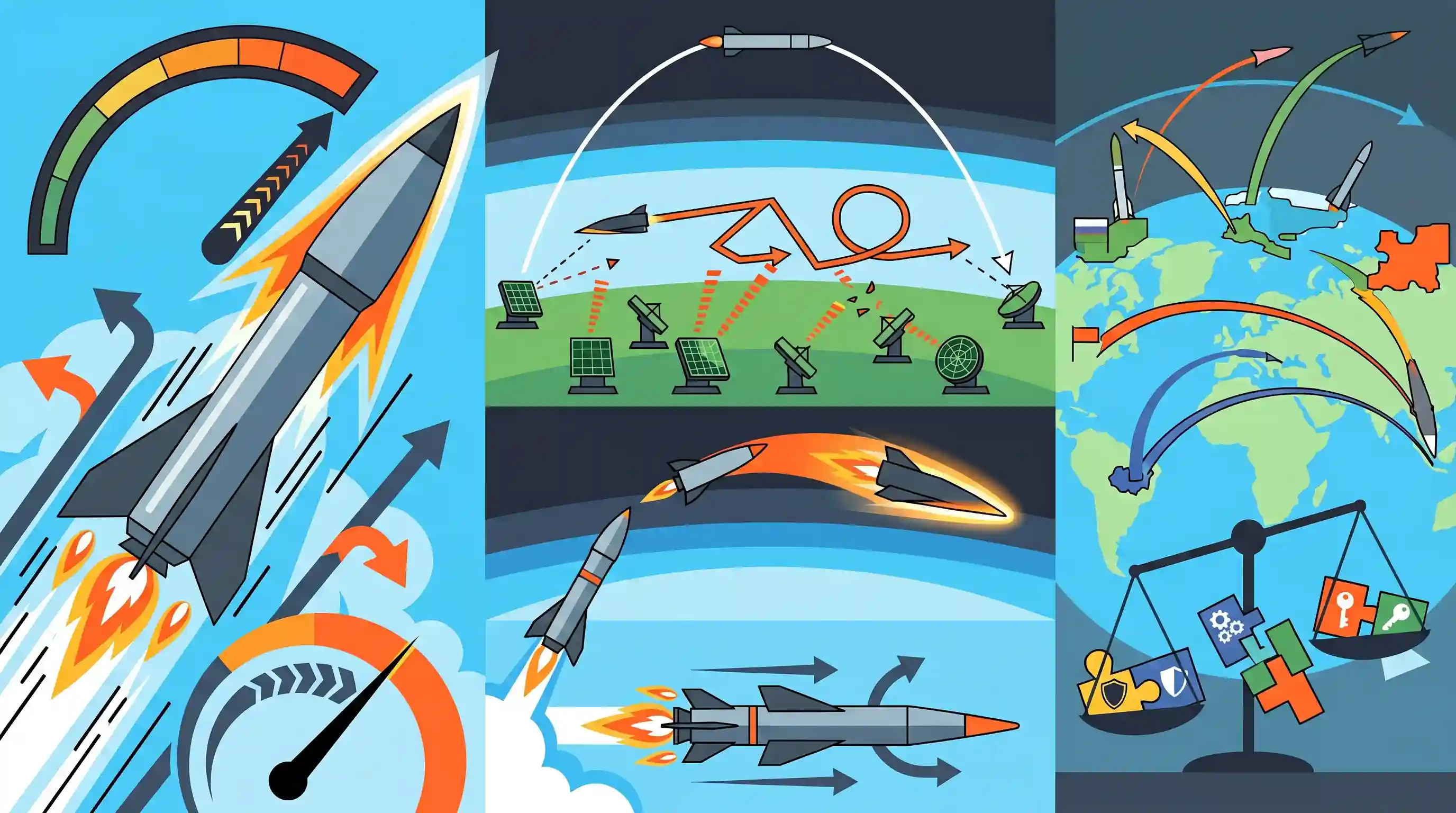
The article explains the fundamental concepts behind hypersonic missiles, highlighting their defining characteristics: speeds exceeding Mach 5 and extreme maneuverability. It distinguishes hypersonic weapons from traditional ballistic and cruise missiles, noting that their ability to change course at low altitudes renders current missile defense systems largely ineffective. The piece also outlines the two primary variants—Hypersonic Glide Vehicles and Hypersonic Cruise Missiles—and underscores the ongoing global arms race to master this disruptive defense technology.
Key Points
- Hypersonic missiles travel at extremely high speeds, exceeding Mach 5 (five times the speed of sound, or approximately 6,100 km/h).
- Unlike traditional ballistic missiles that follow a predictable, arched trajectory, hypersonic weapons can maneuver at lower altitudes, making them extremely difficult to track and intercept.
- There are two main types of hypersonic weapons: Hypersonic Glide Vehicles (HGVs) which are launched into space and glide to their targets, and Hypersonic Cruise Missiles (HCMs) which are powered by high-speed, air-breathing scramjet engines.
- The development of hypersonic technology is triggering a new global arms race, with countries like Russia, China, and the US leading the charge, while India pursues its indigenous HSTDV program.
Important Terms
Hypersonic Missile

Weapon systems traveling at speeds exceeding Mach 5 with high maneuverability, distinguishing them from predictable ballistic trajectories and making them difficult for traditional defense systems to intercept.
UPSC context
GS Paper 3 (Defence Technology); tests understanding of disruptive military advancements, strategic security implications, and India's indigenous missile development programs.
Hypersonic Technology Demonstrator Vehicle (HSTDV)
An unmanned scramjet-powered demonstration aircraft developed by DRDO to test hypersonic flight technologies. It serves as a building block for future Indian hypersonic cruise missiles and low-cost satellite launch vehicles.
UPSC context
GS Paper 3 (Science and Technology); relevant for questions on indigenization of technology and India's progress in high-speed propulsion.
Hypersonic Glide Vehicle (HGV)
A weapon launched via a rocket booster to high altitudes before detaching to glide to its target at hypersonic speeds. It utilizes aerodynamic lift to maneuver mid-flight, evading radar detection.
UPSC context
GS Paper 3 (Defence); tests conceptual clarity on missile trajectories and the challenges they pose to existing missile defense architectures.
Hypersonic Cruise Missile (HCM)
A missile powered throughout its flight by high-speed air-breathing engines, such as scramjets, to maintain speeds above Mach 5. Unlike glide vehicles, HCMs remain powered and typically fly at lower altitudes.
UPSC context
GS Paper 3 (Science & Technology); focuses on advanced propulsion systems and the military-strategic transition from supersonic to hypersonic strike capabilities.
Scramjet Engine
A "supersonic combustion ramjet" where airflow through the engine remains supersonic, allowing efficient combustion at hypersonic speeds. It uses atmospheric oxygen as an oxidizer, significantly reducing weight compared to rockets.
UPSC context
GS Paper 3 (Science & Technology); critical for understanding air-breathing propulsion systems and India’s technological self-reliance in the defense sector.
DRDO (Defence Research and Development Organisation)
India's premier agency under the Ministry of Defence responsible for the R&D of military technologies. It leads the indigenous development of hypersonic platforms like the HSTDV and long-range hypersonic missiles.
UPSC context
GS Paper 3 (Institutional Framework); important for discussing the role of domestic institutions in strengthening national security and technological sovereignty.
Prelims Trap
"Hypersonic Glide Vehicles (HGVs) maintain Mach 5+ speeds by utilizing scramjet engines for continuous propulsion."
False. HGVs are launched into space via rocket boosters and glide unpowered to the target. It is Hypersonic Cruise Missiles (HCMs) that use scramjets for continuous flight.
Static Concepts Connected
How do Ramjet and Scramjet engines differ in propulsion technology?
- Ramjet Engine: Compresses incoming air but slows it to subsonic speeds for combustion. Generally highly effective for speeds up to Mach 3.
- Scramjet Engine: Maintains supersonic airflow throughout the combustion process, allowing highly efficient sustained propulsion at speeds of Mach 5 and beyond.
- Air-Breathing Property: Both are air-breathing engines. They rely on atmospheric oxygen for combustion rather than carrying heavy onboard oxidizers, drastically reducing weight.
What is the fundamental difference between Ballistic and Cruise missiles?
- Ballistic Missiles: Follow a predictable, unpowered parabolic trajectory after their initial rocket boost, often briefly exiting the Earth's atmosphere before re-entering.
- Cruise Missiles: Remain entirely within the atmosphere. They are powered and guided throughout their flight, making them capable of complex, terrain-hugging maneuvers.
Cross-Topic Patterns
Hypersonics and Space Weaponization
The use of the upper atmosphere for launching HGVs blurs the line between aerospace defense and space militarization, complicating international arms control agreements like the Outer Space Treaty.
Scramjets in Civilian Spaceflight
Air-breathing propulsion isn't strictly for defence. ISRO tests similar scramjet technology principles in its sounding rockets to eliminate heavy oxidizer tanks, aiming to lower the cost of satellite launches.

Expect a 2026 Prelims question directly comparing Ramjet vs Scramjet mechanics, paired with India's indigenous HSTDV capabilities.
Linked PYQs · 2
Linked PYQs · 2
- 2023PrelimsGS1
Consider the following statements: 1. Ballistic missiles are jet-propelled at subsonic speeds throughout their flights, while cruise missiles are rocket-powered only in the initial phase of flight. 2. Agni-V is a medium-range supersonic cruise missile, while BrahMos is a solid-fuelled intercontinental ballistic missile. Which of the statements given above is/are correct?
- 2022PrelimsGS1
Which one of the following statements best reflects the idea behind the "Fractional Orbital Bombardment System" often talked about in media?
