AMCA and defining traits of fifth-generation fighter aircraft
Source:Indian Express ↗
Why It Matters
UPSC consistently asks about the classification and indigenization of defense platforms (e.g., Prelims 2024 question on 5th generation fighters). Understanding the technological leap from 4th to 5th generation aircraft and the specifics of the AMCA project is vital for both Prelims (defense tech facts) and Mains (evaluating self-reliance in defense manufacturing).
Summary
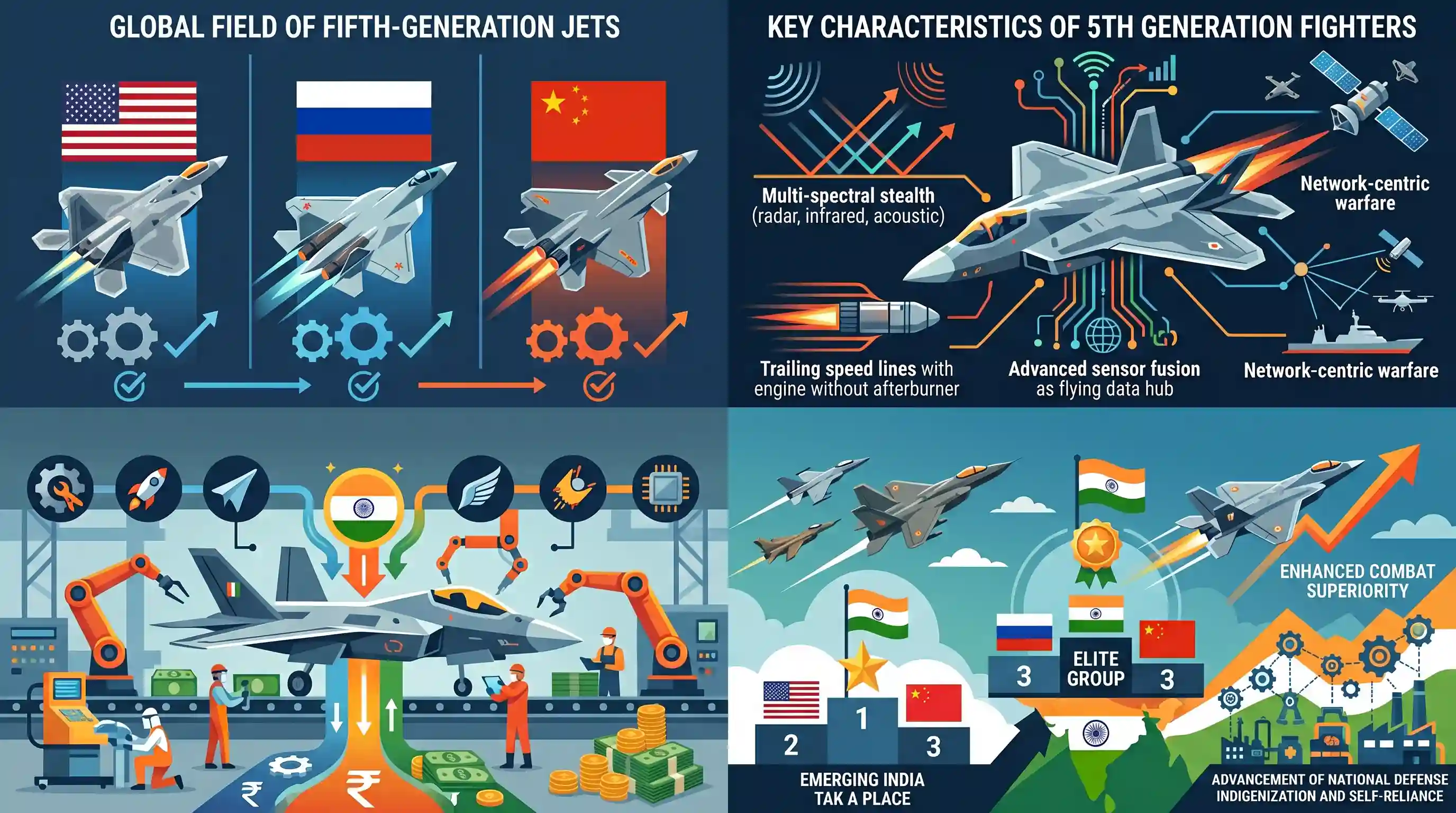
The article explains the defining characteristics of a "fifth-generation fighter" aircraft in the context of India clearing the development of its indigenous Advanced Medium Combat Aircraft (AMCA). Fifth-generation jets stand out from older generations due to multi-spectral stealth (reducing radar, infrared, and acoustic signatures), supercruise capabilities, and highly advanced sensor fusion that acts as a flying data hub in network-centric warfare. Currently, only the US, Russia, and China have operational fifth-generation jets. The Rs 15,000 crore AMCA project, spearheaded by DRDO's Aeronautical Development Agency (ADA) and HAL, aims to propel India into this elite group, significantly enhancing the Indian Air Force's combat superiority and advancing the nation's defense indigenization efforts.
Key Points
- Fifth-generation fighter jets are the most advanced combat aircraft, distinguished by features like all-aspect stealth, supercruise (supersonic speed without afterburners), advanced sensor fusion, and networked data links.
- The stealth capability is achieved via specialized airframe geometries, internal weapons bays, and radar-absorbent materials designed to significantly reduce the radar cross-section (RCS).
- The Cabinet Committee on Security (CCS) recently cleared a Rs 15,000 crore project to design and develop India's indigenous fifth-generation fighter jet, the Advanced Medium Combat Aircraft (AMCA), led by ADA and HAL.
- Only a select few countries currently operate fifth-generation fighters, including the United States (F-22 Raptor, F-35 Lightning II), Russia (Su-57), and China (J-20).
- The successful development of the AMCA will be a crucial milestone for India's self-reliance (Atmanirbhar Bharat) in critical defense technologies, bolstering the modernization and strategic edge of the IAF.
Important Terms
Advanced Medium Combat Aircraft (AMCA) Project

An indigenous programme to develop a fifth-generation, twin-engine, multi-role stealth fighter for India. It features advanced sensor fusion, internal weapons bays, and supercruise capabilities for high-contested environments.
UPSC context
GS Paper 3 (Science & S&T/Defence); critical for understanding self-reliance (Atmanirbharta) and technological indigenization in military hardware.
Cabinet Committee on Security (CCS)
The apex executive body responsible for India's national security, defense expenditure, and strategic affairs. Chaired by the Prime Minister, it includes Ministers of Defence, Home, Finance, and External Affairs.
UPSC context
GS Paper 2 (Polity/Executive); essential for understanding high-level decision-making processes and institutional governance of national security.
Aeronautical Development Agency (ADA)
An autonomous body under the Ministry of Defence that serves as the nodal agency for the design and development of India's indigenous combat aircraft, including the Tejas and AMCA.
UPSC context
GS Paper 3 (Indigenization of Technology); tests awareness of domestic R&D bodies driving aerospace innovation and strategic self-sufficiency.
Hindustan Aeronautics Limited (HAL)
A premier state-owned aerospace and defense company. It is the primary manufacturer for India's indigenous aircraft and will lead the series production of the AMCA fighter jets.
UPSC context
GS Paper 3 (Economy/Defence Manufacturing); relevant for questions on Public Sector Undertakings (PSUs) and their role in the defense industrial base.
Defence Research and Development Organisation (DRDO)
India's premier military R&D agency. It operates a network of laboratories to develop advanced weapon systems, sensors, and electronic warfare suites for the three wings of the armed forces.
UPSC context
GS Paper 3 (S&T/Security); central to discussions on indigenous technology, military modernization, and domestic innovation.
Indian Air Force (IAF)
The air arm of the Indian Armed Forces tasked with securing Indian airspace and conducting aerial warfare. It is the primary end-user and operational requirement-setter for the AMCA project.
UPSC context
GS Paper 3 (Security Forces & Agencies); tests understanding of the service-specific requirements and modernization goals of India's defense forces.
Prelims Trap
Rafale and LCA Tejas are India's operational fifth-generation stealth fighters.
Rafale and Tejas are 4.5-generation aircraft. AMCA will be India's first 5th-generation jet, and it is currently only in development, not operational.
Static Concepts Connected
What are the core technological pillars of a fifth-generation fighter jet?
- All-aspect Stealth: Specialized airframe geometry, internal weapons bays, and radar-absorbent materials (RAM) drastically reduce the aircraft's Radar Cross Section (RCS).
- Supercruise: The ability to sustain supersonic flight without using fuel-guzzling afterburners, increasing operational range and reducing infrared/thermal signatures.
- Sensor Fusion: Integration of data from multiple sensors to provide the pilot with a unified, comprehensive battlefield picture in network-centric warfare.
Which entities manage India's indigenous combat aircraft development?
- ADA (DRDO): The Aeronautical Development Agency (under DRDO) is the nodal agency for the design and development of India's combat aircraft, including the LCA and AMCA.
- HAL: Hindustan Aeronautics Limited is the primary state-owned aerospace company responsible for the manufacturing and assembly of the indigenously designed aircraft.
Cross-Topic Patterns
AMCA + Indo-US iCET framework
AMCA's development relies on high-thrust engines, directly linking to the GE-HAL jet engine technology transfer deal under the Indo-US Initiative on Critical and Emerging Technology (iCET).
Stealth tech + Metamaterials
Radar-absorbent materials used in stealth heavily rely on advanced nanotechnology and metamaterials, connecting macro defense platforms to frontier materials science in the UPSC S&T syllabus.

Expect a Prelims tech question defining 'supercruise' and 'stealth', or a match-the-following on 5th-gen platforms (J-20, Su-57, F-35).
Linked PYQs · 2
Linked PYQs · 2
- 2024PrelimsGS1
Consider the following aircraft : 1. Rafael 2. MiG-29 3. Tejas MK-1 How many of the above are considered fifth generation fighter aircraft?
- 2025PrelimsGS1
With reference to India's defence, consider the following pairs : Aircraft type Description I. Dornier-228 : Maritime patrol aircraft II. IL-76 : Supersonic combat aircraft III. C-17 Globemaster III : Military transport aircraft How many of the pairs given above are correctly matched?
