Bombay High Court Reprimands BMC Over Urban Encroachments
Source:Indian Express ↗
Why It Matters
The article serves as an excellent case study for GS-2 (Local Governance and Role of Judiciary) and GS-1 (Urbanization). It practically demonstrates how vote-bank politics and lack of administrative will directly lead to the collapse of urban infrastructure, and how judicial intervention frequently acts as a corrective mechanism for executive inaction.
Summary
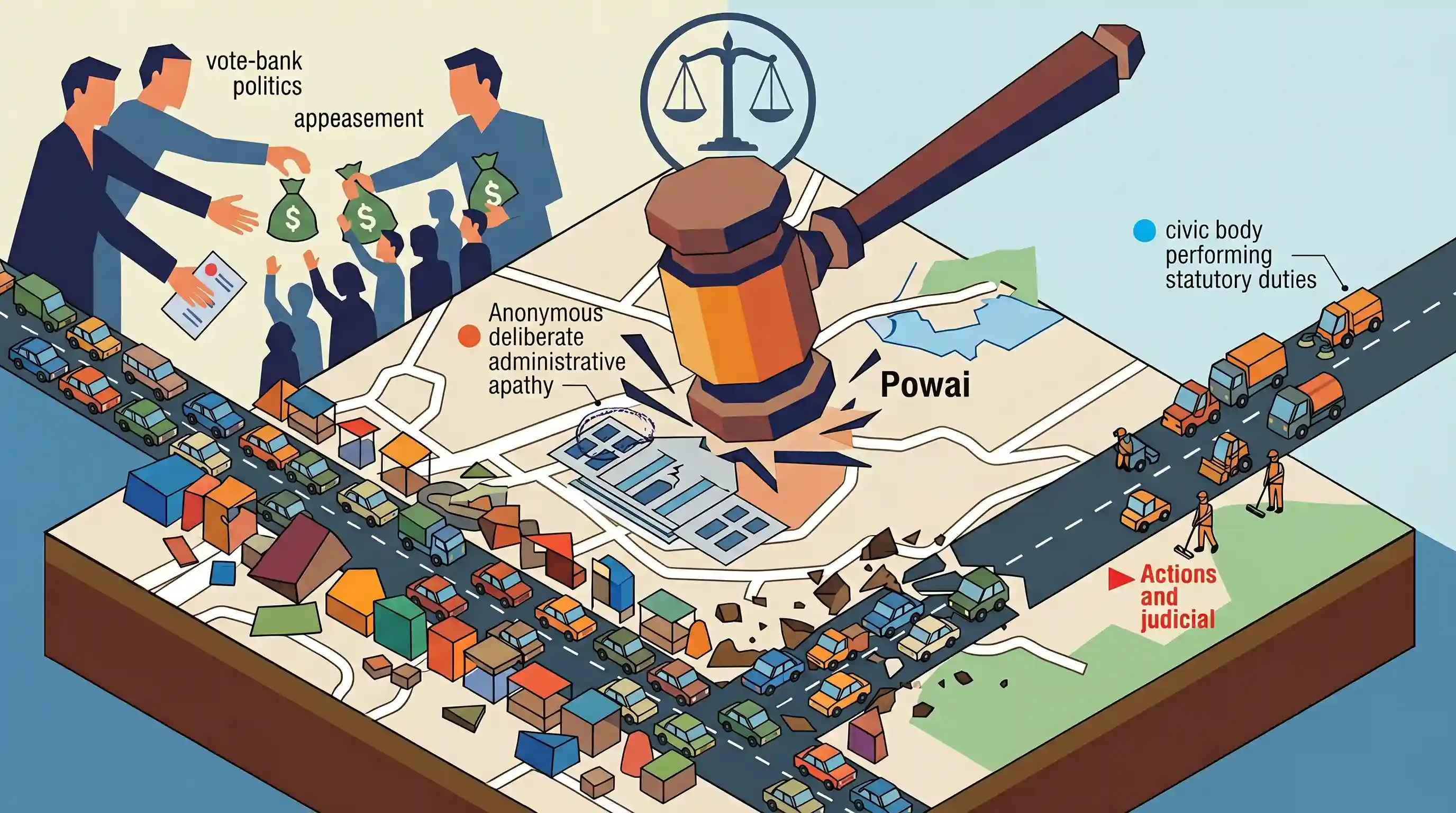
The Bombay High Court has reprimanded the Brihanmumbai Municipal Corporation (BMC) over rampant road encroachments in Powai, Mumbai, which have severely congested traffic. The court attributed the proliferation of these illegal structures to political "appeasement," indicating that vote-bank politics and deliberate administrative apathy have compromised urban infrastructure. This development highlights critical flaws in urban governance and city planning, while illustrating the necessity of judicial intervention to compel civic bodies to perform their statutory duties and enforce municipal laws.
Key Points
- The Bombay High Court strongly criticized the Brihanmumbai Municipal Corporation (BMC) for failing to remove illegal road encroachments in the Powai area of Mumbai.
- The court highlighted that traffic in the area has slowed to a snail's pace due to these bottlenecks.
- The bench explicitly termed the encroachment issue as a result of "creation and appeasement" by the authorities, pointing to political leniency and vote-bank politics.
- The intervention underscores the chronic administrative apathy of Urban Local Bodies (ULBs) in enforcing municipal laws and protecting public infrastructure.
- This instance exemplifies judicial oversight stepping in to mandate statutory performance when the executive fails due to political compulsions.
Important Terms
Urban Local Bodies (ULBs)

Constitutional local self-government institutions in urban areas, empowered by the 74th Amendment Act to manage 18 functional subjects like urban planning, public health, and sanitation under the Twelfth Schedule.
UPSC context
GS Paper II (Polity); tests understanding of democratic decentralization and the structural challenges of local governance.
Urban Governance
The institutional frameworks, processes, and decision-making systems through which cities are managed and developed. It involves coordinating public services, infrastructure, and land-use planning among various stakeholders.
UPSC context
GS Paper II and III; essential for addressing urbanization challenges, city planning, and municipal service delivery.
Judicial Activism
A proactive judicial philosophy where courts use their power to protect citizen rights and compel the executive or legislature to discharge their constitutional and statutory obligations.
UPSC context
GS Paper II (Judiciary); evaluates the judiciary's role in governance and the balance between different organs of state.
Brihanmumbai Municipal Corporation (BMC)
Established in 1888, it is India's wealthiest municipal body governing Mumbai. It handles critical infrastructure, public health, and urban services for one of the world's most populous metropolises.
UPSC context
GS Paper II; serves as a key case study for ULB administration, financial autonomy, and urban management issues.
Bombay High Court
One of India's oldest High Courts (est. 1862), with jurisdiction over Maharashtra, Goa, Daman & Diu, and Dadra & Nagar Haveli. It possesses extensive original and writ powers.
UPSC context
GS Paper II; central to topics on the state-level judiciary and the enforcement of fundamental rights under Article 226.
Encroachment
The unauthorized occupation of public land, such as roads or pavements, by private structures or vendors. It leads to traffic congestion and compromises formal urban planning and safety.
UPSC context
GS Paper III; relevant to urban development, infrastructure management, and the impacts of unplanned urbanization.
Prelims Trap
Regulation of land-use in urban areas is exclusively a State Government subject.
The 12th Schedule (74th CAA) explicitly lists "regulation of land-use and construction of buildings" as a devolved function of Urban Local Bodies.
Static Concepts Connected
What are the key planning functions of ULBs under the 12th Schedule?
- Urban planning: Encompasses comprehensive town planning, regulation of land-use, and the construction of buildings.
- Infrastructure: Provision of essential public amenities including roads, bridges, street lighting, parking lots, and bus stops.
- Slum upgrading: Slum improvement and upgradation are explicitly listed as direct municipal responsibilities.
What distinguishes Judicial Activism from Judicial Overreach?
- Judicial Activism: Courts proactively compelling the executive to perform its constitutional or statutory duties (e.g., ordering municipal encroachment removal).
- Judicial Overreach: Courts stepping beyond legal interpretation to usurp executive or legislative policy-making functions, violating the separation of powers.
Cross-Topic Patterns
Urbanization vs. Patronage Politics
Informal settlements persist due to clientelism and vote-bank appeasement, linking GS1 urbanization challenges directly to the political economy of local governance in GS2.
Courts as Civic Administrators
Frequent High Court interventions in basic civic duties—like traffic or waste management—highlight chronic ULB capacity deficits and blur the separation of powers.

Expect a GS2 Mains question linking 74th Amendment failures (ULB apathy) with the increasing reliance on judicial activism for civic issues.
Linked PYQs · 5
Linked PYQs · 5
- 2024MainsGS2
Analyse the role of local bodies in providing good governance at local level and bring out the pros and cons merging the rural local bodies with the urban local bodies.
- 2020MainsGS2
Judicial Legislation is antithetical to the doctrine of separation of powers as envisaged in the Indian Constitution. In this context justify the filing of large number of public interest petitions praying for issuing guidelines to executive authorities.
- 2023MainsGS2
“The states in India seem reluctant to empower urban local bodies both functionally as well as financially.” Comment.
- 2013MainsGS1
Discuss the various social problems which originated out of the speedy process of urbanization in India.
- 2014MainsGS2
Starting from inventing the 'basic structure' doctrine, the judiciary has played a highly proactive role in ensuring that India develops into a thriving democracy. In light of the statement, evaluate the role played by judicial activism in achieving the ideals of democracy.
