Khatipura Mega Terminal Inaugurated to Boost Jaipur Rail Capacity
Source:aninews ↗
Why It Matters
Understanding regional transport infrastructure projects, budgetary allocations for state development, and connectivity corridors is highly relevant for RPSC RAS Prelims under Rajasthan's Geography, Economy, and Infrastructure sections.
Summary
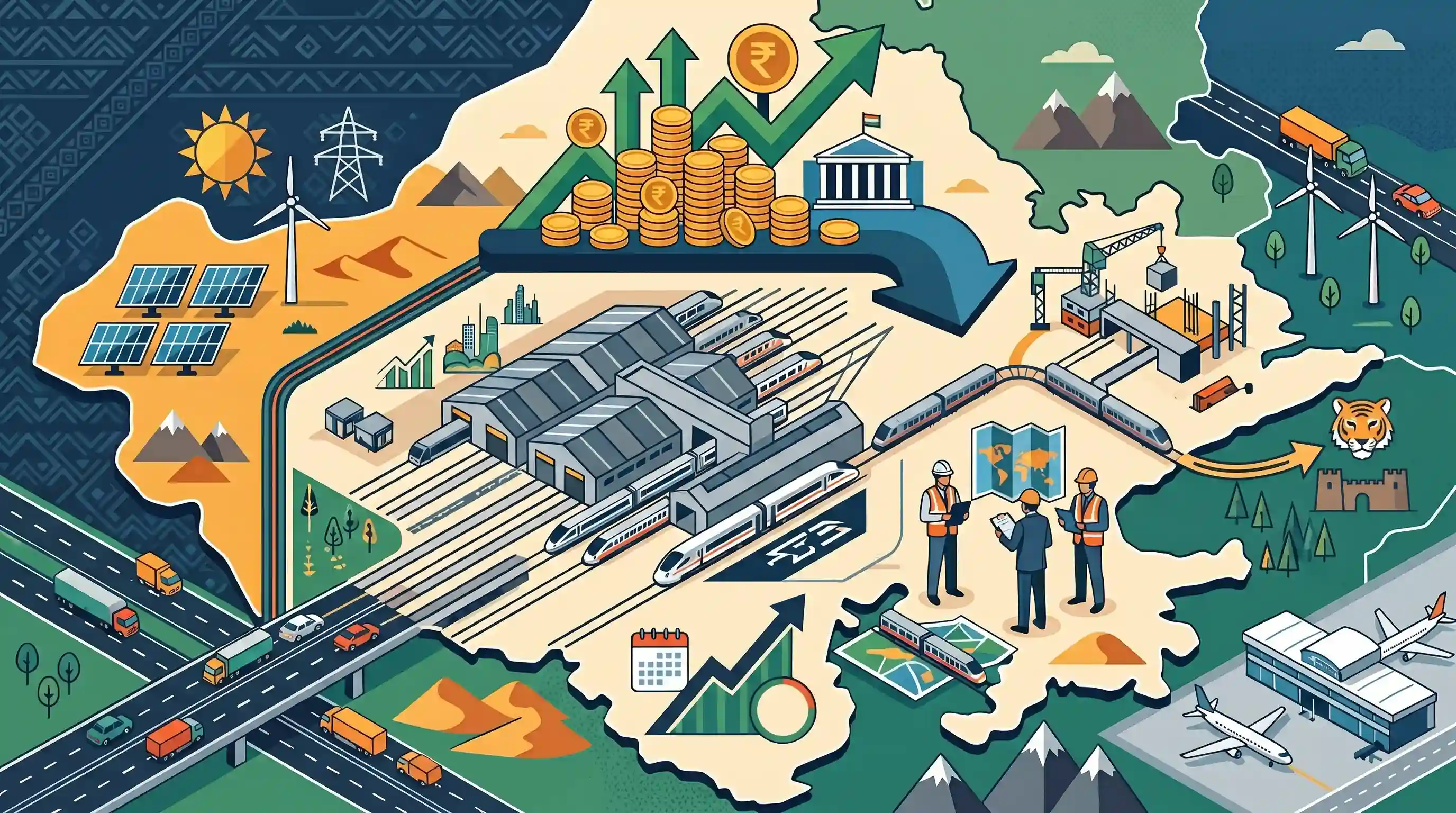
Union Railway Minister Ashwini Vaishnaw inspected the Mega Coaching Terminal and ongoing railway development works in Jaipur, highlighting the launch of the Khatipura Mega Terminal. Built to meet Jaipur's railway demands for the next 20 years, the facility is equipped to maintain 450 trains monthly, including modern Vande Bharat and Amrit Bharat services. The government also plans a new facility in Sanganer for Sawai Madhopur connectivity and highlighted an unprecedented Rs 10,000 crore Union Budget allocation for Rajasthan's railways.
Key Points
- Inspection of Khatipura Mega Terminal: The newly built coaching terminal in Jaipur is designed to sustain the city's railway expansion and infrastructure needs for the next 20 years.
- Train Maintenance Capacity: Equipped with modern technology, the terminal can service and maintain approximately 450 trains monthly, including modern trains like Vande Bharat and Amrit Bharat.
- Connectivity & Future Sanganer Terminal: The Khatipura terminal will connect Jaipur with Delhi, Jodhpur, and Bikaner, while a new coaching facility in Sanganer will be built to serve the Sawai Madhopur route.
- Budgetary Increase: The central government has allocated Rs 10,000 crore for railway infrastructure in Rajasthan, a massive increase from Rs 682 crore during the previous UPA regime.
- Bikaner-Ahmedabad Train: The Railway Minister also flagged off a new train service connecting Bikaner in Rajasthan with Ahmedabad in Gujarat.
- Aim to Eliminate Waiting Lists: The administration plans to introduce over 200 trains from Rajasthan in the next 5 years, aiming to nearly eliminate passenger waiting lists.
Important Terms
Khatipura Mega Terminal Project

A state-of-the-art railway coaching terminal in Jaipur, Rajasthan, built at a cost of ₹205 crore to handle maintenance of around 450 trains monthly, reducing operational pressure on Jaipur Junction.
UPSC context
GS Paper III (Infrastructure-Railways), testing regional transport modernization, decongestion of urban hubs, and federal-state infrastructure collaboration.
Vande Bharat Express
India's premier indigenously designed, self-propelled, semi-high-speed trainset system operating up to 160 kmph, equipped with advanced safety features like KAVACH and world-class passenger amenities under 'Make in India'.
UPSC context
GS Paper III (Infrastructure, Technology Indigenisation), testing knowledge of domestic manufacturing success and high-speed rail modernization.
Amrit Bharat Express
A modern, non-air-conditioned, low-cost long-distance sleeper and unreserved superfast express train service introduced by Indian Railways, designed to provide comfortable, affordable travel to the common passenger.
UPSC context
GS Paper III (Infrastructure), testing understanding of inclusive development, public utility affordability, and regional mobility solutions.
Indian Railways
India's state-owned national railway network, serving as a critical driver of economic integration, mass passenger mobility, and heavy freight logistics across the country.
UPSC context
GS Paper III (Infrastructure), testing understanding of national transport logistics, public transport management, and clean energy transitions.
Union Railway Ministry
The central ministry responsible for India's rail transport system, overseeing the policymaking, financial administration, and safety regulations of the state-owned Indian Railways network.
UPSC context
GS Paper II (Executive Structure), testing governance frameworks, public spending, and infrastructure policymaking in India.
Prelims Trap
The Amrit Bharat Express is a fully air-conditioned, self-propelled train set similar to the Vande Bharat Express.
Amrit Bharat is actually a non-AC, budget-friendly, locomotive-hauled train utilizing push-pull technology, unlike the distributed-power, fully AC Vande Bharat.
Static Concepts Connected
What is 'Push-Pull' technology in Indian Railways and how does it operate?
- Locomotive arrangement: Employs two aerodynamic locomotives (WAP5) positioned at both the front and rear ends of the train.
- Turnaround efficiency: Eliminates the need to detach and reverse the engine at terminating stations, saving up to 20-30% turnaround time.
- Jerk elimination: Uses semi-permanent couplers instead of standard couplers, providing a smooth, jerk-free ride for passengers.
What was 'Project Unigauge' and why was it initiated?
- Unification goal: Launched in 1992 to convert selective Metre Gauge and Narrow Gauge lines into standard Broad Gauge (1676 mm).
- Economic benefits: Aimed to establish seamless transport, eliminate transshipment bottlenecks, and reduce rolling stock maintenance costs across regional zones.
Cross-Topic Patterns
Mass Transit & Urban De-congestion
Satellite railway terminals like Khatipura highlight how transport-oriented development (TOD) mitigates hyper-congestion in core historic Indian cities.
Inclusive Tech in Public Transport
Amrit Bharat trains demonstrate applying high-end aerodynamics and push-pull efficiency to non-AC budget segments, balancing social equity with modernization.

Prelims 2026 may target operational tech differences between Vande Bharat's distributed power and Amrit Bharat's push-pull system.
Linked PYQs · 2
Linked PYQs · 2
- 2025RPSC_PRELIMSGS1
The correct order of decreasing contribution of different sectors in Rajasthan’s Gross Fixed Capital Formation is
- 2021RPSC_PRELIMSGS1
'Green Energy Corridor' – Through which of the following districts will it pass in Rajasthan?
