Semiconductor Manufacturing and Supply Chain Resilience in India
Source:The Hindu ↗
Why It Matters
Semiconductors are the foundational building blocks for modern technologies, including AI, EVs, and critical infrastructure. Transitioning from an importer to a domestic manufacturer reduces India's strategic vulnerability to global supply chain shocks and advances the goals of Atmanirbhar Bharat. This development highlights the success of joint ventures and state-level industrial ecosystems in driving high-tech manufacturing.
Summary
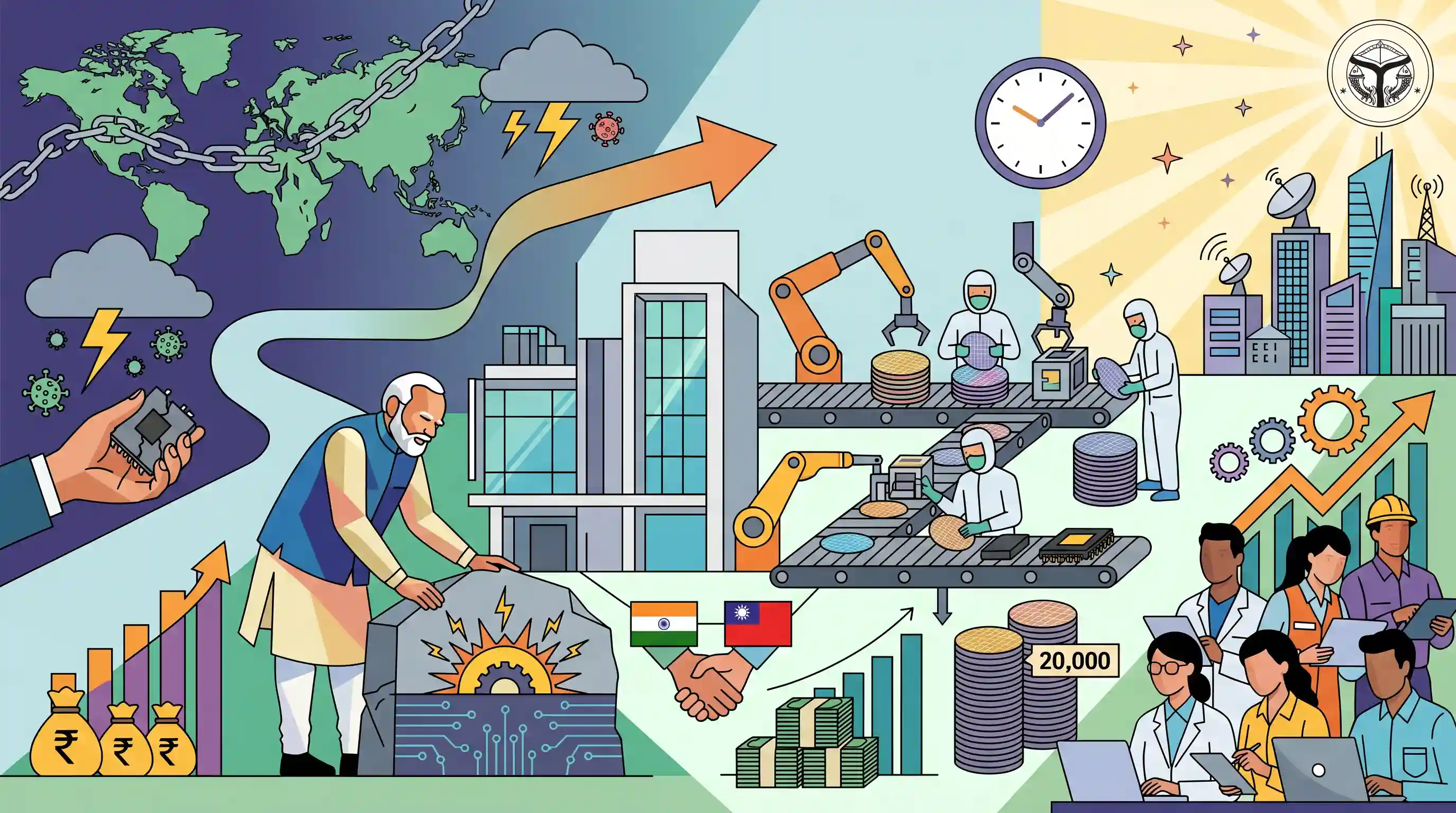
Prime Minister Narendra Modi laid the foundation stone for an Outsourced Semiconductor Assembly and Test (OSAT) facility by India Chip Private Limited in Greater Noida, Uttar Pradesh. The ₹3,700 crore joint venture between India's HCL Group and Taiwan's Foxconn marks a significant milestone in India's drive towards semiconductor self-reliance. PM Modi declared this decade as India's 'tech-ade,' noting the fragility of global chip supply chains exposed during the pandemic and stressing the strategic need for domestic manufacturing. Expected to be operational by 2028, the facility will produce 20,000 wafers monthly, boost employment, and reinforce UP's status as a growing tech and electronics manufacturing powerhouse.
Key Points
- Prime Minister Narendra Modi laid the foundation stone for India Chip Private Limited, an Outsourced Semiconductor Assembly and Test (OSAT) facility in Greater Noida, UP.
- The ₹3,700 crore joint venture between India's HCL Group and Taiwan's Foxconn is expected to be operational by 2028, producing 20,000 semiconductor wafers per month.
- The Prime Minister emphasized that this decade is India's 'tech-ade,' highlighting the push to build a robust domestic semiconductor ecosystem.
- The initiative aims to establish semiconductor self-reliance and build supply chain resilience, mitigating vulnerabilities exposed during the COVID-19 pandemic.
- Uttar Pradesh is emerging as a major tech hub, already manufacturing over 60% of the mobile phones produced in India.
Important Terms
India Semiconductor Mission (ISM)

A specialized agency under the Ministry of Electronics and Information Technology (MeitY) tasked with building a sustainable semiconductor and display ecosystem through financial incentives and policy support.
UPSC context
GS Paper 3: Industrial policy and indigenization of technology; tests knowledge of government initiatives for high-tech manufacturing.
OSAT (Outsourced Semiconductor Assembly and Test)
A crucial phase in the semiconductor value chain where third-party providers perform the packaging, assembly, and rigorous testing of silicon wafers to produce finished, functional integrated circuits.
UPSC context
GS Paper 3: Science & Technology; tests understanding of global value chains (GVCs) and technical manufacturing stages.
India Chip Private Limited
A specific joint venture between India's HCL Group and Taiwan's Foxconn, established to build an OSAT facility in Uttar Pradesh with a ₹3,700 crore investment.
UPSC context
Current Affairs: Corporate-strategic partnerships; tests awareness of key private-sector players in India's semiconductor journey.
Foxconn
A Taiwanese multinational electronics giant (Hon Hai Precision Industry) and a key strategic partner for India in high-end electronics and semiconductor manufacturing.
UPSC context
GS Paper 2 & 3: International Relations (Indo-Taiwan ties) and FDI; highlights global cooperation in domestic manufacturing.
Supply Chain Resilience
The strategic ability of a nation to ensure consistent availability of critical goods by diversifying sources and reducing over-dependence on single manufacturing hubs (e.g., China).
UPSC context
GS Paper 2 & 3: IR and Economy; tests knowledge of the 'China Plus One' strategy and economic security.
India’s Tech-ade
A term used by PM Modi to describe the decade (2021-2030) as one where India leverages technology to drive economic growth and global leadership.
UPSC context
GS Paper 3: Science & Tech / Economy; represents the government's long-term vision for technology-led industrial transformation.
Prelims Trap
The Greater Noida facility will be India's first fully functional semiconductor fabrication (fab) plant.
OSAT (Outsourced Semiconductor Assembly and Test) involves packaging and testing existing silicon wafers, not fabricating the raw chips themselves.
Static Concepts Connected
What is the difference between Semiconductor Fabs and OSAT?
- Semiconductor Fabs: Manufactures the actual integrated circuits on raw silicon wafers; an extremely capital and technology-intensive process.
- OSAT / ATMP: Assembles, packages, and tests already-manufactured wafers into finished chips ready for deployment in electronic devices.
What are the key components of the India Semiconductor Mission (ISM)?
- Capital Subsidy: Offers up to 50% project cost subsidy pari-passu for setting up Fabs, display units, and OSAT facilities.
- Nodal Agency: Operates as an independent business division within the Digital India Corporation (DIC) under MeitY.
- DLI Scheme: Provides Design Linked Incentives (DLI) offering financial and infrastructure support for domestic semiconductor design startups.
Cross-Topic Patterns
Semiconductors + Quad Tech Resilience
India's domestic chip push structurally aligns with the Quad Semiconductor Supply Chain Initiative to de-risk critical tech dependencies on China.
UP's Industrial Geography Shift
Establishing high-tech OSATs in Greater Noida signals a geographical shift of electronics manufacturing clusters beyond traditional Western and Southern Indian corridors.

Prelims 2026 will likely test the technical distinction between OSAT and Fab units within a multi-statement question on the PLI scheme.
Linked PYQs · 2
Linked PYQs · 2
- 2025MainsGS3
India aims to become a semiconductor manufacturing hub. What are the challenges faced by the semiconductor industry in India? Mention the salient features of the India Semiconductor Mission.
- 2025MainsGS3
Discuss the rationale of the Production Linked Incentive (PLI) scheme. What are its achievements? In what way can the functioning and outcomes of the scheme be improved?
